Once every three years, incense procession and jiao combined
MoreLess
The Tuchengzi Incense Procession (土城仔香) is held in the middle and latter part of the third lunar month in Chou, Chen, Wei, and Xu years, with a three-day raojing (遶境, procession circuit) covering more than 100 kilometers in all R001Source《台江地區無形文化資產暨文獻資料蒐集計畫成果報告書》 [Final Report of the Project to Collect Intangible Cultural Heritage and Documentary Materials of the Taijiang Area], commissioned by 臺江國家公園管理處 [Taijiang National Park Headquarters], 2020 (printed pp. 112–115, 159, 231–240, 444, 449–452)Original URLhttps://www.tjnp.gov.tw/Retrieved2026-10-24Snapshot timestamp2026-10-19The main source for this page; after conversion to text, some instances of the character 「一」 appear as 「㇐」, and quotations follow the original.. Official record Its character lies in its name: the second of the five major folk features in the official summary reads 「鹿耳門媽香、五府千歲醮」 ("the incense procession of the Luermen Mazu, the jiao of the Wufu Qiansui [Lords of the Five Palaces]") — Mazu's incense procession and the Wangye's jiao take place at the same time. The other four are: inviting the deities before the jiao; the conduct of the Wangye's office, inherited from the Xigang Wangye office and the Sucuo fangke (ritual staffing tradition); the designation of a different Wangye in each festival cycle to accompany the Luermen Mazu (鹿耳門媽) on procession; and the civil and martial procession troupes with their associated customs R001Source《台江地區無形文化資產暨文獻資料蒐集計畫成果報告書》 [Final Report of the Project to Collect Intangible Cultural Heritage and Documentary Materials of the Taijiang Area], commissioned by 臺江國家公園管理處 [Taijiang National Park Headquarters], 2020 (printed pp. 112–115, 159, 231–240, 444, 449–452)Original URLhttps://www.tjnp.gov.tw/Retrieved2026-10-24Snapshot timestamp2026-10-19The main source for this page; after conversion to text, some instances of the character 「一」 appear as 「㇐」, and quotations follow the original.. The institutional vehicle of the eleven jiaotou (角頭, neighborhood units) is the "Sanzhao Xiangjiao Fuzhang" (三朝香醮福章, the blessing petition of the three-day incense jiao), on which all of the jiaotou are listed R001Source《台江地區無形文化資產暨文獻資料蒐集計畫成果報告書》 [Final Report of the Project to Collect Intangible Cultural Heritage and Documentary Materials of the Taijiang Area], commissioned by 臺江國家公園管理處 [Taijiang National Park Headquarters], 2020 (printed pp. 112–115, 159, 231–240, 444, 449–452)Original URLhttps://www.tjnp.gov.tw/Retrieved2026-10-24Snapshot timestamp2026-10-19The main source for this page; after conversion to text, some instances of the character 「一」 appear as 「㇐」, and quotations follow the original..
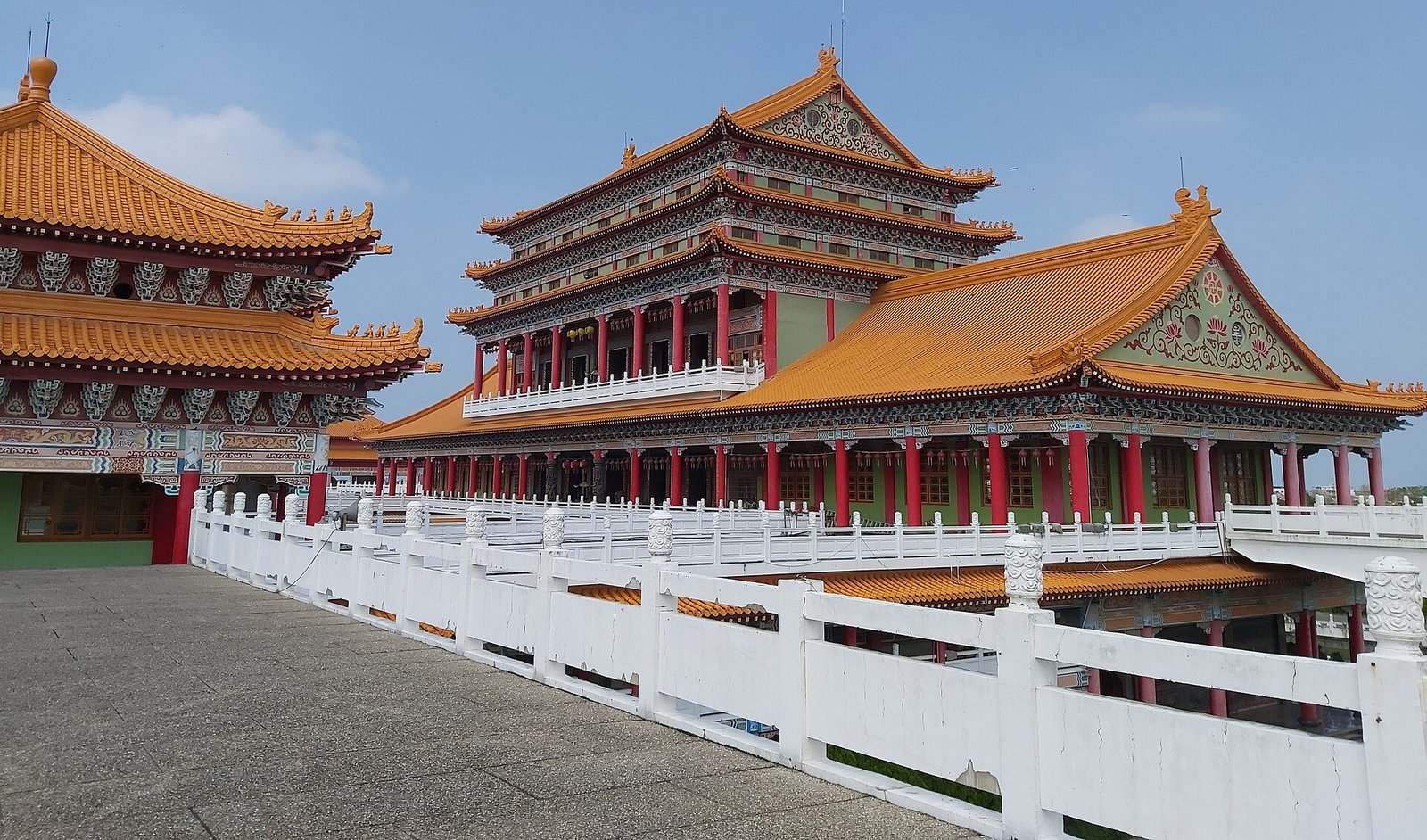
The permanently enshrined royal boat
First items: The largest example of a regional customThe seven steps of the royal boatMoreLess
The largest example of a regional custom
Permanently enshrined royal boats are a regional custom of the Taijiang–Anping sandbar belt. Printed p. 114 of the report commissioned by the Taijiang National Park Headquarters (台江處) in 2020 lists five in Anping (安平):
- The Jin Wan'an (金萬安號) of the Miaoshou Temple (妙壽宮)
- The Jin De'an (金德安號) of the Wude Temple (伍德宮)
- The Xue Jinhai (薛金海號) and the Tong'en (通恩號) of the Lingji Temple (靈濟殿)
- The Dongwu (東伍號) of the Wenzhu Temple (文朱殿)
- The Xun Xingsheng (巡興盛號) of the Hangzhou Temple (杭州殿)
The Orthodox Luermen Shengmu Temple (正統鹿耳門聖母廟) is the largest of these and the only one bound up with a large-scale guaxiang (kuah-hiunn; 刈香, incense-gathering procession); what makes it distinctive is not that the boat is "not sent off," but that, though not sent off, it is still cleared out, used for water-drawing, consecrated, and docked every festival cycle R001Source《台江地區無形文化資產暨文獻資料蒐集計畫成果報告書》 [Final Report of the Project to Collect Intangible Cultural Heritage and Documentary Materials of the Taijiang Area], commissioned by 臺江國家公園管理處 [Taijiang National Park Headquarters], 2020 (printed pp. 112–115, 159, 231–240, 444, 449–452)Original URLhttps://www.tjnp.gov.tw/Retrieved2026-10-24Snapshot timestamp2026-10-19The main source for this page; after conversion to text, some instances of the character 「一」 appear as 「㇐」, and quotations follow the original.. Official record The reason the report gives is 「因王船為撿拾之神物,故只祭不送……也因不送王船,便延伸送五瘟桶之俗」 ("because the royal boat is a sacred object that was found, it is only worshipped and not sent off …; and because the royal boat is not sent off, the custom of sending off the Five Plagues barrel developed") R001Source《台江地區無形文化資產暨文獻資料蒐集計畫成果報告書》 [Final Report of the Project to Collect Intangible Cultural Heritage and Documentary Materials of the Taijiang Area], commissioned by 臺江國家公園管理處 [Taijiang National Park Headquarters], 2020 (printed pp. 112–115, 159, 231–240, 444, 449–452)Original URLhttps://www.tjnp.gov.tw/Retrieved2026-10-24Snapshot timestamp2026-10-19The main source for this page; after conversion to text, some instances of the character 「一」 appear as 「㇐」, and quotations follow the original.. The wooden permanently enshrined royal boat found in 1913 is listed on the 2013 registration page as the "emblematic sacred object" (指標神物) of this folk custom R002Source〈鹿耳門聖母廟土城仔香〉 [Luermen Shengmu Temple Tuchengzi Xiang], Municipal Folk Custom registration announcement (2013-01-28, 府文資處字第 1020066902C 號; amended 2018-11-12, 府文資處字第 1071237560B 號), 文化部文化資產局 [Bureau of Cultural Heritage, Ministry of Culture], 國家文化資產網 [National Cultural Heritage Database]Original URLhttps://nchdb.boch.gov.tw/Retrieved2026-10-24Snapshot timestamp2026-10-23The official reasons for registration state only facts and do not give the reason for the 1958 break in incense ties; this is the most reliable source..
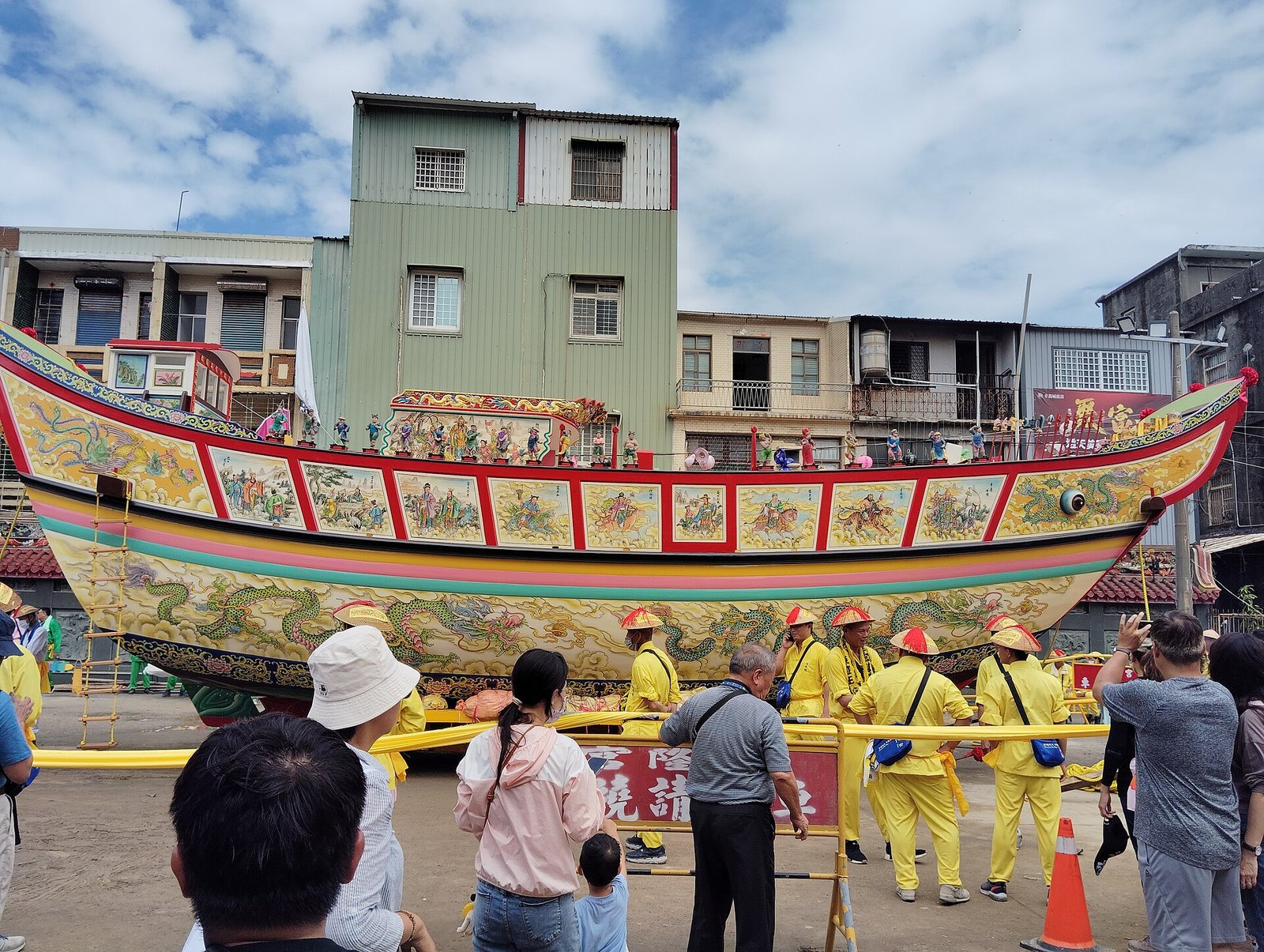
The seven steps of the royal boat
The report commissioned by the Taijiang National Park Headquarters in 2020 describes the path the royal boat travels in a single festival cycle as seven steps; in ordinary times it is enshrined on the tiger (right-hand) side of the Hall of the Five Lords (五王殿) R001Source《台江地區無形文化資產暨文獻資料蒐集計畫成果報告書》 [Final Report of the Project to Collect Intangible Cultural Heritage and Documentary Materials of the Taijiang Area], commissioned by 臺江國家公園管理處 [Taijiang National Park Headquarters], 2020 (printed pp. 112–115, 159, 231–240, 444, 449–452)Original URLhttps://www.tjnp.gov.tw/Retrieved2026-10-24Snapshot timestamp2026-10-19The main source for this page; after conversion to text, some instances of the character 「一」 appear as 「㇐」, and quotations follow the original.: Official record
- Clearing the hold (2 months before the xiangke)
- Drawing water (1 month before)
- Consecration (5 days before; a reenactment of finding the royal boat)
- Leaving the dock (3 days before; pushed out to the tiger side of the yamen [Wangye office] for the public to pray for blessings)
- Loading provisions
- Inspecting the hold (afternoon of the 2nd day of the guaxiang)
- Re-entering the dock (5 days after the wangjiao (王醮, Wangye jiao ritual) ends)
The cultural heritage registration page, the National Cultural Memory Bank (國家文化記憶庫), and the tourism bureau's pages record instead four steps: drawing water, consecration, leaving the dock, and re-entering the dock R006SourceWikipedia, 〈土城仔香〉 [Tuchengzi Incense Procession] article (popular source, tier ④)Original URLhttps://zh.wikipedia.org/Retrieved2026-10-24Snapshot timestamp2026-10-23This page cites it in two places: the 「戒嚴」 ("martial law") version of the break in incense ties, and the step of respectfully inviting the deities back aboard to be enthroned before the royal boat leaves the dock.. Unverified
Three ritual sites
First items: Qingwang (請王, inviting the Wangye) takes…Drawing water takes place at the "Old Te…Sending off the Fire King takes place on…MoreLess
The three ritual sites R001Source《台江地區無形文化資產暨文獻資料蒐集計畫成果報告書》 [Final Report of the Project to Collect Intangible Cultural Heritage and Documentary Materials of the Taijiang Area], commissioned by 臺江國家公園管理處 [Taijiang National Park Headquarters], 2020 (printed pp. 112–115, 159, 231–240, 444, 449–452)Original URLhttps://www.tjnp.gov.tw/Retrieved2026-10-24Snapshot timestamp2026-10-19The main source for this page; after conversion to text, some instances of the character 「一」 appear as 「㇐」, and quotations follow the original.: Official record
- Qingwang (請王, inviting the Wangye) takes place at Xibianhu (西爿湖) (Chengxi Village, 城西里): 「依據地方傳說在面對拾到王船的西爿湖仔進行請王,迎請五王登殿」 ("in accordance with local legend, the inviting of the Wangye is performed facing Xibianhu, where the royal boat was found, and the Five Lords are welcomed up into the hall").
- Drawing water takes place at the "Old Temple Ground Pit" (舊廟地堀仔): 「儀式由鹿耳門媽手轎主持,道士進行」 ("the ritual is presided over by the hand palanquin of the Luermen Mazu and carried out by Taoist priests"). The report does not state the exact location of the Old Temple Ground Pit. Unverified
- Tucheng has two related sites, each with its own memorial stele; they are two different steles:
- The old site of the Shengmu Temple: beside the Tucheng Public Market (土城公有市場), around the intersection of Zun'an Road (尊安路) and Anzhong Road (安中路) (Chengzhong Village, 城中里), where the "Orthodox Luermen Tianshang Shengmu Memorial Stele" (正統鹿耳門天上聖母紀念碑) stands R010Source國家文化記憶庫 [National Cultural Memory Bank]〈土城市場〉[Tucheng Market] (author Chen Kuei-lan (陳桂蘭), from 《臺南府城市場誌》[Gazetteer of the Markets of Tainan Prefectural City], 臺南市政府文化局 [Cultural Affairs Bureau, Tainan City Government], 2017)Original URLhttps://tcmb.culture.tw/zh-tw/detail?indexCode=Culture_Place&id=285017Retrieved2026-10-30Snapshot timestamp—Records that the old site of the Shengmu Temple was at the intersection of Zun'an Road and Anzhong Road, roughly where the 「正統鹿耳門天上聖母紀念碑」 (Orthodox Luermen Tianshang Shengmu Memorial Stele) stands today..
- The ruins of the old Luermen Mazu temple (Miaodiku, 廟地堀): on a fishpond embankment on the north bank of the Luermen River (鹿耳門溪), where a separate memorial stele marks the ruins.
- Which of the two pits was the water-drawing site is still to be verified.
- Tucheng has two related sites, each with its own memorial stele; they are two different steles:
- Sending off the Fire King takes place on the bank of the Luermen River south of the village: 「送火王時全庄熄火,並出動境內武陣將火王送至庄南鹿耳門溪畔」 ("when the Fire King is sent off, the whole village puts out its fires, and the martial troupes within the territory are sent out to escort the Fire King to the bank of the Luermen River south of the village").
The order of authority in which the hand palanquin stands above the Taoist priests is itself a distinguishing feature of this ritual system. The three fixed sites are Xibianhuzi (西爿湖仔) in Chengxi Village, the Old Temple Ground Pit, and the bank of the Luermen River south of the village.
The 1958 break in incense ties: six versions
First items: The 2013 registration announcement: 「195…Lin Sen-tse's (林森澤) 1988 〈周牛先生訪問稿〉 (Tran…Academic and officially commissioned rep…MoreLess
There are six versions of the 1958 duanxiang (斷香, break in incense ties):
- The 2013 registration announcement: 「1958 年西港仔戊戌香科,因迎請北港媽作客事件,土城仔及鄰近角頭、聚落退出西港仔刈香……1961 年首辦辛丑年土城仔香科」 ("In the Wuxu-year xiangke of Xigangzi in 1958, owing to the incident of inviting the Beigang Mazu as a guest, Tuchengzi and the neighboring jiaotou and settlements withdrew from the Xigangzi guaxiang … In 1961 the first Xinchou-year Tuchengzi xiangke was held") R002Source〈鹿耳門聖母廟土城仔香〉 [Luermen Shengmu Temple Tuchengzi Xiang], Municipal Folk Custom registration announcement (2013-01-28, 府文資處字第 1020066902C 號; amended 2018-11-12, 府文資處字第 1071237560B 號), 文化部文化資產局 [Bureau of Cultural Heritage, Ministry of Culture], 國家文化資產網 [National Cultural Heritage Database]Original URLhttps://nchdb.boch.gov.tw/Retrieved2026-10-24Snapshot timestamp2026-10-23The official reasons for registration state only facts and do not give the reason for the 1958 break in incense ties; this is the most reliable source..
- Lin Sen-tse's (林森澤) 1988 〈周牛先生訪問稿〉 (Transcript of an Interview with Mr. Chou Niu (周牛)) adds "Lee Chang-jung" (李長榮) and 「增添交誼廟」 ("adding friendship temples") R005SourceLin Sen-tse (林森澤), 〈周牛先生訪問稿〉 [Transcript of an Interview with Mr. Chou Niu], 1988 (the earliest firsthand field interview)Original URL—Retrieved2026-10-24Snapshot timestamp—The firsthand original has not yet been obtained; at present there are only secondhand citations in blogs and Wikipedia.. Secondhand account
- Academic and officially commissioned reports:
- Huang Wen-po's (黃文博) 《南瀛刈香誌》 (Records of the Incense Processions of Nanying) records Kuo Tai-shan (郭泰山), the upper and lower tables, and the apology that was not accepted R004SourceHuang Wen-po (黃文博), 《南瀛刈香誌》 [Records of the Incense Processions of Nanying], 1994, pp. 337–338 (Kuo Tai-shan, the upper and lower tables, the apology that was not accepted)Original URL—Retrieved2026-10-24Snapshot timestamp—Cited secondhand; the printed original has not been checked..
- The Taijiang National Park Headquarters' 2010 report records 「以遠客『北港媽』居主壇大位,土城仔媽祖則變成配祀。此一『易首為次』的轉變,引發了土城仔方面的不悅與不諒解」 ("the distant guest, the 'Beigang Mazu,' was placed in the chief seat of the main altar, while the Tuchengzi Mazu became a secondary deity. This shift of 'turning the head into the second' provoked displeasure and resentment on the Tuchengzi side"), and lists the eight villages that withdrew at the same time — Shalunjiao (砂崙腳), Huweiliao (虎尾寮), Zhengziliao (鄭仔寮), Qingcaolun (青草崙), Hailiaozi (海寮仔), Zhongzhoujiao (中州角), Guofenliao (郭份寮), and Keliao (蚵寮) R003Source《台江國家公園及周緣地區人文歷史調查及保存之先期規劃成果報告》 [Final Report on the Preliminary Planning for the Survey and Preservation of the Human History of Taijiang National Park and Its Surrounding Areas], commissioned by 臺江國家公園管理處 [Taijiang National Park Headquarters], 中華民國國家公園學會 [National Park Society of the Republic of China], chapter 5 written by Huang Wen-po (黃文博), 2010-12-19 (printed pp. 71–72)Original URLhttps://www.tjnp.gov.tw/Retrieved2026-10-24Snapshot timestamp2026-10-20The earliest and most detailed version of the 1958 break in incense ties in an officially commissioned report, including the list of the 「八庄同退」 ("eight villages that withdrew together") and the statement 「原稱保安宮,1981 年易為今稱」 ("originally called the Bao'an Temple, it took its present name in 1981")..
- Popular accounts:
- Wikipedia's account that it was done 「戒嚴時期為避免政府干涉」 ("to avoid government interference during the martial law period") R006SourceWikipedia, 〈土城仔香〉 [Tuchengzi Incense Procession] article (popular source, tier ④)Original URLhttps://zh.wikipedia.org/Retrieved2026-10-24Snapshot timestamp2026-10-23This page cites it in two places: the 「戒嚴」 ("martial law") version of the break in incense ties, and the step of respectfully inviting the deities back aboard to be enthroned before the royal boat leaves the dock..
- The adversarial version in a forum post on the official website of the Luermen Tianhou Temple (鹿耳門天后宮): 「假借神意鬧事退出」 ("they stirred up trouble and withdrew under the false pretext of divine will") R007SourceDiscussion thread in the forum on the official website of the Luermen Tianhou Temple (one party to the dispute; not a formal temple document)Original URLhttps://www.luerhmen.org.tw/topic_view.phpRetrieved2026-10-24Snapshot timestamp2026-10-23A forum post on the official website, not a formal official document..
The Taijiang National Park Headquarters' 2010 report also supplies the year of the name change: 「原稱保安宮,1981 年易為今稱」 ("originally called the Bao'an Temple, it took its present name in 1981") R003Source《台江國家公園及周緣地區人文歷史調查及保存之先期規劃成果報告》 [Final Report on the Preliminary Planning for the Survey and Preservation of the Human History of Taijiang National Park and Its Surrounding Areas], commissioned by 臺江國家公園管理處 [Taijiang National Park Headquarters], 中華民國國家公園學會 [National Park Society of the Republic of China], chapter 5 written by Huang Wen-po (黃文博), 2010-12-19 (printed pp. 71–72)Original URLhttps://www.tjnp.gov.tw/Retrieved2026-10-24Snapshot timestamp2026-10-20The earliest and most detailed version of the 1958 break in incense ties in an officially commissioned report, including the list of the 「八庄同退」 ("eight villages that withdrew together") and the statement 「原稱保安宮,1981 年易為今稱」 ("originally called the Bao'an Temple, it took its present name in 1981")..
The makers of the ritual objects
First items: 2015 Bronze statues of Qianliyan (千里眼, T…2020 The memorial archway (pailou)2024 The fireworks encircling the templeMoreLess
The report commissioned by the Taijiang National Park Headquarters states that the carp banners, embroidered cloths, square flags, dragon-eye lanterns of the Five Lords, and plum-blossom lanterns of Mazu on the royal boat are 「都重新製作」 ("all made anew") for each festival cycle R001Source《台江地區無形文化資產暨文獻資料蒐集計畫成果報告書》 [Final Report of the Project to Collect Intangible Cultural Heritage and Documentary Materials of the Taijiang Area], commissioned by 臺江國家公園管理處 [Taijiang National Park Headquarters], 2020 (printed pp. 112–115, 159, 231–240, 444, 449–452)Original URLhttps://www.tjnp.gov.tw/Retrieved2026-10-24Snapshot timestamp2026-10-19The main source for this page; after conversion to text, some instances of the character 「一」 appear as 「㇐」, and quotations follow the original.. The following named outside commissions are known, all by outside craftsmen or teams R009Source經濟部 [Ministry of Economic Affairs (MOEA)] commercial and industrial registration public data (g0v Taiwan company data mirror, uniform business number 69316932, 鹿耳門繡莊 [Luermen Embroidery Shop]) and six news reports naming outside contractors (自由時報 [Liberty Times] 2015-06-07; Tainan City Government press release of 2020-12-22 (ROC year 109); 中華日報 [China Daily News] 2025-01-12 and 2025-02-05; and others)Original URLhttps://findbiz.nat.gov.tw/Retrieved2026-10-24Snapshot timestamp2026-10-23Registration data; the business items are the scope of business approved by the registration authority, and there is no record of whether the shop supplied the procession troupes of the Tuchengzi Incense Procession.:
- 2015 Bronze statues of Qianliyan (千里眼, Thousand-Li Eye) and Shunfeng'er (順風耳, Wind-Following Ear)
- 2020 The memorial archway (pailou)
- 2024 The fireworks encircling the temple
- 2025 The Spring Ox and the Mangshen (芒神, the herdsman god of spring)
- 2025 Twelve beehive-rocket racks (by beehive-fireworks masters from Yanshui)
Locally, one sees another side.
「在地人記得,聖母廟廟體的西北側有一間廟方自己的修造小工廠,修的多是大件的東西:王船、神轎、元宵用的蜂炮炮台;匾額也曾在裡面整修。」 (Local people remember that on the northwest side of the Shengmu Temple building there is a small repair workshop run by the temple itself, where mostly large items are repaired: the royal boat, palanquins, and the beehive-fireworks platforms used at the Lantern Festival; plaques have also been restored there.) Local oral account
The Luermen Embroidery Shop (鹿耳門繡莊) on the Shengmu Temple's main road (No. 535, Sec. 6, Anzhong Road) was approved for establishment on 1978-12-14 and ceased business on 2023-09-22; its business items read in the original 「八仙彩、錦旗、樣裙、神衣、轎布、頭旗、刺繡」 ("eight-immortals banners, silk banners, altar skirts, deity robes, palanquin cloths, lead banners, embroidery") R009Source經濟部 [Ministry of Economic Affairs (MOEA)] commercial and industrial registration public data (g0v Taiwan company data mirror, uniform business number 69316932, 鹿耳門繡莊 [Luermen Embroidery Shop]) and six news reports naming outside contractors (自由時報 [Liberty Times] 2015-06-07; Tainan City Government press release of 2020-12-22 (ROC year 109); 中華日報 [China Daily News] 2025-01-12 and 2025-02-05; and others)Original URLhttps://findbiz.nat.gov.tw/Retrieved2026-10-24Snapshot timestamp2026-10-23Registration data; the business items are the scope of business approved by the registration authority, and there is no record of whether the shop supplied the procession troupes of the Tuchengzi Incense Procession.. Unverified
Differing accounts
- Motive for the break in incense ties: one account holds it was to avoid government interference during the martial law period R006SourceWikipedia, 〈土城仔香〉 [Tuchengzi Incense Procession] article (popular source, tier ④)Original URLhttps://zh.wikipedia.org/Retrieved2026-10-24Snapshot timestamp2026-10-23This page cites it in two places: the 「戒嚴」 ("martial law") version of the break in incense ties, and the step of respectfully inviting the deities back aboard to be enthroned before the royal boat leaves the dock.; another holds that "turning the head into the second" provoked displeasure R003Source《台江國家公園及周緣地區人文歷史調查及保存之先期規劃成果報告》 [Final Report on the Preliminary Planning for the Survey and Preservation of the Human History of Taijiang National Park and Its Surrounding Areas], commissioned by 臺江國家公園管理處 [Taijiang National Park Headquarters], 中華民國國家公園學會 [National Park Society of the Republic of China], chapter 5 written by Huang Wen-po (黃文博), 2010-12-19 (printed pp. 71–72)Original URLhttps://www.tjnp.gov.tw/Retrieved2026-10-24Snapshot timestamp2026-10-20The earliest and most detailed version of the 1958 break in incense ties in an officially commissioned report, including the list of the 「八庄同退」 ("eight villages that withdrew together") and the statement 「原稱保安宮,1981 年易為今稱」 ("originally called the Bao'an Temple, it took its present name in 1981").. Unverified
- Steps of the royal boat ritual: the commissioned report gives seven steps; the cultural heritage registration page and other official pages give four. Unverified
- Wangjiao or qingjiao: the two books on Tucheng describe it as a wangjiao (王醮, Wangye jiao ritual; the boat is worshipped but not sent off), while Huang Wen-po's (黃文博) Records of the Incense Processions of Nanying (《南瀛刈香誌》) and Jiali Jintang Temple Xiaolong Xiang (《佳里金唐殿蕭壠香》) describe it as a qingjiao (清醮, jiao of purification); for the sources of the two accounts and the key points for weighing them, see 4.1b Where the Rules of the Tuchengzi Incense Procession Came From.
Video
Videos were uploaded by their respective channels; titles and channel names follow the video pages. This site quotes only short excerpts with timecodes; the videos themselves are authoritative.
Behind this door is the internal site, with profiles of people and local comments. The internal site is deployed separately.