Guided reading
For the first three cycles of the Tuchengzi Incense Procession, the presiding deity of the jiao altar was the Baosheng Dadi of the Haiwei Chaohuang Temple; after the third cycle the two sides broke off ties for thirty-six years, until three favorable divination-block casts in 2002 led the Tucheng Incense Procession's second-day route to pass through Haiwei again in 2003.R001Source《台江地區無形文化資產暨文獻資料蒐集計畫成果報告書》 [Final Report of the Project to Collect Intangible Cultural Heritage and Documentary Materials of the Taijiang Area], commissioned by 臺江國家公園管理處 [Taijiang National Park Headquarters], 2020 (printed p. 239, 「海尾朝皇宮宋江陣(2003 年加入)」 ["Haiwei Chaohuang Temple Song Jiang Troupe (joined 2003)"]; history, waist sash, and lineage of instruction of the Haiweiliao Chaohuang Temple Song Jiang Troupe)Original URLhttps://www.tjnp.gov.tw/Retrieved2026-10-24Snapshot timestamp2026-10-19The only officially commissioned report that serves as a source for the factual layer (the return in 2003); the report gives only the outcome, not the reason.
- Current status
- In the 2003 Guiwei cycle the Haiwei Chaohuang Temple returned to the Tuchengzi Incense Procession, and its Song Jiang Troupe has since joined the three-day procession in every Chou, Chen, Wei and Xu year R001Source《台江地區無形文化資產暨文獻資料蒐集計畫成果報告書》 [Final Report of the Project to Collect Intangible Cultural Heritage and Documentary Materials of the Taijiang Area], commissioned by 臺江國家公園管理處 [Taijiang National Park Headquarters], 2020 (printed p. 239, 「海尾朝皇宮宋江陣(2003 年加入)」 ["Haiwei Chaohuang Temple Song Jiang Troupe (joined 2003)"]; history, waist sash, and lineage of instruction of the Haiweiliao Chaohuang Temple Song Jiang Troupe)Original URLhttps://www.tjnp.gov.tw/Retrieved2026-10-24Snapshot timestamp2026-10-19The only officially commissioned report that serves as a source for the factual layer (the return in 2003); the report gives only the outcome, not the reason.R002Source臺南宗教文化資料庫 [Tainan Religious Culture Database] / 臺灣宗教與民俗文化平台 [Taiwan Religion and Folk Culture Platform] trfc.tw, interview with Wu Chin-chih (吳進池), former chairperson of the Haiwei Chaohuang TempleOriginal URLhttps://www.trfc.tw/Retrieved2026-10-24Snapshot timestamp2026-10-23A single oral account from the Haiwei side, in a popular compiled directory that takes a position.R006SourceWikipedia, 〈海尾朝皇宮宋江陣〉 [Haiwei Chaohuang Temple Song Jiang Troupe] (in every Chou, Chen, Wei, and Xu year it also takes part in the three-day procession circuit of the Tucheng xiangke held by the Orthodox Luermen Shengmu Temple); official Facebook page of the Haiwei Chaohuang Temple (which calls the Shengmu Temple and the Tianhou Temple 「咱交陪境」, "our jiaopei territories")Original URLhttps://zh.wikipedia.org/Retrieved2026-10-24Snapshot timestamp2026-10-23Circumstantial evidence for the present-day layer; the temple's own history page still does not mention the Tucheng Incense Procession.
- Key figures
- 36 years (1967–2003)Break in incense tiesR002Source臺南宗教文化資料庫 [Tainan Religious Culture Database] / 臺灣宗教與民俗文化平台 [Taiwan Religion and Folk Culture Platform] trfc.tw, interview with Wu Chin-chih (吳進池), former chairperson of the Haiwei Chaohuang TempleOriginal URLhttps://www.trfc.tw/Retrieved2026-10-24Snapshot timestamp2026-10-23A single oral account from the Haiwei side, in a popular compiled directory that takes a position.
- cycles 1–3 (1961–1967)Haiwei as presiding altarR002Source臺南宗教文化資料庫 [Tainan Religious Culture Database] / 臺灣宗教與民俗文化平台 [Taiwan Religion and Folk Culture Platform] trfc.tw, interview with Wu Chin-chih (吳進池), former chairperson of the Haiwei Chaohuang TempleOriginal URLhttps://www.trfc.tw/Retrieved2026-10-24Snapshot timestamp2026-10-23A single oral account from the Haiwei side, in a popular compiled directory that takes a position.
- 3 favorable casts in a row (2002)Divination to restore tiesR002Source臺南宗教文化資料庫 [Tainan Religious Culture Database] / 臺灣宗教與民俗文化平台 [Taiwan Religion and Folk Culture Platform] trfc.tw, interview with Wu Chin-chih (吳進池), former chairperson of the Haiwei Chaohuang TempleOriginal URLhttps://www.trfc.tw/Retrieved2026-10-24Snapshot timestamp2026-10-23A single oral account from the Haiwei side, in a popular compiled directory that takes a position.
- Evidence mix
Why it matters
For the first three cycles of the Tuchengzi Incense Procession, the presiding deity of the jiao altar was the Baosheng Dadi of the Haiwei Chaohuang Temple; after the third cycle the two sides broke off ties for thirty-six years R002Source臺南宗教文化資料庫 [Tainan Religious Culture Database] / 臺灣宗教與民俗文化平台 [Taiwan Religion and Folk Culture Platform] trfc.tw, interview with Wu Chin-chih (吳進池), former chairperson of the Haiwei Chaohuang TempleOriginal URLhttps://www.trfc.tw/Retrieved2026-10-24Snapshot timestamp2026-10-23A single oral account from the Haiwei side, in a popular compiled directory that takes a position.. The commissioned official report records only the 2003 result; the cause rests on a single interview from the Haiwei side and a discussion page on the Luermen Tianhou Temple website, and neither temple's own history mentions it R001Source《台江地區無形文化資產暨文獻資料蒐集計畫成果報告書》 [Final Report of the Project to Collect Intangible Cultural Heritage and Documentary Materials of the Taijiang Area], commissioned by 臺江國家公園管理處 [Taijiang National Park Headquarters], 2020 (printed p. 239, 「海尾朝皇宮宋江陣(2003 年加入)」 ["Haiwei Chaohuang Temple Song Jiang Troupe (joined 2003)"]; history, waist sash, and lineage of instruction of the Haiweiliao Chaohuang Temple Song Jiang Troupe)Original URLhttps://www.tjnp.gov.tw/Retrieved2026-10-24Snapshot timestamp2026-10-19The only officially commissioned report that serves as a source for the factual layer (the return in 2003); the report gives only the outcome, not the reason.R002Source臺南宗教文化資料庫 [Tainan Religious Culture Database] / 臺灣宗教與民俗文化平台 [Taiwan Religion and Folk Culture Platform] trfc.tw, interview with Wu Chin-chih (吳進池), former chairperson of the Haiwei Chaohuang TempleOriginal URLhttps://www.trfc.tw/Retrieved2026-10-24Snapshot timestamp2026-10-23A single oral account from the Haiwei side, in a popular compiled directory that takes a position.R003SourceDiscussion page on the official website of the Luermen Tianhou Temple (topic_view.php?item_id=1022, giving five points in time: ROC years 34, 50, 56, 92, and 95)Original URLhttps://www.luerhmen.org.tw/topic_view.php?item_id=1022Retrieved2026-10-24Snapshot timestamp2026-10-23A forum post on the website of one party to the dispute; single source; unverified.R004SourceOnline research reports (in-depth research reports G01–G08 and the V2 series) and the common writing guidelinesOriginal URLhttps://www.luermen.org.tw/Retrieved2026-10-24Snapshot timestamp2026-10-23Neither side's temple history page mentions this episode..
Main actors
Haiwei side 3
- Haiwei Chaohuang TempleBaosheng Dadi presided over the first three cyclesR002Source臺南宗教文化資料庫 [Tainan Religious Culture Database] / 臺灣宗教與民俗文化平台 [Taiwan Religion and Folk Culture Platform] trfc.tw, interview with Wu Chin-chih (吳進池), former chairperson of the Haiwei Chaohuang TempleOriginal URLhttps://www.trfc.tw/Retrieved2026-10-24Snapshot timestamp2026-10-23A single oral account from the Haiwei side, in a popular compiled directory that takes a position.
- Wu Chin-chihformer chairman; explained the break in an interviewR002Source臺南宗教文化資料庫 [Tainan Religious Culture Database] / 臺灣宗教與民俗文化平台 [Taiwan Religion and Folk Culture Platform] trfc.tw, interview with Wu Chin-chih (吳進池), former chairperson of the Haiwei Chaohuang TempleOriginal URLhttps://www.trfc.tw/Retrieved2026-10-24Snapshot timestamp2026-10-23A single oral account from the Haiwei side, in a popular compiled directory that takes a position.
- Haiwei Chaohuang Temple Song Jiang Troupejoined the Tuchengzi procession in 2003R001Source《台江地區無形文化資產暨文獻資料蒐集計畫成果報告書》 [Final Report of the Project to Collect Intangible Cultural Heritage and Documentary Materials of the Taijiang Area], commissioned by 臺江國家公園管理處 [Taijiang National Park Headquarters], 2020 (printed p. 239, 「海尾朝皇宮宋江陣(2003 年加入)」 ["Haiwei Chaohuang Temple Song Jiang Troupe (joined 2003)"]; history, waist sash, and lineage of instruction of the Haiweiliao Chaohuang Temple Song Jiang Troupe)Original URLhttps://www.tjnp.gov.tw/Retrieved2026-10-24Snapshot timestamp2026-10-19The only officially commissioned report that serves as a source for the factual layer (the return in 2003); the report gives only the outcome, not the reason.
Tucheng side 1
- Orthodox Luermen Shengmu Templehost of the Tucheng processionR006SourceWikipedia, 〈海尾朝皇宮宋江陣〉 [Haiwei Chaohuang Temple Song Jiang Troupe] (in every Chou, Chen, Wei, and Xu year it also takes part in the three-day procession circuit of the Tucheng xiangke held by the Orthodox Luermen Shengmu Temple); official Facebook page of the Haiwei Chaohuang Temple (which calls the Shengmu Temple and the Tianhou Temple 「咱交陪境」, "our jiaopei territories")Original URLhttps://zh.wikipedia.org/Retrieved2026-10-24Snapshot timestamp2026-10-23Circumstantial evidence for the present-day layer; the temple's own history page still does not mention the Tucheng Incense Procession.
Intermediary 1
- Wang Kuo-chingbrokered reconciliation in 2002, after leaving the legislatureR005SourceLegislative Yuan biographies of legislators across terms, and Tainan City Council member records (Wang Kuo-ching (王國清): member of the 10th, 11th, and 12th Tainan City Councils; member of the 2nd Legislative Yuan, 1993-02-01 to 1996-01-31; delegate to the 3rd National Assembly, 1996-05-20 to 2000-05-19)Original URLhttps://www.ly.gov.tw/Retrieved2026-10-24Snapshot timestamp2026-10-23"A member of the Orthodox Luermen Shengmu Temple committee in 2002" rests on a single source (trfc.tw); the Legislative Yuan biography does not record any temple position.
Central government 1
- Taijiang National Park Headquarters2020 commissioned report records the 2003 returnR001Source《台江地區無形文化資產暨文獻資料蒐集計畫成果報告書》 [Final Report of the Project to Collect Intangible Cultural Heritage and Documentary Materials of the Taijiang Area], commissioned by 臺江國家公園管理處 [Taijiang National Park Headquarters], 2020 (printed p. 239, 「海尾朝皇宮宋江陣(2003 年加入)」 ["Haiwei Chaohuang Temple Song Jiang Troupe (joined 2003)"]; history, waist sash, and lineage of instruction of the Haiweiliao Chaohuang Temple Song Jiang Troupe)Original URLhttps://www.tjnp.gov.tw/Retrieved2026-10-24Snapshot timestamp2026-10-19The only officially commissioned report that serves as a source for the factual layer (the return in 2003); the report gives only the outcome, not the reason.
Other records 1
- Luermen Tianhou Templewebsite discussion page lists five datesR003SourceDiscussion page on the official website of the Luermen Tianhou Temple (topic_view.php?item_id=1022, giving five points in time: ROC years 34, 50, 56, 92, and 95)Original URLhttps://www.luerhmen.org.tw/topic_view.php?item_id=1022Retrieved2026-10-24Snapshot timestamp2026-10-23A forum post on the website of one party to the dispute; single source; unverified.
Points of contention
These are the questions people have argued over. Each side's account is set out as stated; this site does not rule on them.
1Why did Haiwei and Tucheng break off ties for thirty-six years?4
- Haiwei side (former chairman Wu Chin-chih, interview)
In one of the first three cycles the deity was sent home by taxi, and the two sides broke off tiesR002Source臺南宗教文化資料庫 [Tainan Religious Culture Database] / 臺灣宗教與民俗文化平台 [Taiwan Religion and Folk Culture Platform] trfc.tw, interview with Wu Chin-chih (吳進池), former chairperson of the Haiwei Chaohuang TempleOriginal URLhttps://www.trfc.tw/Retrieved2026-10-24Snapshot timestamp2026-10-23A single oral account from the Haiwei side, in a popular compiled directory that takes a position.
- 2020 report commissioned by the Taijiang National Park Headquarters
Records only that the Haiwei Chaohuang Temple Song Jiang Troupe joined in 2003, without giving a causeR001Source《台江地區無形文化資產暨文獻資料蒐集計畫成果報告書》 [Final Report of the Project to Collect Intangible Cultural Heritage and Documentary Materials of the Taijiang Area], commissioned by 臺江國家公園管理處 [Taijiang National Park Headquarters], 2020 (printed p. 239, 「海尾朝皇宮宋江陣(2003 年加入)」 ["Haiwei Chaohuang Temple Song Jiang Troupe (joined 2003)"]; history, waist sash, and lineage of instruction of the Haiweiliao Chaohuang Temple Song Jiang Troupe)Original URLhttps://www.tjnp.gov.tw/Retrieved2026-10-24Snapshot timestamp2026-10-19The only officially commissioned report that serves as a source for the factual layer (the return in 2003); the report gives only the outcome, not the reason.
- Luermen Tianhou Temple website discussion page
Ties were broken in ROC year 56 (1967); Haiwei's Baosheng Dadi returned to the presiding altar in ROC year 92 (2003)R003SourceDiscussion page on the official website of the Luermen Tianhou Temple (topic_view.php?item_id=1022, giving five points in time: ROC years 34, 50, 56, 92, and 95)Original URLhttps://www.luerhmen.org.tw/topic_view.php?item_id=1022Retrieved2026-10-24Snapshot timestamp2026-10-23A forum post on the website of one party to the dispute; single source; unverified.
- The temples' own histories
Neither the Haiwei Chaohuang Temple nor the Shengmu Temple mentions the episodeR004SourceOnline research reports (in-depth research reports G01–G08 and the V2 series) and the common writing guidelinesOriginal URLhttps://www.luermen.org.tw/Retrieved2026-10-24Snapshot timestamp2026-10-23Neither side's temple history page mentions this episode.
- Haiwei side (former chairman Wu Chin-chih, interview)
Turning points
- 1961First Tucheng cycle; Haiwei's Baosheng Dadi presides over the jiao altarR002Source臺南宗教文化資料庫 [Tainan Religious Culture Database] / 臺灣宗教與民俗文化平台 [Taiwan Religion and Folk Culture Platform] trfc.tw, interview with Wu Chin-chih (吳進池), former chairperson of the Haiwei Chaohuang TempleOriginal URLhttps://www.trfc.tw/Retrieved2026-10-24Snapshot timestamp2026-10-23A single oral account from the Haiwei side, in a popular compiled directory that takes a position.
- 1967Ties broken after the third cycleR002Source臺南宗教文化資料庫 [Tainan Religious Culture Database] / 臺灣宗教與民俗文化平台 [Taiwan Religion and Folk Culture Platform] trfc.tw, interview with Wu Chin-chih (吳進池), former chairperson of the Haiwei Chaohuang TempleOriginal URLhttps://www.trfc.tw/Retrieved2026-10-24Snapshot timestamp2026-10-23A single oral account from the Haiwei side, in a popular compiled directory that takes a position.
- 2002Wang Kuo-ching brokers talks; three favorable casts in a rowR002Source臺南宗教文化資料庫 [Tainan Religious Culture Database] / 臺灣宗教與民俗文化平台 [Taiwan Religion and Folk Culture Platform] trfc.tw, interview with Wu Chin-chih (吳進池), former chairperson of the Haiwei Chaohuang TempleOriginal URLhttps://www.trfc.tw/Retrieved2026-10-24Snapshot timestamp2026-10-23A single oral account from the Haiwei side, in a popular compiled directory that takes a position.
- 2003Return in the Guiwei cycle; the Haiwei Song Jiang Troupe joinsR001Source《台江地區無形文化資產暨文獻資料蒐集計畫成果報告書》 [Final Report of the Project to Collect Intangible Cultural Heritage and Documentary Materials of the Taijiang Area], commissioned by 臺江國家公園管理處 [Taijiang National Park Headquarters], 2020 (printed p. 239, 「海尾朝皇宮宋江陣(2003 年加入)」 ["Haiwei Chaohuang Temple Song Jiang Troupe (joined 2003)"]; history, waist sash, and lineage of instruction of the Haiweiliao Chaohuang Temple Song Jiang Troupe)Original URLhttps://www.tjnp.gov.tw/Retrieved2026-10-24Snapshot timestamp2026-10-19The only officially commissioned report that serves as a source for the factual layer (the return in 2003); the report gives only the outcome, not the reason.
Where to start reading
- EntryHaiwei's Thirty-Six-Year Break in Incense TiesHaiwei's thirty-six-year break in incense ties refers to the rupture between the Tuchengzi Incense Procession and the Haiwei Chaohuang Temple in the mid-1960s, restored only about thirty-six years later; the presiding altar of the first three cycles had been at the Haiwei Chaohuang Temple, and only after three favorable divination results were cast around 2003 did the procession route pass through Haiwei again.
- EntryHaiwei Chaohuang TempleHaiwei Chaohuang Temple is the Dadaogong temple of Haiwei in Annan District, Tainan, with Baosheng Dadi as principal deity; it was the chief altar of the jiao in the first three xiangke of the Tuchengzai Incense Procession and rejoined the procession in 2003 after a thirty-six-year break.
- EntryTuchengzi Incense Procession (Tuchengzi Xiang)The Tuchengzi Incense Procession is a festival combining incense procession and jiao, centered on the Orthodox Luermen Shengmu Temple in Annan District, Tainan, held once every three years (in Chou, Chen, Wei, and Xu years), with a three-day procession of more than 100 km on both banks of the Zengwen River; first held in 1961, it was registered as a Municipal Folk Custom in 2013.
- EntryThe 1958 Break in Incense TiesThe 1958 Break in Incense Ties refers to the rift between Tucheng and Xigang during the 1958 Wuxu cycle of the Xigang incense procession, after which Tucheng's Bao'an Temple and its neighborhoods withdrew from the Xigang procession and held their own Tuchengzi procession from 1961; six versions of the cause circulate.
Full recordBelow is the item-by-item record; every item cites its source.
Thirty-six years apart
First items: One taxi rideFive points in timeMoreLess
The Haiwei Chaohuang Temple Song Jiang Troupe (海尾朝皇宮宋江陣) joined the Tuchengzi Incense Procession (土城仔香) in 2003 R001Source《台江地區無形文化資產暨文獻資料蒐集計畫成果報告書》 [Final Report of the Project to Collect Intangible Cultural Heritage and Documentary Materials of the Taijiang Area], commissioned by 臺江國家公園管理處 [Taijiang National Park Headquarters], 2020 (printed p. 239, 「海尾朝皇宮宋江陣(2003 年加入)」 ["Haiwei Chaohuang Temple Song Jiang Troupe (joined 2003)"]; history, waist sash, and lineage of instruction of the Haiweiliao Chaohuang Temple Song Jiang Troupe)Original URLhttps://www.tjnp.gov.tw/Retrieved2026-10-24Snapshot timestamp2026-10-19The only officially commissioned report that serves as a source for the factual layer (the return in 2003); the report gives only the outcome, not the reason.. Official record
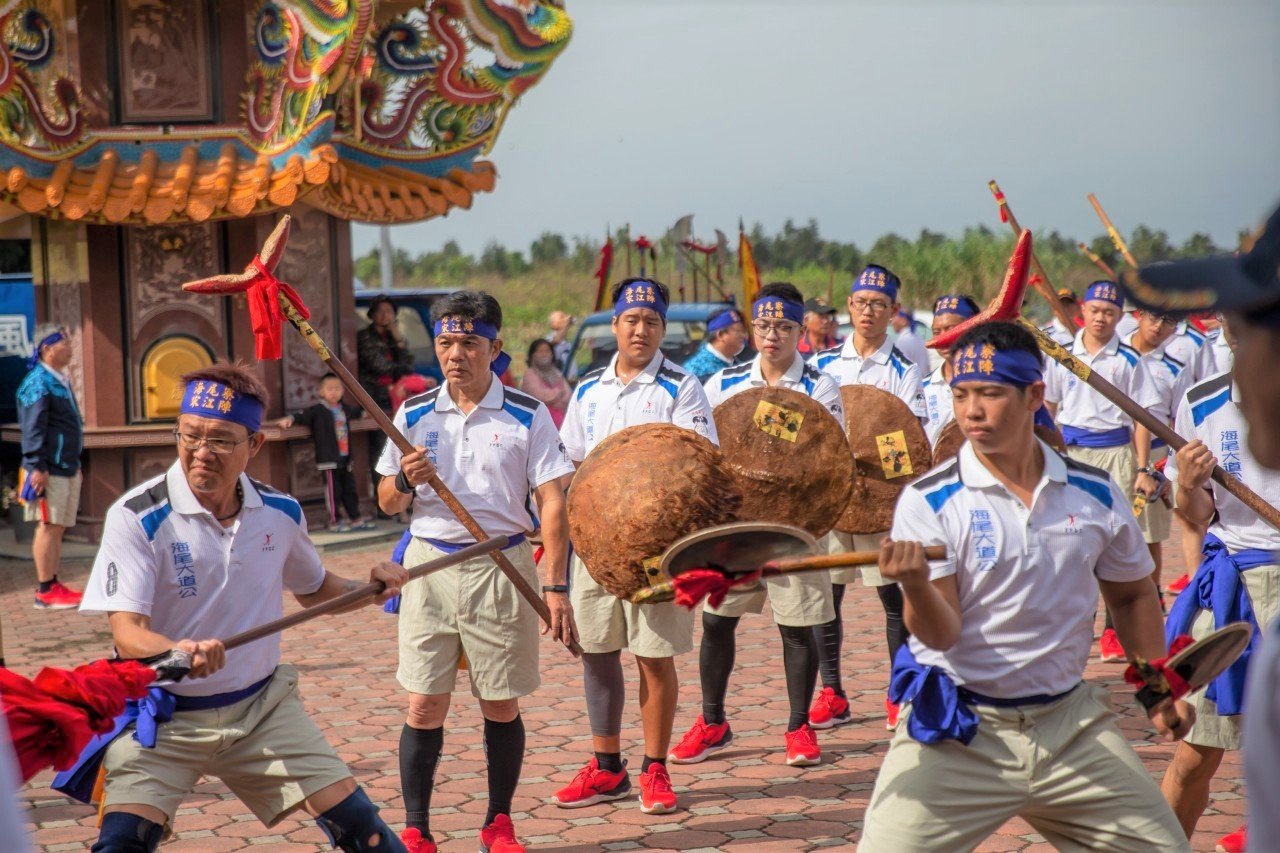
One taxi ride
In an interview, Wu Chin-chih (吳進池), former chairperson of the Haiwei Chaohuang Temple (海尾朝皇宮), said that in the first to third cycles, from 1961 to 1967, the Baosheng Dadi (保生大帝) of the Haiwei Chaohuang Temple served as the presiding deity of the jiao altar; 「送佛回來時,竟然有一科是坐計程車送回而已」 ("when it came to sending the god back, in one cycle he was actually just sent back in a taxi"), and as a result the two sides broke off ties for thirty-six years. In 2002, through the mediation of Wang Kuo-ching (王國清), then a legislator, three consecutive favorable divination-block casts restored relations, and Haiwei returned in the Guiwei cycle of 2003 R002Source臺南宗教文化資料庫 [Tainan Religious Culture Database] / 臺灣宗教與民俗文化平台 [Taiwan Religion and Folk Culture Platform] trfc.tw, interview with Wu Chin-chih (吳進池), former chairperson of the Haiwei Chaohuang TempleOriginal URLhttps://www.trfc.tw/Retrieved2026-10-24Snapshot timestamp2026-10-23A single oral account from the Haiwei side, in a popular compiled directory that takes a position.. Secondhand accountUnverified Wang Kuo-ching served as a member of the 10th, 11th, and 12th Tainan City Councils (臺南市議會), a member of the 2nd Legislative Yuan (1993-02-01 to 1996-01-31), and a delegate to the 3rd National Assembly (1996-05-20 to 2000-05-19); at the time of his mediation in 2002 he had already left the Legislative Yuan, and another source says he was then a member of the Orthodox Luermen Shengmu Temple (正統鹿耳門聖母廟) committee R005SourceLegislative Yuan biographies of legislators across terms, and Tainan City Council member records (Wang Kuo-ching (王國清): member of the 10th, 11th, and 12th Tainan City Councils; member of the 2nd Legislative Yuan, 1993-02-01 to 1996-01-31; delegate to the 3rd National Assembly, 1996-05-20 to 2000-05-19)Original URLhttps://www.ly.gov.tw/Retrieved2026-10-24Snapshot timestamp2026-10-23"A member of the Orthodox Luermen Shengmu Temple committee in 2002" rests on a single source (trfc.tw); the Legislative Yuan biography does not record any temple position..
Five points in time
A discussion page on the official website of the Luermen Tianhou Temple (鹿耳門天后宮) gives five points in time R003SourceDiscussion page on the official website of the Luermen Tianhou Temple (topic_view.php?item_id=1022, giving five points in time: ROC years 34, 50, 56, 92, and 95)Original URLhttps://www.luerhmen.org.tw/topic_view.php?item_id=1022Retrieved2026-10-24Snapshot timestamp2026-10-23A forum post on the website of one party to the dispute; single source; unverified.: Unverified
- ROC year 34 (1945) Retrocession of Taiwan
- ROC year 50 (1961) First cycle of the Tucheng Incense Procession
- ROC year 56 (1967) 「土城王爺公會海尾大道公」 ("the Wangye of Tucheng meet the Dadaogong of Haiwei") is discontinued
- ROC year 92 (2003) The Dadaogong (大道公, i.e., Baosheng Dadi) of Haiwei is restored to the main altar
- ROC year 95 (2006) 「王爺會保生」 ("the Wangye meet Baosheng") is changed to 「媽祖迎保生」 ("Mazu welcomes Baosheng")
The Haiwei Chaohuang Temple Song Jiang Troupe
The Song Jiang troupe of the Haiweiliao (海尾寮) Chaohuang Temple wears blue waist sashes. It began as a self-defense corps of able-bodied men formed to resist bandits, received its instruction from the Longshan area of Qigu (七股), and passed it on to Chenqingliao (陳卿寮) and Zongtouliao (總頭寮); a local saying goes, 「未曾看過海尾斧,也要聽過海尾鼓」 ("even if you have never seen the axes of Haiwei, you must have heard the drums of Haiwei") R001Source《台江地區無形文化資產暨文獻資料蒐集計畫成果報告書》 [Final Report of the Project to Collect Intangible Cultural Heritage and Documentary Materials of the Taijiang Area], commissioned by 臺江國家公園管理處 [Taijiang National Park Headquarters], 2020 (printed p. 239, 「海尾朝皇宮宋江陣(2003 年加入)」 ["Haiwei Chaohuang Temple Song Jiang Troupe (joined 2003)"]; history, waist sash, and lineage of instruction of the Haiweiliao Chaohuang Temple Song Jiang Troupe)Original URLhttps://www.tjnp.gov.tw/Retrieved2026-10-24Snapshot timestamp2026-10-19The only officially commissioned report that serves as a source for the factual layer (the return in 2003); the report gives only the outcome, not the reason.. Official record There are three accounts of its founding year: the officially commissioned report gives Shōwa 15 (1940), its note 29 gives 1938, and the temple's official website gives Meiji 33 (1900) (see 4.3). Unverified
Jiaopei ties
The Haiwei Chaohuang Temple's Facebook page calls the Shengmu Temple and the Luermen Tianhou Temple 「咱交陪境」 ("our jiaopei territories," i.e., temples with which it maintains fraternal ties); in every Chou, Chen, Wei, and Xu year, the Haiwei Chaohuang Temple Song Jiang Troupe also takes part in the three-day procession circuit of the Tucheng xiangke R006SourceWikipedia, 〈海尾朝皇宮宋江陣〉 [Haiwei Chaohuang Temple Song Jiang Troupe] (in every Chou, Chen, Wei, and Xu year it also takes part in the three-day procession circuit of the Tucheng xiangke held by the Orthodox Luermen Shengmu Temple); official Facebook page of the Haiwei Chaohuang Temple (which calls the Shengmu Temple and the Tianhou Temple 「咱交陪境」, "our jiaopei territories")Original URLhttps://zh.wikipedia.org/Retrieved2026-10-24Snapshot timestamp2026-10-23Circumstantial evidence for the present-day layer; the temple's own history page still does not mention the Tucheng Incense Procession.. Secondhand account
Differing accounts
- Founding year of the Haiwei Chaohuang Temple R004SourceOnline research reports (in-depth research reports G01–G08 and the V2 series) and the common writing guidelinesOriginal URLhttps://www.luermen.org.tw/Retrieved2026-10-24Snapshot timestamp2026-10-23Neither side's temple history page mentions this episode.: Unverified
- Daoguang era, by Wu Peng-she (吳椪舍) (district office and trfc.tw)
- Daoguang 23 (1843), by the villager Wu Huifen (吳彙汾) (the temple's history leaflet)
- 1823 (NCKU's 文史脈流 [Currents of Culture and History])
Behind this door is the internal site, with profiles of people and local comments. The internal site is deployed separately.