History
First items: The four stages of the temple's own history1918 and 1921 are two separate eventsMoreLess
The four stages of the temple's own history
The periodization in the history on the temple's official website is as follows. According to tradition, in the Song dynasty, when fishermen traveled back and forth between Fujian and Taiwan, a thatched temple had already been built on the Luermen (鹿耳門) sandbar to worship the Luermen Mazu (鹿耳門媽祖); in 1661, when Koxinga (Zheng Chenggong) (鄭成功) landed at Luermen, he burned incense and prayed, then went ashore to survey a campsite; in Kangxi 58 (1719) the temple was enlarged into an officially built, officially maintained temple R001SourceOfficial Wix satellite site of the 正統鹿耳門聖母廟 [Orthodox Luermen Shengmu Temple], pages 「本廟簡介」 [About the Temple] and 「月老姻緣殿」 [Yuelao Marriage Hall] (footer: "©2023 台南正統鹿耳門聖母廟版權所有" [©2023 Tainan Orthodox Luermen Shengmu Temple, all rights reserved])Original URLhttps://luermenma.wixsite.com/luermen-fellowshipRetrieved2026-10-23Snapshot timestamp—The temple's official website (satellite site), treated as official primary material.. Official record
Next comes: "道光年後,台江內海發生陸化現象,古廟不敵自然環境劇變而傾圮。1831 年,百餘尊神像被『寄佛』至府城『海安宮』" ("After the Daoguang years, the Taijiang Inland Sea turned to land; the old temple could not withstand the drastic change in its natural environment and collapsed. In 1831, more than a hundred deity images were 'entrusted' to the 'Hai'an Temple' in Fucheng") R001SourceOfficial Wix satellite site of the 正統鹿耳門聖母廟 [Orthodox Luermen Shengmu Temple], pages 「本廟簡介」 [About the Temple] and 「月老姻緣殿」 [Yuelao Marriage Hall] (footer: "©2023 台南正統鹿耳門聖母廟版權所有" [©2023 Tainan Orthodox Luermen Shengmu Temple, all rights reserved])Original URLhttps://luermenma.wixsite.com/luermen-fellowshipRetrieved2026-10-23Snapshot timestamp—The temple's official website (satellite site), treated as official primary material.. In 1913 a royal boat (王船, wangchuan) came ashore on the Tucheng (土城) seashore; the Wufu Qiansui (五府千歲, Lords of the Five Palaces) on board sent down a divine message saying that they had come at the invitation of the Luermen Mazu to revive the temple. The residents dug up the building materials of the sunken old temple, and in 1918 they welcomed back the Luermen Mazu and the deities of the old temple that had been entrusted to the Hai'an Temple (海安宮), installing them with the ritual of entering the fire and enthronement (入火安座, ruhuo anzuo), which completed the second building R001SourceOfficial Wix satellite site of the 正統鹿耳門聖母廟 [Orthodox Luermen Shengmu Temple], pages 「本廟簡介」 [About the Temple] and 「月老姻緣殿」 [Yuelao Marriage Hall] (footer: "©2023 台南正統鹿耳門聖母廟版權所有" [©2023 Tainan Orthodox Luermen Shengmu Temple, all rights reserved])Original URLhttps://luermenma.wixsite.com/luermen-fellowshipRetrieved2026-10-23Snapshot timestamp—The temple's official website (satellite site), treated as official primary material.. Official record
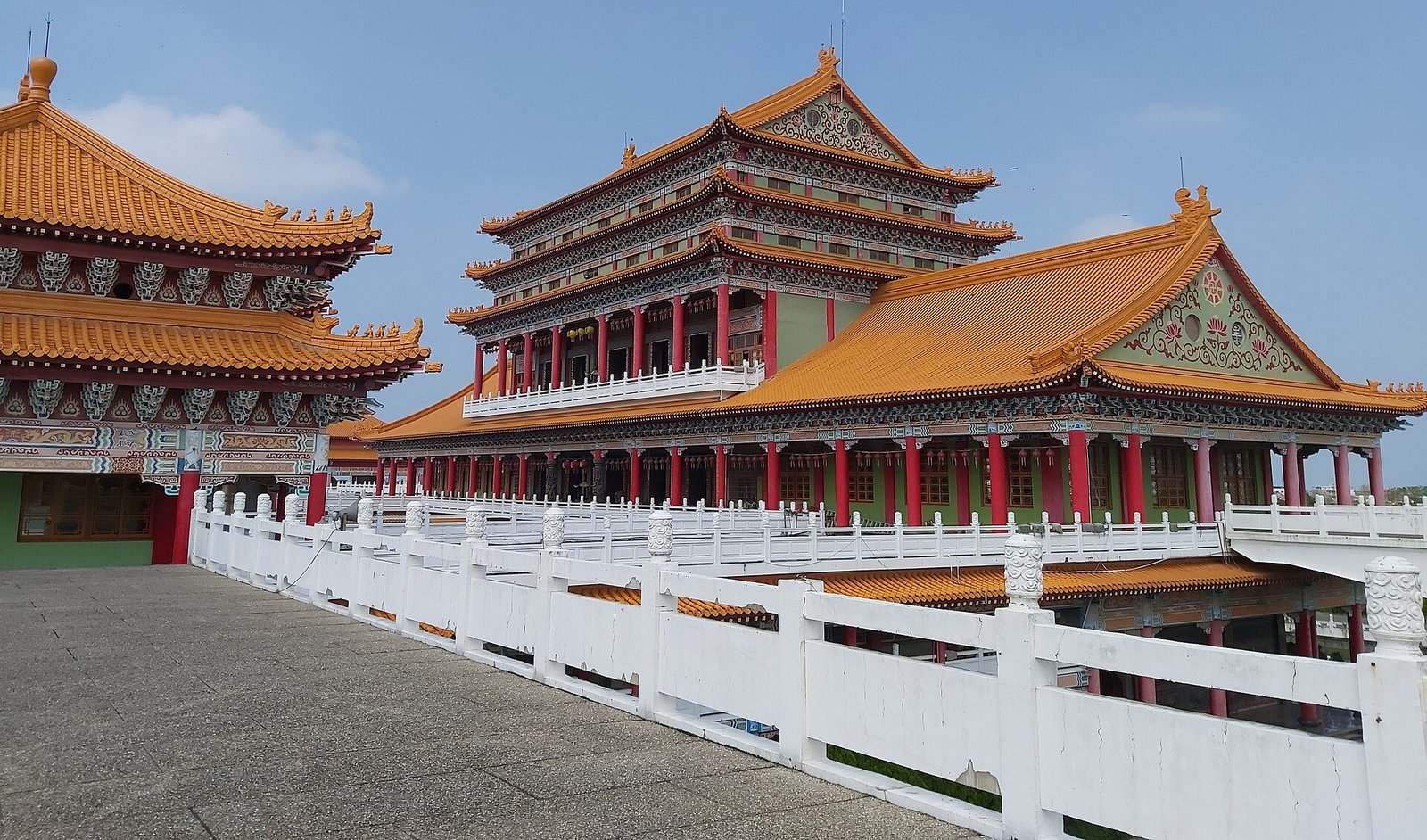
The third building came when, "1975 年重新由鹿耳門媽與眾神『踏廟地』,選定二建舊廟北方半里處" ("in 1975 the Luermen Mazu and the other deities once again 'walked the temple ground' and chose a site half a li north of the old temple of the second building"); it was completed and the deities enthroned on November 8, 1981, in a building modeled on the Forbidden City. Thereafter, giant statues of Qianliyan (千里眼, Thousand-Li Eye) and Shunfeng'er (順風耳, Wind-Following Ear) were completed in 2015, the Luermen Archway in 2020, and a new Yuelao Marriage Hall (月老姻緣殿) was added in 2023 R001SourceOfficial Wix satellite site of the 正統鹿耳門聖母廟 [Orthodox Luermen Shengmu Temple], pages 「本廟簡介」 [About the Temple] and 「月老姻緣殿」 [Yuelao Marriage Hall] (footer: "©2023 台南正統鹿耳門聖母廟版權所有" [©2023 Tainan Orthodox Luermen Shengmu Temple, all rights reserved])Original URLhttps://luermenma.wixsite.com/luermen-fellowshipRetrieved2026-10-23Snapshot timestamp—The temple's official website (satellite site), treated as official primary material.. The version of the Tainan Municipal Administration of Cultural Heritage (臺南市文化資產管理處) adds two details: the royal boat's landing site is given as "土城港仔西海濱" ("the Gangzixi seashore, Tucheng"), and the second building was jointly initiated by the Tucheng xiucai (licentiate) Wang Chung-yueh (王鐘嶽) and descendants of the Guo family through whom the Sanjiao (三郊, Three Merchant Guilds) had entrusted the deity images R002Source臺南市文化資產管理處 [Tainan Municipal Administration of Cultural Heritage], official page 「宮廟博物館:正統鹿耳門聖母廟」 [Temple Museums: Orthodox Luermen Shengmu Temple]Original URLhttps://tmach-culture.tainan.gov.tw/templemuseums/templepage.asp?mainid=887F2311-75AF-4C50-940D-AA93A518D2FFRetrieved2026-10-23Snapshot timestamp—This page shares its source with the temple's own introduction but adds two details: the landing site is given as "土城港仔西海濱" ("the Gangzixi seashore, Tucheng"), and the second building of 1918 was jointly initiated by the Tucheng *xiucai* (秀才, licentiate) Wang Chung-yueh (王鐘嶽) and descendants of the Guo family through whom the Sanjiao had entrusted the deity images.. Official record
1918 and 1921 are two separate events
The "Tuchengzi Shengmu Temple" (土城子聖母廟) entry in the Ministry of the Interior's standard place-name data separates the two years: "建於大正七年(1918),原祀五府千歲,媽祖為副祀,名保安宮" ("built in Taishō 7 (1918), originally worshiping the Wufu Qiansui, with Mazu as a secondary deity, and named the Bao'an Temple"), and "大約民國十年,土城子又自海安宮迎回毀於同治十年(1871)洪水的天后宮內的媽祖神像,合祀於後殿" ("around ROC year 10 [1921], Tuchengzi also brought back from the Hai'an Temple the Mazu images from the Tianhou Temple destroyed by the flood of Tongzhi 10 (1871), and worshiped them together in the rear hall") R003Source內政部地名資訊服務網 [MOI Place Name Information Service] / 《臺灣地名辭書.卷廿一.臺南市》 [Gazetteer of Taiwanese Place Names, vol. 21: Tainan City], standard place-name entry 「土城子聖母廟」 [Tuchengzi Shengmu Temple] (placeId 1002106-005, Chengdong Village), citing Chen Teng-feng (陳登風) 1990: 118Original URLhttps://gn.moi.gov.tw/Retrieved2026-10-19Snapshot timestamp—Three entries in the same reference work give two different years, 1909 and 1913, for the royal boat's arrival; this entry gives 1909 and records that the boat drifted in from Zhufagang and ran aground at Gangzixi.. Official record
In other words, 1918 was the building of the Bao'an Temple (保安宮), and only around 1921 was Mazu brought back and worshiped together in the rear hall. The same entry also records three temple sites: the original site was at the end of Section 1 of Chengxi Street (城西街) and Section 6 of Anzhong Road (安中路), beside the market; a few years later it moved to the intersection of Chengxi Street and Qingsha Street (青沙街); and in ROC year 65 (1976) it moved to its present site R003Source內政部地名資訊服務網 [MOI Place Name Information Service] / 《臺灣地名辭書.卷廿一.臺南市》 [Gazetteer of Taiwanese Place Names, vol. 21: Tainan City], standard place-name entry 「土城子聖母廟」 [Tuchengzi Shengmu Temple] (placeId 1002106-005, Chengdong Village), citing Chen Teng-feng (陳登風) 1990: 118Original URLhttps://gn.moi.gov.tw/Retrieved2026-10-19Snapshot timestamp—Three entries in the same reference work give two different years, 1909 and 1913, for the royal boat's arrival; this entry gives 1909 and records that the boat drifted in from Zhufagang and ran aground at Gangzixi.. Official record Unverified
Eight versions of the 1913 royal boat
MoreLess
There are eight versions of the origin of this royal boat. The Tucheng version records that all 52 deity images were brought back, the decision having been made by "鄭仔寮文館三媽起乩指示" ("the instruction of the Sanma [Third Mazu] of the Zhengziliao Wenguan, given through a spirit medium") R004Source《台江地區無形文化資產暨文獻資料蒐集計畫成果報告書》 [Final Report of the Project to Collect Intangible Cultural Heritage and Documentary Materials of the Taijiang Area], commissioned by 臺江國家公園管理處 [Taijiang National Park Headquarters], 2020; printed pages 52, 80-84, 112-114, 146, 237, 286, 287, 347, 440Original URLhttps://www.tjnp.gov.tw/Retrieved2026-10-19Snapshot timestamp—The "大正 5 年(1918)" ("Taishō 5 (1918)") on printed page 81 is a misprint (Taishō 5 = 1916); note 20 itself admits it is "比 1913 晚了 5 年" ("five years later than 1913"), and printed page 146 gives "次年(1918)" ("the following year (1918)").. The version of the Qingkunshen (青鯤身) temple is carved on a stele of 1984: "民國二年癸丑,有閩省沿海王船停泊於中沙崙頭……為免爭執,雙方乃在神前求筊,由本庄漁夫迎回代天巡狩七王千歲" ("In ROC year 2, the guichou year [1913], a royal boat from the coast of Fujian Province moored at the head of Zhongshalun ... To avoid a dispute, the two sides cast divination blocks before the gods, and the fishermen of this village brought back the Daitian Xunshou Seven Royal Lords") R004Source《台江地區無形文化資產暨文獻資料蒐集計畫成果報告書》 [Final Report of the Project to Collect Intangible Cultural Heritage and Documentary Materials of the Taijiang Area], commissioned by 臺江國家公園管理處 [Taijiang National Park Headquarters], 2020; printed pages 52, 80-84, 112-114, 146, 237, 286, 287, 347, 440Original URLhttps://www.tjnp.gov.tw/Retrieved2026-10-19Snapshot timestamp—The "大正 5 年(1918)" ("Taishō 5 (1918)") on printed page 81 is a misprint (Taishō 5 = 1916); note 20 itself admits it is "比 1913 晚了 5 年" ("five years later than 1913"), and printed page 146 gives "次年(1918)" ("the following year (1918)").. Official record
The Huang Wen-po (黃文博) version (Nanying Diming Zhi (Beimen Qu Juan) (《南瀛地名誌(北門區卷)》, Gazetteer of Nanying Place Names: Beimen District Volume), p. 163) writes "青鯤身人迎回的神明除了代巡七王以外,還有五府千歲,而土城仔人只迎回王船" ("the deities the people of Qingkunshen brought back included not only the Seven Touring Lords but also the Wufu Qiansui, while the people of Tuchengzi brought back only the royal boat"); the Shanziliao (山仔寮) version is that Shanziliao received the Third Qiansui, Lord Jin (金府三千歲), Qingkunshen received the Seven Touring Lords, and the people of Tuchengzi kept the Five Lords and the royal boat R004Source《台江地區無形文化資產暨文獻資料蒐集計畫成果報告書》 [Final Report of the Project to Collect Intangible Cultural Heritage and Documentary Materials of the Taijiang Area], commissioned by 臺江國家公園管理處 [Taijiang National Park Headquarters], 2020; printed pages 52, 80-84, 112-114, 146, 237, 286, 287, 347, 440Original URLhttps://www.tjnp.gov.tw/Retrieved2026-10-19Snapshot timestamp—The "大正 5 年(1918)" ("Taishō 5 (1918)") on printed page 81 is a misprint (Taishō 5 = 1916); note 20 itself admits it is "比 1913 晚了 5 年" ("five years later than 1913"), and printed page 146 gives "次年(1918)" ("the following year (1918)").. Secondhand account
The other four versions come from official web pages: the temple's official website gives "土城海濱" ("the Tucheng seashore") R001SourceOfficial Wix satellite site of the 正統鹿耳門聖母廟 [Orthodox Luermen Shengmu Temple], pages 「本廟簡介」 [About the Temple] and 「月老姻緣殿」 [Yuelao Marriage Hall] (footer: "©2023 台南正統鹿耳門聖母廟版權所有" [©2023 Tainan Orthodox Luermen Shengmu Temple, all rights reserved])Original URLhttps://luermenma.wixsite.com/luermen-fellowshipRetrieved2026-10-23Snapshot timestamp—The temple's official website (satellite site), treated as official primary material.; the Tainan Municipal Administration of Cultural Heritage (臺南市文資處) gives "土城港仔西海濱" ("the Gangzixi seashore, Tucheng") R002Source臺南市文化資產管理處 [Tainan Municipal Administration of Cultural Heritage], official page 「宮廟博物館:正統鹿耳門聖母廟」 [Temple Museums: Orthodox Luermen Shengmu Temple]Original URLhttps://tmach-culture.tainan.gov.tw/templemuseums/templepage.asp?mainid=887F2311-75AF-4C50-940D-AA93A518D2FFRetrieved2026-10-23Snapshot timestamp—This page shares its source with the temple's own introduction but adds two details: the landing site is given as "土城港仔西海濱" ("the Gangzixi seashore, Tucheng"), and the second building of 1918 was jointly initiated by the Tucheng *xiucai* (秀才, licentiate) Wang Chung-yueh (王鐘嶽) and descendants of the Guo family through whom the Sanjiao had entrusted the deity images.; the Ministry of the Interior's "100 Religious Sites of Taiwan" (臺灣宗教百景) names the Fumei Temple (富美宮) in Quanzhou as the ancestral temple that set the boat adrift; the official website of the Taijiang National Park Headquarters (台江處) names the Wenxing Temple (文興宮) in Quanzhou; and the Ministry of Culture's Memory Bank says only "從福建省放流大海" ("set adrift at sea from Fujian Province") R006Source文化部國家文化記憶庫 2.0 [Ministry of Culture, National Cultural Memory Bank 2.0], 〈土城聖母廟王船〉 [Royal Boat of the Tucheng Shengmu Temple] (wooden permanently enshrined royal boat), metadataOriginal URLhttps://tcmb.culture.tw/zh-tw/detail?indexCode=Culture_Object&id=733979Retrieved2026-10-23Snapshot timestamp—Records "相傳是民國二年從福建省放流大海" ("said to have been set adrift at sea from Fujian Province in ROC year 2 [1913]") without naming the ancestral temple that released it; its list of deity images differs from that of the 2020 Taijiang National Park Headquarters report, and both accounts are presented.. Official record Unverified
The versions share one point of agreement: the boat was summoned by the Luermen Mazu — the Tucheng version writes "此行為鹿耳門媽之邀不能久留" ("this journey was at the invitation of the Luermen Mazu, so they could not stay long"), and the Shanziliao version writes "聽聞是要來協助鹿耳門媽祖通水路" ("it was heard that they were coming to help the Luermen Mazu open up the waterway") R004Source《台江地區無形文化資產暨文獻資料蒐集計畫成果報告書》 [Final Report of the Project to Collect Intangible Cultural Heritage and Documentary Materials of the Taijiang Area], commissioned by 臺江國家公園管理處 [Taijiang National Park Headquarters], 2020; printed pages 52, 80-84, 112-114, 146, 237, 286, 287, 347, 440Original URLhttps://www.tjnp.gov.tw/Retrieved2026-10-19Snapshot timestamp—The "大正 5 年(1918)" ("Taishō 5 (1918)") on printed page 81 is a misprint (Taishō 5 = 1916); note 20 itself admits it is "比 1913 晚了 5 年" ("five years later than 1913"), and printed page 146 gives "次年(1918)" ("the following year (1918)").. As for the year the royal boat arrived, the versions also differ among 1913, 1916 and 1918 R004Source《台江地區無形文化資產暨文獻資料蒐集計畫成果報告書》 [Final Report of the Project to Collect Intangible Cultural Heritage and Documentary Materials of the Taijiang Area], commissioned by 臺江國家公園管理處 [Taijiang National Park Headquarters], 2020; printed pages 52, 80-84, 112-114, 146, 237, 286, 287, 347, 440Original URLhttps://www.tjnp.gov.tw/Retrieved2026-10-19Snapshot timestamp—The "大正 5 年(1918)" ("Taishō 5 (1918)") on printed page 81 is a misprint (Taishō 5 = 1916); note 20 itself admits it is "比 1913 晚了 5 年" ("five years later than 1913"), and printed page 146 gives "次年(1918)" ("the following year (1918)").. Unverified
Halls and deities
MoreLess
The halls are arranged as follows: the front hall worships the Wufu Qiansui, the central hall principally worships Tianshang Shengmu (天上聖母, Holy Mother in Heaven), the rear hall worships Guanyin Bodhisattva (觀音菩薩), and the second floor of the rear hall is the Dashi Hall (大士殿) R004Source《台江地區無形文化資產暨文獻資料蒐集計畫成果報告書》 [Final Report of the Project to Collect Intangible Cultural Heritage and Documentary Materials of the Taijiang Area], commissioned by 臺江國家公園管理處 [Taijiang National Park Headquarters], 2020; printed pages 52, 80-84, 112-114, 146, 237, 286, 287, 347, 440Original URLhttps://www.tjnp.gov.tw/Retrieved2026-10-19Snapshot timestamp—The "大正 5 年(1918)" ("Taishō 5 (1918)") on printed page 81 is a misprint (Taishō 5 = 1916); note 20 itself admits it is "比 1913 晚了 5 年" ("five years later than 1913"), and printed page 146 gives "次年(1918)" ("the following year (1918)").. The deities of the Hall of the Five Lords (五王殿) in the first courtyard are listed in full as the Wufu Qiansui, Shuixian Zunwang (水仙尊王, the Water Immortal Kings) (following the arrangement of the first courtyard of the old temple), Kaitai Shengwang (開臺聖王, the Sage King Who Opened Taiwan), Guanchuan Dawang (管船大王, the Great King in Charge of Boats), the generals of the General's Office (將軍府將爺), Jingzhugong (境主公, Lord of the Territory), General Lu Qing (盧清將軍), General Han De (韓德將軍) and the "Five Lords' Boat" (五王船) R001SourceOfficial Wix satellite site of the 正統鹿耳門聖母廟 [Orthodox Luermen Shengmu Temple], pages 「本廟簡介」 [About the Temple] and 「月老姻緣殿」 [Yuelao Marriage Hall] (footer: "©2023 台南正統鹿耳門聖母廟版權所有" [©2023 Tainan Orthodox Luermen Shengmu Temple, all rights reserved])Original URLhttps://luermenma.wixsite.com/luermen-fellowshipRetrieved2026-10-23Snapshot timestamp—The temple's official website (satellite site), treated as official primary material.. Official record
The royal boat is normally kept in the Hall of the Five Lords; at each Tuchengzi Incense Procession (土城仔香) it is moved to the plaza in front of the temple so that worshipers can pray for blessings, and afterward it is returned to the temple and enshrined there — it is worshiped but never sent off R006Source文化部國家文化記憶庫 2.0 [Ministry of Culture, National Cultural Memory Bank 2.0], 〈土城聖母廟王船〉 [Royal Boat of the Tucheng Shengmu Temple] (wooden permanently enshrined royal boat), metadataOriginal URLhttps://tcmb.culture.tw/zh-tw/detail?indexCode=Culture_Object&id=733979Retrieved2026-10-23Snapshot timestamp—Records "相傳是民國二年從福建省放流大海" ("said to have been set adrift at sea from Fujian Province in ROC year 2 [1913]") without naming the ancestral temple that released it; its list of deity images differs from that of the 2020 Taijiang National Park Headquarters report, and both accounts are presented.. The "Luermen Shengmu Temple Tuchengzi Xiang" (鹿耳門聖母廟土城仔香) was registered as a Municipal Folk Custom by public notice of the Tainan City Government (臺南市政府) on 2013-01-28, with this temple as its custodian R005Source文化部文化資產局 [Bureau of Cultural Heritage, Ministry of Culture], National Cultural Heritage Database, folklore registration case 「鹿耳門聖母廟土城仔香」 [Luermen Shengmu Temple Tuchengzi Xiang] (caseId 20130128000002), registered by public notice of the 臺南市政府 [Tainan City Government] 府文資處字第1020066902C號 on 2013-01-28, amended by notice 府文資處字第1071237560B號 on 2018-11-12Original URLhttps://nchdb.boch.gov.tw/assets/advanceSearch/folklore/20130128000002Retrieved2026-10-19Snapshot timestamp—The custodian is the Orthodox Luermen Shengmu Temple, No. 160 Cheng'an Road; the official wording of reason 4 for registration is "武陣有 6 陣和蜈蚣陣" ("the martial troupes comprise six troupes and the Centipede Procession").. Official record
Over the year there are also five peak periods of jinxiang (進香, pilgrimage) and the kaojun (犒軍, rewarding the spirit soldiers) ritual on the 16th of every month. The Zhongyuan pudu (普度, Ghost Festival offering) falls on the 15th day of the 7th lunar month; in 2020 there were more than a thousand tables, and the temple also holds a separate pudu at the ruins of the old Luermen Tianhou Temple R004Source《台江地區無形文化資產暨文獻資料蒐集計畫成果報告書》 [Final Report of the Project to Collect Intangible Cultural Heritage and Documentary Materials of the Taijiang Area], commissioned by 臺江國家公園管理處 [Taijiang National Park Headquarters], 2020; printed pages 52, 80-84, 112-114, 146, 237, 286, 287, 347, 440Original URLhttps://www.tjnp.gov.tw/Retrieved2026-10-19Snapshot timestamp—The "大正 5 年(1918)" ("Taishō 5 (1918)") on printed page 81 is a misprint (Taishō 5 = 1916); note 20 itself admits it is "比 1913 晚了 5 年" ("five years later than 1913"), and printed page 146 gives "次年(1918)" ("the following year (1918)").. Official record
Temple grounds: construction, management and present-day use
First items: Construction on the temple grounds since 2019The management committeePresent-day facilities on the temple groundsMoreLess
Construction on the temple grounds since 2019
The sentence in the temple history 「2020 年完成鹿耳門牌樓」 ("the Luermen Archway was completed in 2020") can be expanded:
- The Luermen Archway (鹿耳門牌樓): Ground was broken on 2019-03-11; it is about 60 meters long and 19 meters high, with five gates and twenty pillars, and it was opened on 2020-12-22, the day of the 39th anniversary of the enthronement R009Source自由時報 [Liberty Times], 〈耗資近億打造「鹿耳門牌樓」 土城聖母廟今動土〉 [Tucheng Shengmu Temple Breaks Ground Today on the "Luermen Archway," Costing Nearly 100 Million] (2019-03-11) and 〈鹿耳門聖母廟牌樓動土 明年底完工〉 [Luermen Shengmu Temple Archway Breaks Ground, to Be Completed by the End of Next Year] (local edition); 中時新聞網 [China Times News], 〈土城正統鹿耳門聖母廟牌樓落成 蔡英文親臨揭牌〉 [Archway of the Tucheng Orthodox Luermen Shengmu Temple Completed; Tsai Ing-wen Attends the Unveiling in Person] (2020-12-22; total length about 60 meters, height 19 meters, five gates and twenty pillars)Original URLhttps://news.ltn.com.tw/news/life/breakingnews/2723254Retrieved2026-10-27Snapshot timestamp—Media reports. See also https://news.ltn.com.tw/news/local/paper/1273464 and https://www.chinatimes.com/realtimenews/20201222002140-260405 . The cost figures differ between reports, so this page gives no figure.R010Source中華民國總統府 [Office of the President, Republic of China] news release, 〈出席「正統鹿耳門聖母廟安座39週年」 總統祈求風調雨順、國泰民安〉 [Attending the "39th Anniversary of the Enthronement of the Orthodox Luermen Shengmu Temple," the President Prays for Favorable Weather and National Peace] (2020-12-22, opening of the Luermen Archway)Original URLhttps://www.president.gov.tw/News/25808Retrieved2026-10-27Snapshot timestamp—Official material.. Secondhand accountOfficial record
- The Temple-Emblem Family Park (廟徽親子園區): The "Orthodox Luermen Shengmu Temple Temple-Emblem Family Park," built jointly by the temple and the city government's Public Works Bureau on the former site of the Woozland Amusement Park (悟智樂園) behind the temple, began construction on 2023-12-13 and opened on 2024-06-03 R012Source臺南市政府 [Tainan City Government] website press release, 〈正統鹿耳門聖母廟廟徽親子園區啟用〉 [Orthodox Luermen Shengmu Temple Temple-Emblem Family Park Opens] (2024-06-03)Original URLhttps://www.tainan.gov.tw/news_content.aspx?n=13370&s=8641265Retrieved2026-10-27Snapshot timestamp—Official material. For details, see 6.9. (see 6.9 for details). Official record
- The three major projects of 2025: The Luermen Mazu Museum (鹿耳門媽文物館) (ground broken 2025-03-09, directly behind the Jade Emperor Hall (玉皇殿)), the Hall of Five Hundred Arhats (五百羅漢殿), and the great flagpole project R011Source臺南市政府 [Tainan City Government] website press release, 〈黃偉哲出席鹿耳門媽文物館動土大典 見證媽祖信仰傳承新里程碑〉 [Huang Wei-che Attends Groundbreaking of the Luermen Mazu Museum, Witnessing a New Milestone in the Mazu Faith] (2025-03-09 (ROC 114-03-09); three major projects: the Luermen Mazu Museum, the Hall of Five Hundred Arhats, and the great flagpole; committee chairperson at the time Cheng Shen-chih (鄭深池)); 人間福報 [Merit Times], 〈正統鹿耳門聖母廟「鹿耳門媽文物館」舉行興建動土大典〉 [Orthodox Luermen Shengmu Temple Holds Groundbreaking Ceremony for the "Luermen Mazu Museum"]Original URLhttps://www.tainan.gov.tw/News_Content.aspx?n=13370&s=8727888Retrieved2026-10-27Snapshot timestamp—Official and media sources. See also Merit Times https://www.merit-times.com/news/453315 . For the museum's specifications, see 9.9.. Official record
The management committee
The management committee serves three-year terms. The chairperson of the 13th committee, Wang Tseng-jung (王增榮), was elected on 2021-08-22 (the believers' representative assembly originally scheduled for June 13 was postponed because of the pandemic) and served until the end of May 2024; in the election of 2024-06-15, Cheng Shen-chih (鄭深池) became chairperson of the 14th committee R011Source臺南市政府 [Tainan City Government] website press release, 〈黃偉哲出席鹿耳門媽文物館動土大典 見證媽祖信仰傳承新里程碑〉 [Huang Wei-che Attends Groundbreaking of the Luermen Mazu Museum, Witnessing a New Milestone in the Mazu Faith] (2025-03-09 (ROC 114-03-09); three major projects: the Luermen Mazu Museum, the Hall of Five Hundred Arhats, and the great flagpole; committee chairperson at the time Cheng Shen-chih (鄭深池)); 人間福報 [Merit Times], 〈正統鹿耳門聖母廟「鹿耳門媽文物館」舉行興建動土大典〉 [Orthodox Luermen Shengmu Temple Holds Groundbreaking Ceremony for the "Luermen Mazu Museum"]Original URLhttps://www.tainan.gov.tw/News_Content.aspx?n=13370&s=8727888Retrieved2026-10-27Snapshot timestamp—Official and media sources. See also Merit Times https://www.merit-times.com/news/453315 . For the museum's specifications, see 9.9.R013Source中華日報 [China Daily News], 〈正統鹿耳門聖母廟改選 王增榮當選第13屆主委〉 [Orthodox Luermen Shengmu Temple Holds Election; Wang Tseng-jung Elected 13th-Term Chairperson] (2021; the believers' representative assembly originally set for June 13 was postponed to August 8 because of the pandemic, and he was elected on August 22); 中華日報 [China Daily News], 〈正統鹿耳門聖母廟6/15改選第14屆主委〉 [Orthodox Luermen Shengmu Temple to Elect 14th-Term Chairperson on 6/15] (2024-06-13); 台灣民眾電子報 [Taiwan People's E-News], 〈正統鹿耳門聖母廟第13屆任期屆滿〉 [13th Term of the Orthodox Luermen Shengmu Temple Expires]; 勁報 [Power News], 〈聖母廟普渡植福活動延續第13屆王增榮主委〉 [Shengmu Temple's Pudu Blessing Activities Continue under 13th-Term Chairperson Wang Tseng-jung]Original URLhttps://www.cdnnews.com.tw/articles/446253Retrieved2026-10-27Snapshot timestamp—Reported by several media outlets. See also https://www.cdns.com.tw/articles/1028999 , https://www.cnma.org.tw/page/news/show.aspx?num=39789 and https://twpowernews.com/news_pagein.php?n_id=266828 . Only positions and the names of public figures are given.. Secondhand account
Present-day facilities on the temple grounds
For the 6 a.m. morning activities on the temple plaza, see Hall of Local Memory 9.1. Today the temple grounds include a night market, pilgrim lodges, a palace-style period costume photo studio, the temple-emblem water park and the Luermen Archway. The pilgrim lodges consist of two buildings about 160 meters apart; the temple's official website states that its four-person rooms "只收清潔費" ("charge only a cleaning fee") and are "不以營利為目的" ("not run for profit"), and the temple also runs its own "Luermen Restaurant" (鹿耳門餐廳) R007SourceOfficial website of the 正統鹿耳門聖母廟 [Orthodox Luermen Shengmu Temple], page 「鹿耳門會館」 [Luermen Hostel], and 11 Google Business place listings including 「鹿耳門聖母廟夜市」 [Luermen Shengmu Temple Night Market], 「鹿耳門會館一館(東邊香客房)」 [Luermen Hostel Building 1 (east pilgrims' rooms)], 「鹿耳門會館二館西邊香客房」 [Luermen Hostel Building 2, west pilgrims' rooms] and 「鹿耳門餐廳」 [Luermen Restaurant]Original URLhttps://www.luermen.org.tw/Retrieved2026-10-23Snapshot timestamp—Google Maps place categories are only the platform's own classification and do not mean the places are owned or run by the temple.. Official record The two buildings go by three sets of names: media and travel sites call them 「東香客大樓/西香客大樓」 (the "East Pilgrim Lodge / West Pilgrim Lodge"), Google Business calls them 「鹿耳門會館一館(東邊香客房)/二館西邊香客房」 ("Luermen Hostel Building 1 (east pilgrims' rooms) / Building 2, west pilgrims' rooms"), and blogs call them 「東廂房/西廂房」 (the "East Wing / West Wing") R007SourceOfficial website of the 正統鹿耳門聖母廟 [Orthodox Luermen Shengmu Temple], page 「鹿耳門會館」 [Luermen Hostel], and 11 Google Business place listings including 「鹿耳門聖母廟夜市」 [Luermen Shengmu Temple Night Market], 「鹿耳門會館一館(東邊香客房)」 [Luermen Hostel Building 1 (east pilgrims' rooms)], 「鹿耳門會館二館西邊香客房」 [Luermen Hostel Building 2, west pilgrims' rooms] and 「鹿耳門餐廳」 [Luermen Restaurant]Original URLhttps://www.luermen.org.tw/Retrieved2026-10-23Snapshot timestamp—Google Maps place categories are only the platform's own classification and do not mean the places are owned or run by the temple.R015Source輕旅行 [Yam Travel], 〈府城觀光公車(四)..鹿耳門聖母廟〉 [Fucheng Tourist Bus (4): Luermen Shengmu Temple] (last updated 2016-05-03), "東香客大樓…西香客大樓" ("East Pilgrim Lodge ... West Pilgrim Lodge"); HouseFeel 房感, 〈網友最愛10 間香客大樓住宿清單〉 [Netizens' 10 Favorite Pilgrim Lodges]; VR 實景旅遊網 [VR Travel Network], attraction page 「鹿耳門聖母廟」 [Luermen Shengmu Temple]Original URLhttps://travel.yam.com/article/92309Retrieved2026-10-27Snapshot timestamp—Media / databases of questionable reliability. "東廂房" ("east wing") refers on different websites to the offices and to pilgrims' rooms, so this page does not treat the terms as synonymous.. Secondhand account In 2020 the temple told the media that "東、西兩棟香客大樓可住宿七、八百人" ("the east and west pilgrim lodges can accommodate seven or eight hundred people"); on 2020-03-24 the temple announced that the pilgrim lodges would suspend accommodation because of the COVID-19 pandemic R014Source自由時報 [Liberty Times], 〈台南》鹿耳門聖母廟香客大樓不接受住宿〉 [Tainan: Luermen Shengmu Temple Pilgrim Lodges Stop Taking Guests] (2020-03-24): "東、西兩棟香客大樓可住宿七、八百人" ("the east and west pilgrim lodges can accommodate seven or eight hundred people"); "即日起香客大樓暫停住宿…香客住宿僅剩一至二成" ("effective immediately the pilgrim lodges suspend accommodation ... pilgrim occupancy has fallen to only 10 to 20 percent")Original URLhttps://news.ltn.com.tw/news/life/paper/1360882Retrieved2026-10-27Snapshot timestamp—Media report, single source. "Seven or eight hundred people" is the temple's own figure; it is in a different unit from the 「118 間房」 ("118 rooms") of 2026, so no conversion is made.. Secondhand account Unverified
Seen as a place that people use — pilgrims, fireworks watchers, night-market strollers, the pilgrims, film crews and disaster evacuees who stay in the pilgrim lodges, joggers on the temple plaza, and voters who have never been there — the temple has a page of its own: 3.8 Who comes to the Shengmu Temple, and what they do there.
在地人記得,聖母廟廟體的西北側有一間廟方自己的修造小工廠。裡頭修造的多半是大件的東西:王船、神轎,還有元宵節用的蜂炮炮台;匾額也曾在這裡整修。 (Local people remember that on the northwest side of the Shengmu Temple building there was a small repair workshop run by the temple itself. What was built and repaired there was mostly large items: royal boats, palanquins, and the launch racks for the beehive fireworks of the Lantern Festival; plaques were also restored there.) Local oral account
Differing accounts
- The year the old temple was finally destroyed: The Luermen Tianhou Temple (鹿耳門天后宮) side, the Place-Name Trilogy and the Ministry of the Interior's standard place-name database give the great flood of 1871 (Tongzhi 10); the current history on the temple's official website gives 1831 (Daoguang 11) R001SourceOfficial Wix satellite site of the 正統鹿耳門聖母廟 [Orthodox Luermen Shengmu Temple], pages 「本廟簡介」 [About the Temple] and 「月老姻緣殿」 [Yuelao Marriage Hall] (footer: "©2023 台南正統鹿耳門聖母廟版權所有" [©2023 Tainan Orthodox Luermen Shengmu Temple, all rights reserved])Original URLhttps://luermenma.wixsite.com/luermen-fellowshipRetrieved2026-10-23Snapshot timestamp—The temple's official website (satellite site), treated as official primary material.R003Source內政部地名資訊服務網 [MOI Place Name Information Service] / 《臺灣地名辭書.卷廿一.臺南市》 [Gazetteer of Taiwanese Place Names, vol. 21: Tainan City], standard place-name entry 「土城子聖母廟」 [Tuchengzi Shengmu Temple] (placeId 1002106-005, Chengdong Village), citing Chen Teng-feng (陳登風) 1990: 118Original URLhttps://gn.moi.gov.tw/Retrieved2026-10-19Snapshot timestamp—Three entries in the same reference work give two different years, 1909 and 1913, for the royal boat's arrival; this entry gives 1909 and records that the boat drifted in from Zhufagang and ran aground at Gangzixi.. Unverified
- The year the royal boat drifted ashore: The temple and the common account give 1913; the Gazetteer of Taiwanese Place Names (臺灣地名辭書), citing Chen Teng-feng (陳登風) 1990: 118, gives 1909 R003Source內政部地名資訊服務網 [MOI Place Name Information Service] / 《臺灣地名辭書.卷廿一.臺南市》 [Gazetteer of Taiwanese Place Names, vol. 21: Tainan City], standard place-name entry 「土城子聖母廟」 [Tuchengzi Shengmu Temple] (placeId 1002106-005, Chengdong Village), citing Chen Teng-feng (陳登風) 1990: 118Original URLhttps://gn.moi.gov.tw/Retrieved2026-10-19Snapshot timestamp—Three entries in the same reference work give two different years, 1909 and 1913, for the royal boat's arrival; this entry gives 1909 and records that the boat drifted in from Zhufagang and ran aground at Gangzixi.R004Source《台江地區無形文化資產暨文獻資料蒐集計畫成果報告書》 [Final Report of the Project to Collect Intangible Cultural Heritage and Documentary Materials of the Taijiang Area], commissioned by 臺江國家公園管理處 [Taijiang National Park Headquarters], 2020; printed pages 52, 80-84, 112-114, 146, 237, 286, 287, 347, 440Original URLhttps://www.tjnp.gov.tw/Retrieved2026-10-19Snapshot timestamp—The "大正 5 年(1918)" ("Taishō 5 (1918)") on printed page 81 is a misprint (Taishō 5 = 1916); note 20 itself admits it is "比 1913 晚了 5 年" ("five years later than 1913"), and printed page 146 gives "次年(1918)" ("the following year (1918)").. Unverified
- The ancestral temple that set the boat adrift: The Ministry of the Interior names the Fumei Temple in Quanzhou; the Taijiang National Park Headquarters names the Wenxing Temple in Quanzhou; the Ministry of Culture says only "Fujian Province" R006Source文化部國家文化記憶庫 2.0 [Ministry of Culture, National Cultural Memory Bank 2.0], 〈土城聖母廟王船〉 [Royal Boat of the Tucheng Shengmu Temple] (wooden permanently enshrined royal boat), metadataOriginal URLhttps://tcmb.culture.tw/zh-tw/detail?indexCode=Culture_Object&id=733979Retrieved2026-10-23Snapshot timestamp—Records "相傳是民國二年從福建省放流大海" ("said to have been set adrift at sea from Fujian Province in ROC year 2 [1913]") without naming the ancestral temple that released it; its list of deity images differs from that of the 2020 Taijiang National Park Headquarters report, and both accounts are presented.. Unverified
- Number of deity images on the boat: The 2020 Taijiang National Park Headquarters report gives 52; the Ministry of Culture's Memory Bank and media reports quoting the temple's chairperson give 48 R004Source《台江地區無形文化資產暨文獻資料蒐集計畫成果報告書》 [Final Report of the Project to Collect Intangible Cultural Heritage and Documentary Materials of the Taijiang Area], commissioned by 臺江國家公園管理處 [Taijiang National Park Headquarters], 2020; printed pages 52, 80-84, 112-114, 146, 237, 286, 287, 347, 440Original URLhttps://www.tjnp.gov.tw/Retrieved2026-10-19Snapshot timestamp—The "大正 5 年(1918)" ("Taishō 5 (1918)") on printed page 81 is a misprint (Taishō 5 = 1916); note 20 itself admits it is "比 1913 晚了 5 年" ("five years later than 1913"), and printed page 146 gives "次年(1918)" ("the following year (1918)").R006Source文化部國家文化記憶庫 2.0 [Ministry of Culture, National Cultural Memory Bank 2.0], 〈土城聖母廟王船〉 [Royal Boat of the Tucheng Shengmu Temple] (wooden permanently enshrined royal boat), metadataOriginal URLhttps://tcmb.culture.tw/zh-tw/detail?indexCode=Culture_Object&id=733979Retrieved2026-10-23Snapshot timestamp—Records "相傳是民國二年從福建省放流大海" ("said to have been set adrift at sea from Fujian Province in ROC year 2 [1913]") without naming the ancestral temple that released it; its list of deity images differs from that of the 2020 Taijiang National Park Headquarters report, and both accounts are presented.. The Wufu Qiansui appear in two orders, 「李、池、吳、范、朱」 ("Li, Chi, Wu, Fan, Zhu") and 「李、池、吳、朱、范」 ("Li, Chi, Wu, Zhu, Fan") R001SourceOfficial Wix satellite site of the 正統鹿耳門聖母廟 [Orthodox Luermen Shengmu Temple], pages 「本廟簡介」 [About the Temple] and 「月老姻緣殿」 [Yuelao Marriage Hall] (footer: "©2023 台南正統鹿耳門聖母廟版權所有" [©2023 Tainan Orthodox Luermen Shengmu Temple, all rights reserved])Original URLhttps://luermenma.wixsite.com/luermen-fellowshipRetrieved2026-10-23Snapshot timestamp—The temple's official website (satellite site), treated as official primary material.R006Source文化部國家文化記憶庫 2.0 [Ministry of Culture, National Cultural Memory Bank 2.0], 〈土城聖母廟王船〉 [Royal Boat of the Tucheng Shengmu Temple] (wooden permanently enshrined royal boat), metadataOriginal URLhttps://tcmb.culture.tw/zh-tw/detail?indexCode=Culture_Object&id=733979Retrieved2026-10-23Snapshot timestamp—Records "相傳是民國二年從福建省放流大海" ("said to have been set adrift at sea from Fujian Province in ROC year 2 [1913]") without naming the ancestral temple that released it; its list of deity images differs from that of the 2020 Taijiang National Park Headquarters report, and both accounts are presented.. Unverified
- Renaming and scale: One account dates the renaming to "Luermen Shengmu Temple" to 1960, another to the new plaque at the 1981 enthronement; one account gives the site area as 15 hectares, another as 40 hectares; the place where the Wangye are invited (請王, qingwang) is written in two forms, "西爿湖仔" (Xibianhuzi) and "西平湖仔" (Xipinghuzi) R004Source《台江地區無形文化資產暨文獻資料蒐集計畫成果報告書》 [Final Report of the Project to Collect Intangible Cultural Heritage and Documentary Materials of the Taijiang Area], commissioned by 臺江國家公園管理處 [Taijiang National Park Headquarters], 2020; printed pages 52, 80-84, 112-114, 146, 237, 286, 287, 347, 440Original URLhttps://www.tjnp.gov.tw/Retrieved2026-10-19Snapshot timestamp—The "大正 5 年(1918)" ("Taishō 5 (1918)") on printed page 81 is a misprint (Taishō 5 = 1916); note 20 itself admits it is "比 1913 晚了 5 年" ("five years later than 1913"), and printed page 146 gives "次年(1918)" ("the following year (1918)").. Unverified
Behind this door is the internal site, with profiles of people and local comments. The internal site is deployed separately.