Five official accounts of the number of martial troupes
First items: Item 4 of the reasons for the 2013 regis…The reasons for the 2019 registration of…The report commissioned by the Taijiang …MoreLess
- Item 4 of the reasons for the 2013 registration of the Tuchengzi Incense Procession (土城仔香): 「武陣有 6 陣和蜈蚣陣」 ("there are 6 martial troupes and a centipede procession") R006SourceItem 4 of the reasons for the 2013 registration of 〈鹿耳門聖母廟土城仔香〉 [Luermen Shengmu Temple Tuchengzi Xiang] (「武陣有 6 陣和蜈蚣陣」, "there are 6 martial troupes and a centipede procession"); the 2024 book published by 晨星 [Morning Star Publishing], 《正統鹿耳門聖母廟 土城香:陣頭文化》 [Orthodox Luermen Shengmu Temple Tucheng Xiang: Troupe Culture] (Yen Ta-yi (顏大鎰) et al.), which gives 「七大武陣」 ("seven great martial troupes")Original URLhttps://nchdb.boch.gov.tw/Retrieved2026-10-24Snapshot timestamp2026-10-23The first and fourth of the four official accounts..
- The reasons for the 2019 registration of the Keliaojiao Song Jiang White Crane Troupe (蚵寮角宋江白鶴陣): 「更為其護持四陣頭之一」 ("moreover, it is one of its four guardian troupes") R002Source〈蚵寮角宋江白鶴陣〉 [Keliaojiao Song Jiang White Crane Troupe], Municipal Folk Custom registration announcement (2019-12-09), 文化部文化資產局 [Bureau of Cultural Heritage, Ministry of Culture], 國家文化資產網 [National Cultural Heritage Database]Original URLhttps://nchdb.boch.gov.tw/Retrieved2026-10-24Snapshot timestamp2026-10-23「土城仔香護持四陣頭之一」 ("one of the four guardian troupes of the Tuchengzi Incense Procession") and 「至今保留之黃腳巾反映宋江陣師承」 ("the yellow waist sash retained to this day reflects its Song Jiang troupe lineage") are both official wording..
- The report commissioned by the Taijiang National Park Headquarters (台江處) in 2020 itself gives two counts R001Source《台江地區無形文化資產暨文獻資料蒐集計畫成果報告書》 [Final Report of the Project to Collect Intangible Cultural Heritage and Documentary Materials of the Taijiang Area], commissioned by 臺江國家公園管理處 [Taijiang National Park Headquarters], 2020 (printed pp. 239, 427, 432, 434, 439, 442–444, 446–448; Tables 6-01 to 6-06)Original URLhttps://www.tjnp.gov.tw/Retrieved2026-10-24Snapshot timestamp2026-10-19Commissioned research report; the phrase 「七大武陣」 ("seven great martial troupes") does not appear in the book, which gives two counts, 6 troupes and 4 troupes.:
- P. 239 gives 「自組文武陣頭 6 陣」 ("6 self-organized civil and martial troupes") (the Guocenliao Golden Lion, Huweiliao Song Jiang, Keliao White Crane, Shalunjiao Bajiajiang, Qingcaolun Centipede, and Xuejialiao Song Jiang troupes).
- P. 444 gives 「自組武陣 4 陣」 ("4 self-organized martial troupes") (the Guocenliao Golden Lion, Huweiliao Song Jiang, Keliao Song Jiang White Crane, and Xuejialiao Song Jiang troupes).
- The temple's own book, published by Morning Star in 2024, gives "seven great martial troupes": the six troupes of the third account plus the Haiwei Chaohuang Temple Song Jiang Troupe (海尾朝皇宮宋江陣) R006SourceItem 4 of the reasons for the 2013 registration of 〈鹿耳門聖母廟土城仔香〉 [Luermen Shengmu Temple Tuchengzi Xiang] (「武陣有 6 陣和蜈蚣陣」, "there are 6 martial troupes and a centipede procession"); the 2024 book published by 晨星 [Morning Star Publishing], 《正統鹿耳門聖母廟 土城香:陣頭文化》 [Orthodox Luermen Shengmu Temple Tucheng Xiang: Troupe Culture] (Yen Ta-yi (顏大鎰) et al.), which gives 「七大武陣」 ("seven great martial troupes")Original URLhttps://nchdb.boch.gov.tw/Retrieved2026-10-24Snapshot timestamp2026-10-23The first and fourth of the four official accounts..
- Table 6-06 of the same Taijiang National Park Headquarters report again identifies 6 martial troupes taking part in the Tuchengzi Incense Procession, counting the Shuzijiao Bao'an Temple (樹仔腳寶安宮) White Crane Troupe of Qigu and marking the Song Jiang Troupe of the Xiashanziliao Longshan Temple (下山仔寮龍山宮) as inactive R001Source《台江地區無形文化資產暨文獻資料蒐集計畫成果報告書》 [Final Report of the Project to Collect Intangible Cultural Heritage and Documentary Materials of the Taijiang Area], commissioned by 臺江國家公園管理處 [Taijiang National Park Headquarters], 2020 (printed pp. 239, 427, 432, 434, 439, 442–444, 446–448; Tables 6-01 to 6-06)Original URLhttps://www.tjnp.gov.tw/Retrieved2026-10-24Snapshot timestamp2026-10-19Commissioned research report; the phrase 「七大武陣」 ("seven great martial troupes") does not appear in the book, which gives two counts, 6 troupes and 4 troupes.. Official record
The differences arise from where the category boundaries are drawn: the Shalunjiao Bajiajiang (砂崙腳八家將, Eight Generals) Troupe is classified as a religious civil troupe (Table 6-05), the Qingcaolun Centipede Procession (青草崙蜈蚣陣) is classified as a float (yige) (Table 6-01), and the Haiwei Chaohuang Temple Song Jiang Troupe is an outside-village troupe that joined only in 2003 R001Source《台江地區無形文化資產暨文獻資料蒐集計畫成果報告書》 [Final Report of the Project to Collect Intangible Cultural Heritage and Documentary Materials of the Taijiang Area], commissioned by 臺江國家公園管理處 [Taijiang National Park Headquarters], 2020 (printed pp. 239, 427, 432, 434, 439, 442–444, 446–448; Tables 6-01 to 6-06)Original URLhttps://www.tjnp.gov.tw/Retrieved2026-10-24Snapshot timestamp2026-10-19Commissioned research report; the phrase 「七大武陣」 ("seven great martial troupes") does not appear in the book, which gives two counts, 6 troupes and 4 troupes..
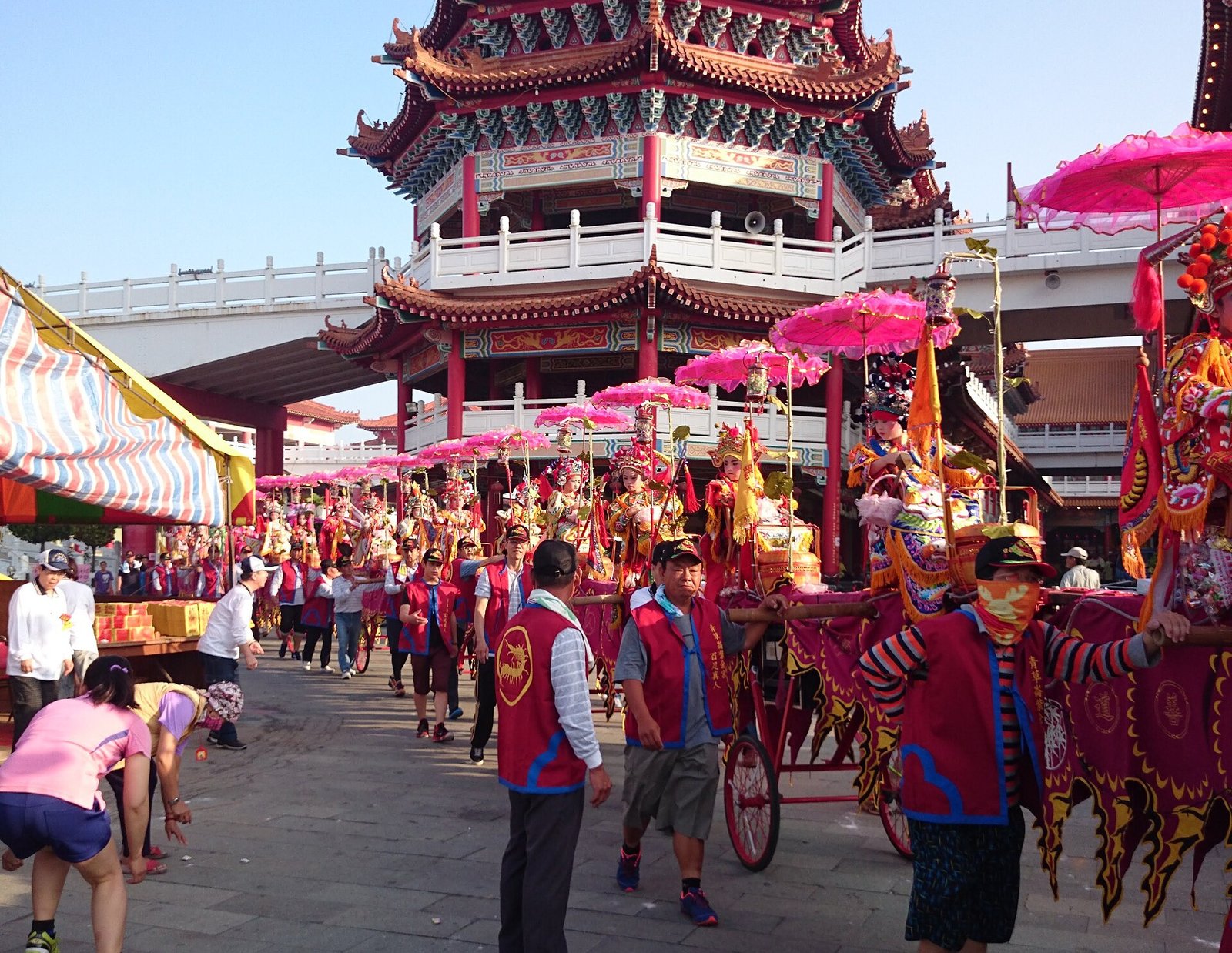
Waist Sashes: five colors, two main lineages of instruction
First items: Keliao YellowGuocenliao YellowHuweiliao RedMoreLess
The function of the waist sash (jiaojin, 腳巾) is 「表示陣頭的結盟、識別」 ("to indicate a troupe's alliances and identity") R001Source《台江地區無形文化資產暨文獻資料蒐集計畫成果報告書》 [Final Report of the Project to Collect Intangible Cultural Heritage and Documentary Materials of the Taijiang Area], commissioned by 臺江國家公園管理處 [Taijiang National Park Headquarters], 2020 (printed pp. 239, 427, 432, 434, 439, 442–444, 446–448; Tables 6-01 to 6-06)Original URLhttps://www.tjnp.gov.tw/Retrieved2026-10-24Snapshot timestamp2026-10-19Commissioned research report; the phrase 「七大武陣」 ("seven great martial troupes") does not appear in the book, which gives two counts, 6 troupes and 4 troupes.. The color assignments on the Tucheng side R001Source《台江地區無形文化資產暨文獻資料蒐集計畫成果報告書》 [Final Report of the Project to Collect Intangible Cultural Heritage and Documentary Materials of the Taijiang Area], commissioned by 臺江國家公園管理處 [Taijiang National Park Headquarters], 2020 (printed pp. 239, 427, 432, 434, 439, 442–444, 446–448; Tables 6-01 to 6-06)Original URLhttps://www.tjnp.gov.tw/Retrieved2026-10-24Snapshot timestamp2026-10-19Commissioned research report; the phrase 「七大武陣」 ("seven great martial troupes") does not appear in the book, which gives two counts, 6 troupes and 4 troupes.: Official record
- Keliao Yellow
- Guocenliao Yellow
- Huweiliao Red
- Xuejialiao Blue-green (qing)
- Haiwei Blue
- Shuzijiao in Qigu, the source of instruction Light green
Yellow waist sashes account for two troupes in Tucheng, and in the Xigang system the yellow waist sash is the largest faction (six temples: the Dawenliao Bao'an Temple, Dazhulin Fenyang Temple, Waidutou Zhongshezi Houde Temple (外渡頭中社仔厚德宮), Daliao Long'an Temple, Guanliao Sheng'an Temple (管寮聖安宮), and Benyuanliao Chaoxing Temple (本淵寮朝興宮)) — the main lineage of instruction of the Tucheng martial troupes therefore points toward the Anding–Guanliao line R001Source《台江地區無形文化資產暨文獻資料蒐集計畫成果報告書》 [Final Report of the Project to Collect Intangible Cultural Heritage and Documentary Materials of the Taijiang Area], commissioned by 臺江國家公園管理處 [Taijiang National Park Headquarters], 2020 (printed pp. 239, 427, 432, 434, 439, 442–444, 446–448; Tables 6-01 to 6-06)Original URLhttps://www.tjnp.gov.tw/Retrieved2026-10-24Snapshot timestamp2026-10-19Commissioned research report; the phrase 「七大武陣」 ("seven great martial troupes") does not appear in the book, which gives two counts, 6 troupes and 4 troupes.. Keliao's white crane techniques come from Shuzijiao, yet its waist sash has remained yellow; the official reasons for registration state 「至今保留之黃腳巾反映宋江陣師承」 ("the yellow waist sash retained to this day reflects its Song Jiang troupe lineage") R002Source〈蚵寮角宋江白鶴陣〉 [Keliaojiao Song Jiang White Crane Troupe], Municipal Folk Custom registration announcement (2019-12-09), 文化部文化資產局 [Bureau of Cultural Heritage, Ministry of Culture], 國家文化資產網 [National Cultural Heritage Database]Original URLhttps://nchdb.boch.gov.tw/Retrieved2026-10-24Snapshot timestamp2026-10-23「土城仔香護持四陣頭之一」 ("one of the four guardian troupes of the Tuchengzi Incense Procession") and 「至今保留之黃腳巾反映宋江陣師承」 ("the yellow waist sash retained to this day reflects its Song Jiang troupe lineage") are both official wording..
Histories troupe by troupe:
- Xuejialiao (學甲寮): founded in 1949, taught by the Madouliao Zhuzigang Golden Lion Troupe, and given the title of vanguard officer of the procession troupes.
- Huweiliao (虎尾寮): founded in 1952, taught by the Xinzhuangzi Bao'an Temple of Anding; on entering training, the troupe must go to the banyan tree at the entrance to Chengxi Street (城西街) to welcome its patriarch, Marshal Song (宋府元帥).
- Guocenliao (郭岑寮): originally a Taiping song (taipingge) ensemble, reorganized as a golden lion troupe in the early postwar years; after the break in incense ties with Xigang, it withdrew together with Tucheng R001Source《台江地區無形文化資產暨文獻資料蒐集計畫成果報告書》 [Final Report of the Project to Collect Intangible Cultural Heritage and Documentary Materials of the Taijiang Area], commissioned by 臺江國家公園管理處 [Taijiang National Park Headquarters], 2020 (printed pp. 239, 427, 432, 434, 439, 442–444, 446–448; Tables 6-01 to 6-06)Original URLhttps://www.tjnp.gov.tw/Retrieved2026-10-24Snapshot timestamp2026-10-19Commissioned research report; the phrase 「七大武陣」 ("seven great martial troupes") does not appear in the book, which gives two counts, 6 troupes and 4 troupes..
- Keliaojiao (蚵寮角): its complete chain of instruction is officially endorsed R002Source〈蚵寮角宋江白鶴陣〉 [Keliaojiao Song Jiang White Crane Troupe], Municipal Folk Custom registration announcement (2019-12-09), 文化部文化資產局 [Bureau of Cultural Heritage, Ministry of Culture], 國家文化資產網 [National Cultural Heritage Database]Original URLhttps://nchdb.boch.gov.tw/Retrieved2026-10-24Snapshot timestamp2026-10-23「土城仔香護持四陣頭之一」 ("one of the four guardian troupes of the Tuchengzi Incense Procession") and 「至今保留之黃腳巾反映宋江陣師承」 ("the yellow waist sash retained to this day reflects its Song Jiang troupe lineage") are both official wording..
- 1928 The Shuzijiao Bao'an Temple White Crane Troupe of Qigu is founded
- 1941 Keliaojiao sets up a martial arts hall
- 1946 Forms a Song Jiang troupe
- 1952 Allies with Shuzijiao
- 1961 Founds a Song Jiang White Crane Troupe under Shuzijiao's instruction
- 2019-12-09 Registered
- Haiwei (海尾): there are three accounts of its founding year: the officially commissioned report gives Shōwa 15 (1940), its note 29 gives 1938, and the temple's official website gives Meiji 33 (1900) R001Source《台江地區無形文化資產暨文獻資料蒐集計畫成果報告書》 [Final Report of the Project to Collect Intangible Cultural Heritage and Documentary Materials of the Taijiang Area], commissioned by 臺江國家公園管理處 [Taijiang National Park Headquarters], 2020 (printed pp. 239, 427, 432, 434, 439, 442–444, 446–448; Tables 6-01 to 6-06)Original URLhttps://www.tjnp.gov.tw/Retrieved2026-10-24Snapshot timestamp2026-10-19Commissioned research report; the phrase 「七大武陣」 ("seven great martial troupes") does not appear in the book, which gives two counts, 6 troupes and 4 troupes.. Unverified
The Bajiajiang, the centipede procession, and the five stages
MoreLess
The Shalunjiao Bajiajiang Troupe has the hall name Jisheng Hall (吉聖堂) and belongs to the 「吉字輩」 ("Ji-generation") Bajiajiang system of the Jihe Hall (吉和堂) of the Fifteenth Jiaotou (第十五角吉和堂) of Jiali (佳里). It was organized in 1966 and first went out in procession in the Dingwei cycle of 1967 (another account gives 1961). The full names of all eleven performers are on record, and the report also notes that it forms only once every three years and does not accept outside engagements in ordinary times R001Source《台江地區無形文化資產暨文獻資料蒐集計畫成果報告書》 [Final Report of the Project to Collect Intangible Cultural Heritage and Documentary Materials of the Taijiang Area], commissioned by 臺江國家公園管理處 [Taijiang National Park Headquarters], 2020 (printed pp. 239, 427, 432, 434, 439, 442–444, 446–448; Tables 6-01 to 6-06)Original URLhttps://www.tjnp.gov.tw/Retrieved2026-10-24Snapshot timestamp2026-10-19Commissioned research report; the phrase 「七大武陣」 ("seven great martial troupes") does not appear in the book, which gives two counts, 6 troupes and 4 troupes.. Unverified The Qingcaolun Centipede Procession has 36 people and 18 wooden boards. Outside the xiangke period, the head and tail of the centipede are kept in the shrine of the Dashi Hall (大士殿) on the second floor of the rear hall of the Shengmu Temple; on the eve of the xiangke, Xitian Fozu (西天佛祖, Buddha of the Western Heaven) and the head and tail are welcomed back to the village; the scaffold is set up on the day before the guaxiang (kuah-hiunn); on arrival at the temple, the chairperson presents an order bestowing the title "Hundred-Legged Perfected One" (百足真人); and the three days of drama are "Xue Rengui's Eastern Campaign," "Xue Dingshan's Western Campaign," and "Luo Tong Sweeps the North" R001Source《台江地區無形文化資產暨文獻資料蒐集計畫成果報告書》 [Final Report of the Project to Collect Intangible Cultural Heritage and Documentary Materials of the Taijiang Area], commissioned by 臺江國家公園管理處 [Taijiang National Park Headquarters], 2020 (printed pp. 239, 427, 432, 434, 439, 442–444, 446–448; Tables 6-01 to 6-06)Original URLhttps://www.tjnp.gov.tw/Retrieved2026-10-24Snapshot timestamp2026-10-19Commissioned research report; the phrase 「七大武陣」 ("seven great martial troupes") does not appear in the book, which gives two counts, 6 troupes and 4 troupes.. The temple to which the centipede procession belongs is the Qingcaolun Zijin Temple (青草崙紫金宮); the Zijin Temple, the Qingfeng Temple (清峰宮), and the Beishanwei Chenghuang Temple (北汕尾城隍廟) are three different temples R007SourceFive independent points in time for the temple to which the Qingcaolun Centipede Procession belongs (2013, Ministry of the Interior, 臺灣宗教百景 [100 Religious Sites of Taiwan]; 2015–2018, Academia Sinica, 《研之有物》 [Research Sinica]; 2022-07-21, Ministry of Culture, National Cultural Memory Bank; 2023-11-04 and 2024-04-14, Liberty Times; 2024-04-11, China Daily News)Original URLhttps://tcmb.culture.tw/Retrieved2026-10-24Snapshot timestamp2026-10-23Wherever a temple name is attached, it is the "Qingcaolun Zijin Temple"; none attributes it to the Chenghuang Temple or the Qingfeng Temple..
The Tucheng version of the troupe customs has five stages: anguan (暗館, closed training), ruguan (入館, entering training), kaiguan (開館, opening ceremony), tanguan (探館, visiting), and xieguan (謝館, thanksgiving closing) — the Xigang version has only four stages and no anguan; the Keliao registration reasons additionally list a "riguan" (日館, daytime training), for six stages R001Source《台江地區無形文化資產暨文獻資料蒐集計畫成果報告書》 [Final Report of the Project to Collect Intangible Cultural Heritage and Documentary Materials of the Taijiang Area], commissioned by 臺江國家公園管理處 [Taijiang National Park Headquarters], 2020 (printed pp. 239, 427, 432, 434, 439, 442–444, 446–448; Tables 6-01 to 6-06)Original URLhttps://www.tjnp.gov.tw/Retrieved2026-10-24Snapshot timestamp2026-10-19Commissioned research report; the phrase 「七大武陣」 ("seven great martial troupes") does not appear in the book, which gives two counts, 6 troupes and 4 troupes.R002Source〈蚵寮角宋江白鶴陣〉 [Keliaojiao Song Jiang White Crane Troupe], Municipal Folk Custom registration announcement (2019-12-09), 文化部文化資產局 [Bureau of Cultural Heritage, Ministry of Culture], 國家文化資產網 [National Cultural Heritage Database]Original URLhttps://nchdb.boch.gov.tw/Retrieved2026-10-24Snapshot timestamp2026-10-23「土城仔香護持四陣頭之一」 ("one of the four guardian troupes of the Tuchengzi Incense Procession") and 「至今保留之黃腳巾反映宋江陣師承」 ("the yellow waist sash retained to this day reflects its Song Jiang troupe lineage") are both official wording.. Unverified The allocation for welcoming the Five Lords to be stationed at the troupe lodges on entering training is: Huweiliao welcomes Lord Chi (池王), Guocenliao welcomes Lord Wu, and Keliao welcomes Lord Fan; Shalunjiao, which built its own temple, does not follow this custom R001Source《台江地區無形文化資產暨文獻資料蒐集計畫成果報告書》 [Final Report of the Project to Collect Intangible Cultural Heritage and Documentary Materials of the Taijiang Area], commissioned by 臺江國家公園管理處 [Taijiang National Park Headquarters], 2020 (printed pp. 239, 427, 432, 434, 439, 442–444, 446–448; Tables 6-01 to 6-06)Original URLhttps://www.tjnp.gov.tw/Retrieved2026-10-24Snapshot timestamp2026-10-19Commissioned research report; the phrase 「七大武陣」 ("seven great martial troupes") does not appear in the book, which gives two counts, 6 troupes and 4 troupes..
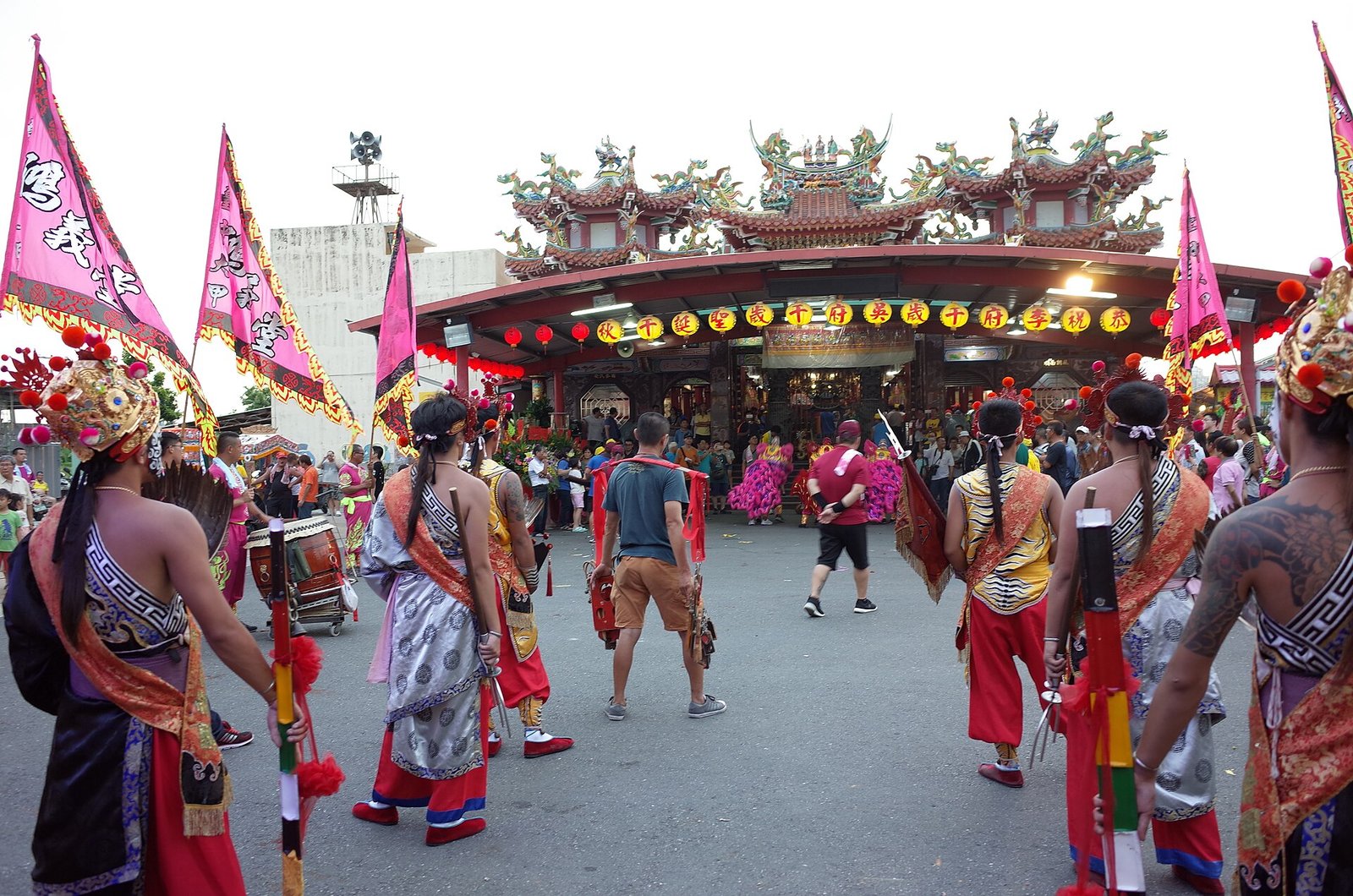
Training sites and opening times
First items: Keliaojiao White Crane Troupe 3/23 (Sat.…Qingsheng Temple Bajiajiang Troupe 3/30 …Guocenliao Golden Lion Troupe 3/30 07:00…MoreLess
The hall of the Keliaojiao Song Jiang White Crane Troupe is at No. 35, Sec. 1, Chengxi Street, Annan District, Tainan City R003Source臺南市政府文化局 [Cultural Affairs Bureau, Tainan City Government], 「臺南市藝陣資源網」 [Tainan Performance Troupe Resource Network], team page for the Keliaojiao Song Jiang White Crane Troupe (source given as 《臺南市民俗藝陣—宋江系統之武陣複查計畫 成果報告書 2》 [Tainan Folk Performance Troupes: Final Report on the Re-survey of Martial Troupes of the Song Jiang System, vol. 2], pp. 1132–1133)Original URLhttps://zhentou.tnc.gov.tw/Retrieved2026-10-24Snapshot timestamp2026-10-23The first street address found for the troupe of a Tucheng jiaotou.. Official record When the Huweiliao Song Jiang Troupe (虎尾寮宋江陣) enters training, it too must go to the banyan tree at the entrance to Chengxi Street to welcome its patriarch — Chengxi Street is a street shared by two martial troupes.
Dates and times of the opening ceremonies of the five martial troupes in the 2024 Jiachen cycle R004SourceDates and times of the opening ceremonies of the five martial troupes in the 2024 Jiachen cycle (a popular event-compilation site; the site acknowledges that some of its text was compiled with AI assistance)Original URL—Retrieved2026-10-24Snapshot timestamp2026-10-23Only the dates and times are used; of the five rows, only the Keliaojiao row has an independent second source (Central News Agency, 2024-03-23); the other four rows are unverified.: Unverified
- Keliaojiao White Crane Troupe 3/23 (Sat.) 09:00–11:00
- Qingsheng Temple Bajiajiang Troupe 3/30 07:00
- Guocenliao Golden Lion Troupe 3/30 07:00–09:00
- Huweiliao Song Jiang Troupe 3/30 17:00–19:00
- Xuejialiao Cixing Temple Song Jiang Troupe 4/7 (Sun.) 09:00–11:00
Each troupe's opening ceremony fell on a different date and time slot. In both cycles, the opening ceremonies were held on the temple plaza rather than at the troupes' own village temples: in 2024 on the plaza of the Orthodox Luermen Shengmu Temple (正統鹿耳門聖母廟), and in 2021 in front of the Shengmu Temple R005SourceCentral News Agency (中央社) report of 2024-03-23 on the opening ceremony of the Keliaojiao White Crane Troupe; Tainan City Government press release of 2021-04-25 (ROC year 110) (the opening ceremony of the Keliaojiao White Crane Troupe held in front of the Shengmu Temple, at which Huang Wei-che (黃偉哲) presented the intangible cultural heritage registration certificate)Original URLhttps://www.tainan.gov.tw/Retrieved2026-10-24Snapshot timestamp2026-10-23The city government press release also provides an official second source for the "anguan" (closed training) stage.. The Haiwei Chaohuang Temple (海尾朝皇宮) also runs a year-round course, "Taijiang Martial Arts" (台江武藝), every Saturday from 7:00 to 8:50 p.m., in terms of 18 weeks, organized by the Taijiang Branch of Tainan Community University (臺南社區大學台江分校) R008SourceTaijiang Branch of Tainan Community University, course schedule for semester 114-1 (2025 fall), 「台江武藝」 [Taijiang Martial Arts] (Haiwei Chaohuang Temple, every Saturday 19:00–20:50, one term of 18 weeks)Original URL—Retrieved2026-10-24Snapshot timestamp2026-10-23A community-university heritage class, not the same as the Song Jiang troupe's own training; this course does not appear on the 115-1 semester schedule.. Unverified It is a community-university heritage class, not the same as the Song Jiang troupe's own training.
Differing accounts
- Founding year of the Haiwei Song Jiang Troupe: the officially commissioned report gives 1940; note 29 of the same book gives 1938; the temple's official website gives 1900. Unverified
- Year the Shalunjiao Bajiajiang Troupe was organized: one account gives 1961; another says it was organized in 1966 and first went out in procession in 1967. Unverified
- Hall name of the Shalunjiao Bajiajiang Troupe: the officially commissioned report gives "Jisheng Hall" (吉聖堂) R001Source《台江地區無形文化資產暨文獻資料蒐集計畫成果報告書》 [Final Report of the Project to Collect Intangible Cultural Heritage and Documentary Materials of the Taijiang Area], commissioned by 臺江國家公園管理處 [Taijiang National Park Headquarters], 2020 (printed pp. 239, 427, 432, 434, 439, 442–444, 446–448; Tables 6-01 to 6-06)Original URLhttps://www.tjnp.gov.tw/Retrieved2026-10-24Snapshot timestamp2026-10-19Commissioned research report; the phrase 「七大武陣」 ("seven great martial troupes") does not appear in the book, which gives two counts, 6 troupes and 4 troupes.; the list of Ji-generation branch halls in the Wikipedia article 〈佳里吉和堂〉 (Jiali Jihe Hall) gives 「土城砂崙腳清聖宮吉勝堂」 ("Jisheng Hall (吉勝堂) of the Shalunjiao Qingsheng Temple, Tucheng"), with the note 「土城鹿耳門聖母廟駕前」 ("in attendance before the Luermen Shengmu Temple of Tucheng") R009SourceWikipedia, 〈佳里吉和堂〉 [Jiali Jihe Hall]Original URLhttps://zh.wikipedia.org/zh-tw/%E4%BD%B3%E9%87%8C%E5%90%89%E5%92%8C%E5%A0%82Retrieved2026-10-30Snapshot timestamp—. Secondhand account Both accounts are presented side by side.
- Guocenliao: one account says its instruction came from a golden lion troupe hired from Guanliao, another from Guanmiao in Tainan; one account gives the temple name as the Shengmu Temple (聖母宮), another as the Shengcen Temple (聖岑宮).
- Keliaojiao waist sash: the official registration gives yellow; the Central News Agency in 2024 gave blue-green (qing). Unverified
- Troupe name: the cultural heritage registration gives "White Crane Troupe" (白鶴陣); it is also written "White Horse Troupe" (白馬陣).
- The disbanded Ox-Plough Song (niulige) troupe: the same report variously says that the Zhengziliao troupe has disappeared, that the Zhengziliao troupe still exists, and that the Zhongzhoujiao troupe stopped in 1955. Unverified
Behind this door is the internal site, with profiles of people and local comments. The internal site is deployed separately.