Land formation: new land after 1823
MoreLess
In the seventh lunar month of Daoguang 3 (1823), days of heavy rain caused the Zengwen River (曾文溪), then called the Wanli River (灣裡溪), to breach its embankments around Sucuojia (蘇厝甲). Its mouth shifted south from the Jiangjun River (將軍溪) in the north to empty through the Luermen River (鹿耳門溪), pouring vast amounts of silt directly into the Taijiang Inland Sea (臺江內海) R001SourceCompiled by this site's editors: historical timeline, compiled from the framework of Lu Chia-hsing (盧嘉興), 〈鹿耳門地理演變考〉 [A Study of the Geographical Evolution of Luermen], and the administrative history published by the 安南區公所 [Annan District Office]Original URLhttps://www.tainan.gov.tw/annan/Retrieved2026-10-18Snapshot timestamp—Compiled by this site; for the original source (Lu Chia-hsing's original table), see R004 on page 1.3. There are two accounts of where the 1823 course change began: Sucuojia (蘇厝甲) and Jianliao (菅寮).. From then on the Taijiang Inland Sea silted up and turned to land rapidly, forming the newly formed tidal land of today's Annan District (安南區). Only two remnant lagoons were left, Sicao Lake (四草湖) and Kunshen Lake (鯤身湖), while the channel of Luermen Harbor (鹿耳門港) silted up and the harbor was abandoned R001SourceCompiled by this site's editors: historical timeline, compiled from the framework of Lu Chia-hsing (盧嘉興), 〈鹿耳門地理演變考〉 [A Study of the Geographical Evolution of Luermen], and the administrative history published by the 安南區公所 [Annan District Office]Original URLhttps://www.tainan.gov.tw/annan/Retrieved2026-10-18Snapshot timestamp—Compiled by this site; for the original source (Lu Chia-hsing's original table), see R004 on page 1.3. There are two accounts of where the 1823 course change began: Sucuojia (蘇厝甲) and Jianliao (菅寮).. Official record
The emerged land was overgrown with silvergrass and was called "Jianaipu" (菅仔埔, "silvergrass flats"). Coastal residents staked out land, reclaimed it and built thatched huts, leaving a large number of place names containing the character liao (藔/寮, "hut") R001SourceCompiled by this site's editors: historical timeline, compiled from the framework of Lu Chia-hsing (盧嘉興), 〈鹿耳門地理演變考〉 [A Study of the Geographical Evolution of Luermen], and the administrative history published by the 安南區公所 [Annan District Office]Original URLhttps://www.tainan.gov.tw/annan/Retrieved2026-10-18Snapshot timestamp—Compiled by this site; for the original source (Lu Chia-hsing's original table), see R004 on page 1.3. There are two accounts of where the 1823 course change began: Sucuojia (蘇厝甲) and Jianliao (菅寮).. The Taiwan Caifang Ce (臺灣采訪冊, Records of Inquiries in Taiwan) of Daoguang 7 (1827) records that Circuit Intendant Kong (孔道憲), noting that "以浮埔略堪耕種" ("the emerged flats are reasonably fit for cultivation"), dispatched officials to survey and measure the land and grant it for reclamation; from then on, reclamation shifted to officially issued licenses and officially drawn boundaries R001SourceCompiled by this site's editors: historical timeline, compiled from the framework of Lu Chia-hsing (盧嘉興), 〈鹿耳門地理演變考〉 [A Study of the Geographical Evolution of Luermen], and the administrative history published by the 安南區公所 [Annan District Office]Original URLhttps://www.tainan.gov.tw/annan/Retrieved2026-10-18Snapshot timestamp—Compiled by this site; for the original source (Lu Chia-hsing's original table), see R004 on page 1.3. There are two accounts of where the 1823 course change began: Sucuojia (蘇厝甲) and Jianliao (菅寮).. Official record
Four accounts of the name's origin
First items: The earthen-rampart and armed-feud defen…The Dutch earthen fort account: The Dutc…The renaming of the Dutch-era 「鹿耳門村/鹿耳門小…MoreLess
- The earthen-rampart and armed-feud defense account: In the Daoguang era, when the emerged land of Taijiang was opened for recruited reclamation, Guo Mushi (郭畝使), a Guo-surname kenshou (墾首, land-reclamation chief) from Xizhou (溪洲) in Xuejia (學甲) (Xia) — who did business under the firm name 「郭義昌」 (the Kuo Yi-chang firm) and who set up an office at Tuchengliao (土城寮) to collect the major rent (大租, dazu) — recruited Guo-surname settlers from Dazhulin (大竹林) in Xigang (西港), Dawenliao (大塭寮), Jianziliao (菅仔寮) in Anding (安定), and Guocenliao (郭岑寮) in Budai (布袋), Chiayi (嘉義). To resist the Huang-surname settlers of the "Sixteen Share-Heads" (十六股首) led by Hong Li (洪理), Huang Jun (黃軍) and others to the east, they built an earthen rampart, and so the settlement came to be called "Tucheng(zi)liao" (土城(仔)寮) R002Source108 年度「台江文化保存及創新應用(3/3)-台江地名書寫計畫暨史普知識推廣」成果報告 [Final Report, 2019 (ROC year 108): Taijiang Cultural Preservation and Innovative Application (3/3): Taijiang Place-Name Writing Project and Popular History Outreach], commissioned by 臺江國家公園管理處 [Taijiang National Park Headquarters], 國立高雄師範大學 [National Kaohsiung Normal University] (principal investigator Liu Cheng-yuan (劉正元)), December 2019 (ROC year 108); printed pages 72, 73, 164, 165-166, Appendix 5, Appendix 6Original URLhttps://www.tjnp.gov.tw/Retrieved2026-10-19Snapshot timestamp—Commissioned research report; the cover states that the contents reflect the authors' personal views and not those of the commissioning agency.. The full name of the boundary stele is "憲准勘洪理黃軍埔界" ("Boundary of the flats of Hong Li and Huang Jun, surveyed with the approval of the Intendant"); it is now held in the cultural relics museum of the Orthodox Luermen Shengmu Temple (正統鹿耳門聖母廟) R002Source108 年度「台江文化保存及創新應用(3/3)-台江地名書寫計畫暨史普知識推廣」成果報告 [Final Report, 2019 (ROC year 108): Taijiang Cultural Preservation and Innovative Application (3/3): Taijiang Place-Name Writing Project and Popular History Outreach], commissioned by 臺江國家公園管理處 [Taijiang National Park Headquarters], 國立高雄師範大學 [National Kaohsiung Normal University] (principal investigator Liu Cheng-yuan (劉正元)), December 2019 (ROC year 108); printed pages 72, 73, 164, 165-166, Appendix 5, Appendix 6Original URLhttps://www.tjnp.gov.tw/Retrieved2026-10-19Snapshot timestamp—Commissioned research report; the cover states that the contents reflect the authors' personal views and not those of the commissioning agency.R003Source《台江地區無形文化資產暨文獻資料蒐集計畫成果報告書》 [Final Report of the Project to Collect Intangible Cultural Heritage and Documentary Materials of the Taijiang Area], commissioned by 臺江國家公園管理處 [Taijiang National Park Headquarters], 2020; printed pages 53, 517Original URLhttps://www.tjnp.gov.tw/Retrieved2026-10-19Snapshot timestamp—The Zheng-period gun battery account on page 517 comes from the review committee's comments section, not from the body of the report, and is the least reliable.. Official record
- The Dutch earthen fort account: The Dutch built an earthen fort to watch the ships entering and leaving the old Luermen Harbor (古鹿耳門港); the on-site interpretive sign beside today's Dutch Well (荷蘭井) adopts this account R002Source108 年度「台江文化保存及創新應用(3/3)-台江地名書寫計畫暨史普知識推廣」成果報告 [Final Report, 2019 (ROC year 108): Taijiang Cultural Preservation and Innovative Application (3/3): Taijiang Place-Name Writing Project and Popular History Outreach], commissioned by 臺江國家公園管理處 [Taijiang National Park Headquarters], 國立高雄師範大學 [National Kaohsiung Normal University] (principal investigator Liu Cheng-yuan (劉正元)), December 2019 (ROC year 108); printed pages 72, 73, 164, 165-166, Appendix 5, Appendix 6Original URLhttps://www.tjnp.gov.tw/Retrieved2026-10-19Snapshot timestamp—Commissioned research report; the cover states that the contents reflect the authors' personal views and not those of the commissioning agency..
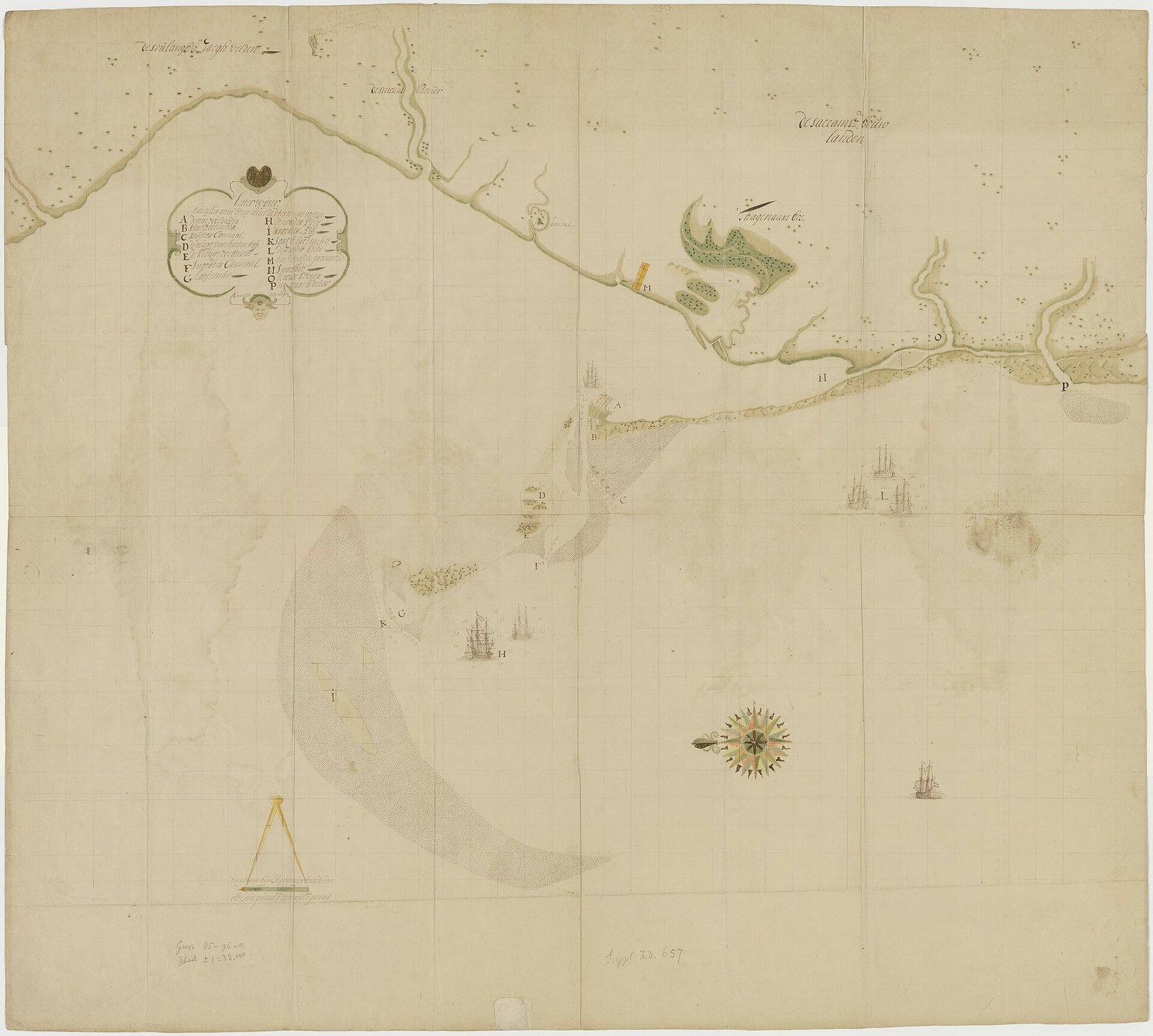
- The renaming of the Dutch-era 「鹿耳門村/鹿耳門小村」 ("Luermen Village / Luermen Hamlet") account: Based on the letter G on the 1629 map of Tayouan (大員) and the 1652 Chinese translation of the Anping (安平) map R002Source108 年度「台江文化保存及創新應用(3/3)-台江地名書寫計畫暨史普知識推廣」成果報告 [Final Report, 2019 (ROC year 108): Taijiang Cultural Preservation and Innovative Application (3/3): Taijiang Place-Name Writing Project and Popular History Outreach], commissioned by 臺江國家公園管理處 [Taijiang National Park Headquarters], 國立高雄師範大學 [National Kaohsiung Normal University] (principal investigator Liu Cheng-yuan (劉正元)), December 2019 (ROC year 108); printed pages 72, 73, 164, 165-166, Appendix 5, Appendix 6Original URLhttps://www.tjnp.gov.tw/Retrieved2026-10-19Snapshot timestamp—Commissioned research report; the cover states that the contents reflect the authors' personal views and not those of the commissioning agency..
- The Zheng-period gun battery account: Holds that the name comes from a gun battery built here during the Zheng period (1661–1683) R003Source《台江地區無形文化資產暨文獻資料蒐集計畫成果報告書》 [Final Report of the Project to Collect Intangible Cultural Heritage and Documentary Materials of the Taijiang Area], commissioned by 臺江國家公園管理處 [Taijiang National Park Headquarters], 2020; printed pages 53, 517Original URLhttps://www.tjnp.gov.tw/Retrieved2026-10-19Snapshot timestamp—The Zheng-period gun battery account on page 517 comes from the review committee's comments section, not from the body of the report, and is the least reliable.. Unverified
Another account appears on page 49 of Abe Meiji's (安倍明義) 1929 Taiwan Chimei Kenkyū (臺灣地名研究, Studies of Taiwanese Place Names): "土城是用土圍起來的防蕃設備" ("a tucheng is a defensive installation against the aborigines, enclosed with earth") R002Source108 年度「台江文化保存及創新應用(3/3)-台江地名書寫計畫暨史普知識推廣」成果報告 [Final Report, 2019 (ROC year 108): Taijiang Cultural Preservation and Innovative Application (3/3): Taijiang Place-Name Writing Project and Popular History Outreach], commissioned by 臺江國家公園管理處 [Taijiang National Park Headquarters], 國立高雄師範大學 [National Kaohsiung Normal University] (principal investigator Liu Cheng-yuan (劉正元)), December 2019 (ROC year 108); printed pages 72, 73, 164, 165-166, Appendix 5, Appendix 6Original URLhttps://www.tjnp.gov.tw/Retrieved2026-10-19Snapshot timestamp—Commissioned research report; the cover states that the contents reflect the authors' personal views and not those of the commissioning agency.. Secondhand account Unverified
Three scales of "Tuchengzi"
First items: The narrowest sense: The site of the ear…"Tuchengzi Village" (土城仔莊) at the ōaza (…The broadest sense: The Eleven Jiaotou (…MoreLess
- The narrowest sense: The site of the earthen rampart, originally called Tuchengliao or Tuchengjiao (土城角), established after Daoguang 3 (1823).
- "Tuchengzi Village" (土城仔莊) at the ōaza (大字, large administrative unit) level: Comprising Zhengziliao (鄭仔寮), Tuchengzi Jiaotou (土城仔角), Guoyinliao (郭吟寮), Zhongzhoujiao (中州角), Huweiliao (虎尾寮) and Keliaojiao (蚵寮角), plus Gangzixi (港仔西) west of Xifazi Harbor (溪筏仔港).
- The broadest sense: The Eleven Jiaotou (十一角頭) of the ritual sphere of the Orthodox Luermen Shengmu Temple, covering seven villages (li): Chengdong (城東), Chengnan (城南), Chengxi (城西), Chengbei (城北), Chengzhong (城中), Qingcao (青草) and Shalun (砂崙) R002Source108 年度「台江文化保存及創新應用(3/3)-台江地名書寫計畫暨史普知識推廣」成果報告 [Final Report, 2019 (ROC year 108): Taijiang Cultural Preservation and Innovative Application (3/3): Taijiang Place-Name Writing Project and Popular History Outreach], commissioned by 臺江國家公園管理處 [Taijiang National Park Headquarters], 國立高雄師範大學 [National Kaohsiung Normal University] (principal investigator Liu Cheng-yuan (劉正元)), December 2019 (ROC year 108); printed pages 72, 73, 164, 165-166, Appendix 5, Appendix 6Original URLhttps://www.tjnp.gov.tw/Retrieved2026-10-19Snapshot timestamp—Commissioned research report; the cover states that the contents reflect the authors' personal views and not those of the commissioning agency.. Official record
As for where the suffix -zi (仔) comes from, page 73 of the Place-Name Trilogy (3/3) judges that it "應為入墾者對此地親切稱呼" ("was probably an affectionate name given to the place by the settlers"); Appendix 6 of the same report gives the Ministry of Education's Tâi-lô romanization: Tuchengzi Thôo-siânn-á R002Source108 年度「台江文化保存及創新應用(3/3)-台江地名書寫計畫暨史普知識推廣」成果報告 [Final Report, 2019 (ROC year 108): Taijiang Cultural Preservation and Innovative Application (3/3): Taijiang Place-Name Writing Project and Popular History Outreach], commissioned by 臺江國家公園管理處 [Taijiang National Park Headquarters], 國立高雄師範大學 [National Kaohsiung Normal University] (principal investigator Liu Cheng-yuan (劉正元)), December 2019 (ROC year 108); printed pages 72, 73, 164, 165-166, Appendix 5, Appendix 6Original URLhttps://www.tjnp.gov.tw/Retrieved2026-10-19Snapshot timestamp—Commissioned research report; the cover states that the contents reflect the authors' personal views and not those of the commissioning agency.. Household records of 1897: Tuchengzi had 55 households and 371 people, and Zhengziliao 19 households and 119 people (Tsuchiya Shigeo (土屋重雄) 1897:315, as cited in the Trilogy) R002Source108 年度「台江文化保存及創新應用(3/3)-台江地名書寫計畫暨史普知識推廣」成果報告 [Final Report, 2019 (ROC year 108): Taijiang Cultural Preservation and Innovative Application (3/3): Taijiang Place-Name Writing Project and Popular History Outreach], commissioned by 臺江國家公園管理處 [Taijiang National Park Headquarters], 國立高雄師範大學 [National Kaohsiung Normal University] (principal investigator Liu Cheng-yuan (劉正元)), December 2019 (ROC year 108); printed pages 72, 73, 164, 165-166, Appendix 5, Appendix 6Original URLhttps://www.tjnp.gov.tw/Retrieved2026-10-19Snapshot timestamp—Commissioned research report; the cover states that the contents reflect the authors' personal views and not those of the commissioning agency.. Official record Secondhand account
The place names Gangzixi and Qingcaolun
First items: Gangzixi: a name not found on the mapsQingcaolun: explanations of year-round green and blowing sandMoreLess
Gangzixi: a name not found on the maps
Among the 12 old maps included in the Place-Name Trilogy, Tuchengzi (written 土城仔/土成仔/土城子) appears on 4, Qingcaolun (青草崙) on 5, Shifenwen (十份塭/十分塭) on 5, and Zhengziliao (鄭仔寮/鄭子寮) on 3, while Gangzixi does not appear on a single one R004SourceThis site's extraction and one-by-one visual check of old maps (12 old-map plates extracted from the Place-Name Trilogy (地名三部曲) with pdftoppm -png -r 300, checking whether the five place names Tuchengzi, Qingcaolun, Shifenwen, Zhengziliao and Gangzixi appear)Original URL—Retrieved2026-10-19Snapshot timestamp—These are the report team's reproduction photographs of the original copies; the originals are held by the 國立臺灣圖書館 [National Taiwan Library] and other institutions.. The only map that marks Gangzixi is the modern 「圖 4-3 城西里地名」 ("Figure 4-3: Place Names of Chengxi Village") drawn by the report itself; the "Gangziliao" (港仔寮) on the 1901 map is a different place name R004SourceThis site's extraction and one-by-one visual check of old maps (12 old-map plates extracted from the Place-Name Trilogy (地名三部曲) with pdftoppm -png -r 300, checking whether the five place names Tuchengzi, Qingcaolun, Shifenwen, Zhengziliao and Gangzixi appear)Original URL—Retrieved2026-10-19Snapshot timestamp—These are the report team's reproduction photographs of the original copies; the originals are held by the 國立臺灣圖書館 [National Taiwan Library] and other institutions.. Official record
The 〈城西里〉 [Chengxi Village] page of the Annan District Office, Tainan City (臺南市安南區公所) states explicitly that Chengxi Village (城西里) is "俗稱港仔西" ("commonly called Gangzixi"), making it the popular name currently recognized by the authorities R005Source臺南市安南區公所 [Annan District Office, Tainan City] official website, 〈城西里〉 [Chengxi Village], explanation of the village name and its administrative history (posted 2024-05-30 (ROC 113-05-30))Original URLhttps://www.tainan.gov.tw/annan/Retrieved2026-10-23Snapshot timestamp—Village-history pages of the district office, all posted 2024-05-30 (ROC 113-05-30); the histories of the five villages of Tucheng use the same boilerplate text, which does not mean the five villages were established at the same time.. Official record
Qingcaolun: explanations of year-round green and blowing sand
Qingcaolun was formerly called Xibeiliao (西北寮). The first account of the name's origin is that "由土城子觀之,即見西北有一砂崙,終年青翠" ("seen from Tuchengzi, one sees to the northwest a sand ridge, green all year round") R002Source108 年度「台江文化保存及創新應用(3/3)-台江地名書寫計畫暨史普知識推廣」成果報告 [Final Report, 2019 (ROC year 108): Taijiang Cultural Preservation and Innovative Application (3/3): Taijiang Place-Name Writing Project and Popular History Outreach], commissioned by 臺江國家公園管理處 [Taijiang National Park Headquarters], 國立高雄師範大學 [National Kaohsiung Normal University] (principal investigator Liu Cheng-yuan (劉正元)), December 2019 (ROC year 108); printed pages 72, 73, 164, 165-166, Appendix 5, Appendix 6Original URLhttps://www.tjnp.gov.tw/Retrieved2026-10-19Snapshot timestamp—Commissioned research report; the cover states that the contents reflect the authors' personal views and not those of the commissioning agency.; the second is that the sand dune was covered with beach morning glory (白馬麻藤草, 白馬鞍藤) that stayed green all year round, hence the name, and that three wells dug on the dune were called "Sancaizi" (三才仔) R003Source《台江地區無形文化資產暨文獻資料蒐集計畫成果報告書》 [Final Report of the Project to Collect Intangible Cultural Heritage and Documentary Materials of the Taijiang Area], commissioned by 臺江國家公園管理處 [Taijiang National Park Headquarters], 2020; printed pages 53, 517Original URLhttps://www.tjnp.gov.tw/Retrieved2026-10-19Snapshot timestamp—The Zheng-period gun battery account on page 517 comes from the review committee's comments section, not from the body of the report, and is the least reliable.. Official record
The same line of explanation preserves a legend: the "red-haired barbarians" (紅毛番, i.e. the Dutch) stole the beach morning glory, and two great pythons (mountain gods) left as a result; "此後飛砂遍佈" ("after that, blowing sand spread everywhere"), and the place name "Baimamatengcaolun" (白馬麻藤草崙, "beach morning glory dune") survives locally R003Source《台江地區無形文化資產暨文獻資料蒐集計畫成果報告書》 [Final Report of the Project to Collect Intangible Cultural Heritage and Documentary Materials of the Taijiang Area], commissioned by 臺江國家公園管理處 [Taijiang National Park Headquarters], 2020; printed pages 53, 517Original URLhttps://www.tjnp.gov.tw/Retrieved2026-10-19Snapshot timestamp—The Zheng-period gun battery account on page 517 comes from the review committee's comments section, not from the body of the report, and is the least reliable.. This is the local explanation for the blowing sand of Chengxi and Qingcaolun, and thus for the existence of the protection forest R003Source《台江地區無形文化資產暨文獻資料蒐集計畫成果報告書》 [Final Report of the Project to Collect Intangible Cultural Heritage and Documentary Materials of the Taijiang Area], commissioned by 臺江國家公園管理處 [Taijiang National Park Headquarters], 2020; printed pages 53, 517Original URLhttps://www.tjnp.gov.tw/Retrieved2026-10-19Snapshot timestamp—The Zheng-period gun battery account on page 517 comes from the review committee's comments section, not from the body of the report, and is the least reliable.. Secondhand account
Differing accounts
- Origin of the place name: Four accounts coexist: the earthen-rampart armed-feud account, the Dutch earthen fort account, the renamed Luermen Village account, and the Zheng-period gun battery account R002Source108 年度「台江文化保存及創新應用(3/3)-台江地名書寫計畫暨史普知識推廣」成果報告 [Final Report, 2019 (ROC year 108): Taijiang Cultural Preservation and Innovative Application (3/3): Taijiang Place-Name Writing Project and Popular History Outreach], commissioned by 臺江國家公園管理處 [Taijiang National Park Headquarters], 國立高雄師範大學 [National Kaohsiung Normal University] (principal investigator Liu Cheng-yuan (劉正元)), December 2019 (ROC year 108); printed pages 72, 73, 164, 165-166, Appendix 5, Appendix 6Original URLhttps://www.tjnp.gov.tw/Retrieved2026-10-19Snapshot timestamp—Commissioned research report; the cover states that the contents reflect the authors' personal views and not those of the commissioning agency.R003Source《台江地區無形文化資產暨文獻資料蒐集計畫成果報告書》 [Final Report of the Project to Collect Intangible Cultural Heritage and Documentary Materials of the Taijiang Area], commissioned by 臺江國家公園管理處 [Taijiang National Park Headquarters], 2020; printed pages 53, 517Original URLhttps://www.tjnp.gov.tw/Retrieved2026-10-19Snapshot timestamp—The Zheng-period gun battery account on page 517 comes from the review committee's comments section, not from the body of the report, and is the least reliable.. Unverified
- Starting point of the 1823 course change: One account says Sucuojia; another says Jianliao (菅寮) (the Annan District Office version) R001SourceCompiled by this site's editors: historical timeline, compiled from the framework of Lu Chia-hsing (盧嘉興), 〈鹿耳門地理演變考〉 [A Study of the Geographical Evolution of Luermen], and the administrative history published by the 安南區公所 [Annan District Office]Original URLhttps://www.tainan.gov.tw/annan/Retrieved2026-10-18Snapshot timestamp—Compiled by this site; for the original source (Lu Chia-hsing's original table), see R004 on page 1.3. There are two accounts of where the 1823 course change began: Sucuojia (蘇厝甲) and Jianliao (菅寮).. Unverified
Behind this door is the internal site, with profiles of people and local comments. The internal site is deployed separately.