What it is
Tuchengzi (土城仔) is not a single village but a set of jiaotou (角頭, neighborhood units); and the difference between the two ways of counting, 「十角」 ("ten jiaotou") and 「十一角」 ("eleven jiaotou"), is Xiashifenwen (下什份塭), the last of them to form. R002SourceChou Tsung-yang (周宗楊) and Wu Ming-hsun (吳明勳), 《鹿耳門聖母廟土城仔香》 [Luermen Shengmu Temple Tuchengzi Xiang], 臺南市政府文化局 [Cultural Affairs Bureau, Tainan City Government], 2016, p. 23 (as cited in the Taijiang National Park Headquarters commissioned report and the Place-Name Trilogy)Original URL—Retrieved2026-10-19Snapshot timestamp—Cited secondhand; the page numbers of the original book and of the citing reports are both given.
How the number of jiaotou took shape
Page 23 of Luermen Shengmu Temple Tuchengzi Xiang (鹿耳門聖母廟土城仔香) states: "聚落內始分角頭,再加上港仔西、溪埔仔與下什份塭形成現在的 11 角頭" ("the settlement first divided into jiaotou, and then, with the addition of Gangzixi, Xipuzi and Xiashifenwen, formed today's eleven jiaotou") R002SourceChou Tsung-yang (周宗楊) and Wu Ming-hsun (吳明勳), 《鹿耳門聖母廟土城仔香》 [Luermen Shengmu Temple Tuchengzi Xiang], 臺南市政府文化局 [Cultural Affairs Bureau, Tainan City Government], 2016, p. 23 (as cited in the Taijiang National Park Headquarters commissioned report and the Place-Name Trilogy)Original URL—Retrieved2026-10-19Snapshot timestamp—Cited secondhand; the page numbers of the original book and of the citing reports are both given.. In other words, the core eight jiaotou (Zhongzhoujiao (中州角), Tuchengzi Jiaotou (土城仔角), Guocenliao (郭岑寮), Keliaojiao (蚵寮角), Huweiliao (虎尾寮), Zhengziliao (鄭仔寮), Shalunjiao (砂崙腳) and Qingcaolun (青草崙)), plus the three added later, make eleven R002SourceChou Tsung-yang (周宗楊) and Wu Ming-hsun (吳明勳), 《鹿耳門聖母廟土城仔香》 [Luermen Shengmu Temple Tuchengzi Xiang], 臺南市政府文化局 [Cultural Affairs Bureau, Tainan City Government], 2016, p. 23 (as cited in the Taijiang National Park Headquarters commissioned report and the Place-Name Trilogy)Original URL—Retrieved2026-10-19Snapshot timestamp—Cited secondhand; the page numbers of the original book and of the citing reports are both given.. Secondhand account
The list of ten jiaotou in the Gazetteer of Taiwanese Place Names (臺灣地名辭書) (Guofenliao (郭份寮), Zhongzhouliao (中洲寮), Tuchengzi Jiaotou, Kezijiao (蚵仔角), Huweiliao Jiaotou (虎尾寮角), Zhengziliao Jiaotou (鄭子寮角), Gangzixi Jiaotou (港仔西角), Shalunjiao (沙崙角), Qingcaolun Jiaotou (青草崙角) and Xipuzi (溪埔仔)) is missing exactly one jiaotou, Xiashifenwen, the last to form R002SourceChou Tsung-yang (周宗楊) and Wu Ming-hsun (吳明勳), 《鹿耳門聖母廟土城仔香》 [Luermen Shengmu Temple Tuchengzi Xiang], 臺南市政府文化局 [Cultural Affairs Bureau, Tainan City Government], 2016, p. 23 (as cited in the Taijiang National Park Headquarters commissioned report and the Place-Name Trilogy)Original URL—Retrieved2026-10-19Snapshot timestamp—Cited secondhand; the page numbers of the original book and of the citing reports are both given.. Ten jiaotou and eleven jiaotou are therefore not two mutually contradictory systems but two points in time of the same system R002SourceChou Tsung-yang (周宗楊) and Wu Ming-hsun (吳明勳), 《鹿耳門聖母廟土城仔香》 [Luermen Shengmu Temple Tuchengzi Xiang], 臺南市政府文化局 [Cultural Affairs Bureau, Tainan City Government], 2016, p. 23 (as cited in the Taijiang National Park Headquarters commissioned report and the Place-Name Trilogy)Original URL—Retrieved2026-10-19Snapshot timestamp—Cited secondhand; the page numbers of the original book and of the citing reports are both given.. Official record
The eleven jiaotou are not merely a popular account: all eleven are named on the "Sanzhao Xiangjiao Fuzhang" (三朝香醮福章, the blessing roll of the three-day incense jiao) of the jiao (醮, Taoist offering ritual) festival R001Source《台江地區無形文化資產暨文獻資料蒐集計畫成果報告書》 [Final Report of the Project to Collect Intangible Cultural Heritage and Documentary Materials of the Taijiang Area], commissioned by 臺江國家公園管理處 [Taijiang National Park Headquarters], 2020; printed pages 52, 56, 93-94, 112 note 100, 234, 259, 274, 425Original URLhttps://www.tjnp.gov.tw/Retrieved2026-10-19Snapshot timestamp—. Official record
Four jiaotou in the Upper Bao, seven in the Lower Bao
The 2020 report commissioned by the Taijiang National Park Headquarters (台江處) gives a complete list in two places, on page 52 and on page 234: the Upper Bao (頂堡, dingbao) consists of Xipuzi, Shalunjiao, Xiashifenwen (下十份塭) and Qingcaolun; the Lower Bao (下堡, xiabao) consists of Zhongzhoujiao (中洲角), Tuchengzi Jiaotou, Guocenliao, Keliao (蚵寮), Huweiliao, Zhengziliao and Gangzixi (港仔西) R001Source《台江地區無形文化資產暨文獻資料蒐集計畫成果報告書》 [Final Report of the Project to Collect Intangible Cultural Heritage and Documentary Materials of the Taijiang Area], commissioned by 臺江國家公園管理處 [Taijiang National Park Headquarters], 2020; printed pages 52, 56, 93-94, 112 note 100, 234, 259, 274, 425Original URLhttps://www.tjnp.gov.tw/Retrieved2026-10-19Snapshot timestamp—. Official record
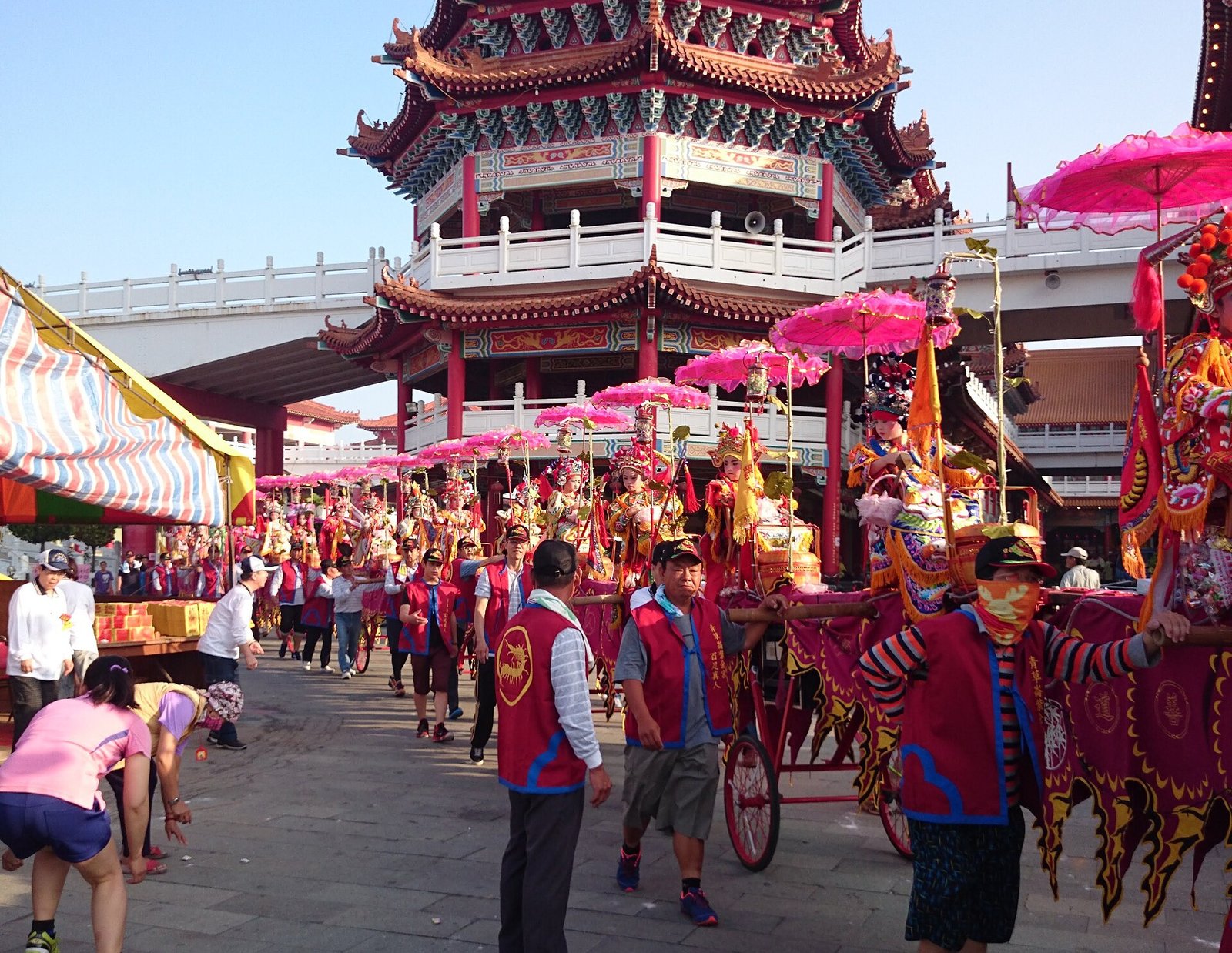
The jiaotou temples of the eleven jiaotou
First items: Tuchengjiao (土城角): No temple; uses the l…Zhongzhoujiao: Baozhou Temple (保洲宮) (Bao…Keliaojiao: Uses the luzhu system, worsh…MoreLess
The temples of the eleven jiaotou are as follows R001Source《台江地區無形文化資產暨文獻資料蒐集計畫成果報告書》 [Final Report of the Project to Collect Intangible Cultural Heritage and Documentary Materials of the Taijiang Area], commissioned by 臺江國家公園管理處 [Taijiang National Park Headquarters], 2020; printed pages 52, 56, 93-94, 112 note 100, 234, 259, 274, 425Original URLhttps://www.tjnp.gov.tw/Retrieved2026-10-19Snapshot timestamp—R003Source內政部全國宗教資訊網 [Ministry of the Interior, National Religion Information Network] temple registration search (Annan District, Tainan City; RT = temple) + 中研院 CRGIS [Academia Sinica CRGIS] temple register (2011 fieldwork, retrieved via the Wayback Machine)Original URLhttps://religion.moi.gov.tw/Religion/FoundationTemple?ci=1Retrieved2026-10-18Snapshot timestamp—Academia Sinica CRGIS fieldwork data, retrieved from a web archive; the Ministry of the Interior's temple registration roster is incomplete.. Official record
- Tuchengjiao (土城角): No temple; uses the luzhu (爐主, incense-burner master) system.
- Zhongzhoujiao: Baozhou Temple (保洲宮) (Baosheng Dadi (保生大帝), brought by the Chen family of Xuejia Zhongzhou (學甲中洲)).
- Keliaojiao: Uses the luzhu system, worshiping Lord Li (Lifu Qiansui) (李府千歲), Guanyin (觀音佛祖) and Huye (虎爺, Tiger Lord) in rotation.
- Guocenliao: Shengmu Temple (聖母宮) (built in 2018, worshiping Tianshang Shengmu (天上聖母, Holy Mother in Heaven) and the Wufu Qiansui (五府千歲, Lords of the Five Palaces)).
- Zhengziliao: No temple, but it has a physical Northern Camp (北營, beiying).
- Huweiliao: Wusheng Temple (伍聖宮).
- Gangzixi: Chongsheng Temple (崇聖宮).
- Qingcaolun: Zijin Temple (紫金宮).
- Xipuzi: Fusheng Temple (福聖宮).
- Shalunjiao: Qingsheng Temple (清聖宮).
- Xiashifenwen: Sheng'an Temple (聖安宮).
The Xipuzi Fusheng Temple (溪埔仔福聖宮) and the Shalunjiao Qingsheng Temple (砂崙腳清聖宮) both appear on the list of temples that took part in the 2009 qingshui (請水, inviting water) procession of the royal boat (王船, wangchuan) of the Jindefeng Zhengwang Temple (金德豐正王府) in Qigu (七股) R001Source《台江地區無形文化資產暨文獻資料蒐集計畫成果報告書》 [Final Report of the Project to Collect Intangible Cultural Heritage and Documentary Materials of the Taijiang Area], commissioned by 臺江國家公園管理處 [Taijiang National Park Headquarters], 2020; printed pages 52, 56, 93-94, 112 note 100, 234, 259, 274, 425Original URLhttps://www.tjnp.gov.tw/Retrieved2026-10-19Snapshot timestamp—. Official record
The Huweiliao Wusheng Temple (虎尾寮伍聖宮) principally worships Wu (吳) Fu Qiansui (伍(吳)府千歲, Lord Wu), whose birthday falls on the 26th day of the 4th lunar month. The local explanation for why the village moved is "流水好=魚獲豐富" ("good flowing water = plentiful catches"). The deity was originally worshiped in rotation under the luzhu system, then moved to the Chengnan Village (城南里) community activity center, after which the worshipers resolved to build a temple R001Source《台江地區無形文化資產暨文獻資料蒐集計畫成果報告書》 [Final Report of the Project to Collect Intangible Cultural Heritage and Documentary Materials of the Taijiang Area], commissioned by 臺江國家公園管理處 [Taijiang National Park Headquarters], 2020; printed pages 52, 56, 93-94, 112 note 100, 234, 259, 274, 425Original URLhttps://www.tjnp.gov.tw/Retrieved2026-10-19Snapshot timestamp—. Secondhand account
Boundaries of jiaotou and procession territories
First items: Boundaries between jiaotouThe boundary between the Tucheng and Xigang procession territoriesMoreLess
Boundaries between jiaotou
Several boundaries between jiaotou can be drawn R001Source《台江地區無形文化資產暨文獻資料蒐集計畫成果報告書》 [Final Report of the Project to Collect Intangible Cultural Heritage and Documentary Materials of the Taijiang Area], commissioned by 臺江國家公園管理處 [Taijiang National Park Headquarters], 2020; printed pages 52, 56, 93-94, 112 note 100, 234, 259, 274, 425Original URLhttps://www.tjnp.gov.tw/Retrieved2026-10-19Snapshot timestamp—:
- Tuchengjiao and Zhongzhoujiao are divided by Lane 172 of Chengbei Road (城北路). The location of the Zhongzhoujiao Huye Pagoda (虎爺寶塔) is recorded two ways: official reports place it on Lane 172 of Chengbei Road, while Google Street View (May 2025) and a local resident's own observation place it beside the street sign at the mouth of Lane 234 of Chengbei Road Local oral account.
- Guocenliao and Keliaojiao are divided by Section 6 of Anzhong Road (安中路).
- Keliaojiao and Huweiliao are divided by Lane 61 of Qingsha Street (青砂街).
Huweiliao covers 1.21 square kilometers, bounded by Keziliao (蚵仔寮) to the east, the Tucheng Drainage Canal (土城大排) to the west, Anqing Road (安清路) to the south, and the old Taisugar (台糖) narrow-gauge railway to the north. Chengxi Village (城西里) begins at the Zhufagang Bridge (竹筏港橋) to the east and the Zengwen River (曾文溪) embankment to the north, and extends to the Luermen River (鹿耳門溪) to the south and the Taiwan Strait to the west R001Source《台江地區無形文化資產暨文獻資料蒐集計畫成果報告書》 [Final Report of the Project to Collect Intangible Cultural Heritage and Documentary Materials of the Taijiang Area], commissioned by 臺江國家公園管理處 [Taijiang National Park Headquarters], 2020; printed pages 52, 56, 93-94, 112 note 100, 234, 259, 274, 425Original URLhttps://www.tjnp.gov.tw/Retrieved2026-10-19Snapshot timestamp—. Official record
The reception of the Five Lords (五王) into the lodges (入館, ruguan) for the zhuguan (駐館, stationing the deity's lodge) also follows a fixed allocation: Huweiliao receives Lord Chi (池王), Guocenliao receives Lord Wu (吳王), and Keliao receives Lord Fan (范王); Shalunjiao, which built its own temple, does not have this custom R001Source《台江地區無形文化資產暨文獻資料蒐集計畫成果報告書》 [Final Report of the Project to Collect Intangible Cultural Heritage and Documentary Materials of the Taijiang Area], commissioned by 臺江國家公園管理處 [Taijiang National Park Headquarters], 2020; printed pages 52, 56, 93-94, 112 note 100, 234, 259, 274, 425Original URLhttps://www.tjnp.gov.tw/Retrieved2026-10-19Snapshot timestamp—. Official record
The boundary between the Tucheng and Xigang procession territories
Annan District (安南區) has to be seen as divided between two xiangjing (香境, procession territories). The eleven jiaotou of Tuchengzi belong to the Tucheng procession territory, while ten other settlements in Annan District belong to the Xigang procession territory. Official records name six villages explicitly (the Gongwenzi Wan'an Temple (公塭仔萬安宮), the Gongqinliao Qingshui Temple (公親寮清水寺), the Xinanliao Xing'an Temple (溪南寮興安宮), the Benyuanliao Chaoxing Temple (本淵寮朝興宮), the Luermen Tianhou Temple (鹿耳門天后宮) at Mazugong (媽祖宮), and the Shifenwen Qing'an Temple (什份塭清安宮)); the two lists do not overlap at all R001Source《台江地區無形文化資產暨文獻資料蒐集計畫成果報告書》 [Final Report of the Project to Collect Intangible Cultural Heritage and Documentary Materials of the Taijiang Area], commissioned by 臺江國家公園管理處 [Taijiang National Park Headquarters], 2020; printed pages 52, 56, 93-94, 112 note 100, 234, 259, 274, 425Original URLhttps://www.tjnp.gov.tw/Retrieved2026-10-19Snapshot timestamp—. Official record
Shifenwen (什份塭) is the exception on this boundary: in 1965 it withdrew from the joint palanquins and joint troupes (合轎合陣, hejiao hezhen) of the Xigang Incense Procession (西港香), yet the Waidutou Song Jiang Troupe (外渡頭宋江陣) must come to receive the incense both on the day the Xigang Incense Procession invites Mazu and during the Tuchengzi Incense Procession (土城仔香) R001Source《台江地區無形文化資產暨文獻資料蒐集計畫成果報告書》 [Final Report of the Project to Collect Intangible Cultural Heritage and Documentary Materials of the Taijiang Area], commissioned by 臺江國家公園管理處 [Taijiang National Park Headquarters], 2020; printed pages 52, 56, 93-94, 112 note 100, 234, 259, 274, 425Original URLhttps://www.tjnp.gov.tw/Retrieved2026-10-19Snapshot timestamp—. Official record
The Qing'an Temple (清安宮) and the Sheng'an Temple are two different temples. The Qing'an Temple (清安宮) at Lane 871, Chengbei Road, Shalun Village (砂崙里) (worshiping Leifu Dajiang (雷府大將, Generals of the Thunder Bureau)) is the "Dingshifenwen Qing'an Temple (清安宮)" (頂什份塭清安宮) and takes part in the Xigangzi Incense Procession (西港仔香); the Xiashifenwen Sheng'an Temple (下十份塭聖安宮) (worshiping Marshal Xie (謝府元帥)) belongs to the Tucheng procession territory. The two belong to different xiangke (香科, multi-day incense procession festival) systems R001Source《台江地區無形文化資產暨文獻資料蒐集計畫成果報告書》 [Final Report of the Project to Collect Intangible Cultural Heritage and Documentary Materials of the Taijiang Area], commissioned by 臺江國家公園管理處 [Taijiang National Park Headquarters], 2020; printed pages 52, 56, 93-94, 112 note 100, 234, 259, 274, 425Original URLhttps://www.tjnp.gov.tw/Retrieved2026-10-19Snapshot timestamp—R003Source內政部全國宗教資訊網 [Ministry of the Interior, National Religion Information Network] temple registration search (Annan District, Tainan City; RT = temple) + 中研院 CRGIS [Academia Sinica CRGIS] temple register (2011 fieldwork, retrieved via the Wayback Machine)Original URLhttps://religion.moi.gov.tw/Religion/FoundationTemple?ci=1Retrieved2026-10-18Snapshot timestamp—Academia Sinica CRGIS fieldwork data, retrieved from a web archive; the Ministry of the Interior's temple registration roster is incomplete.. Official record
Differing accounts
- Number of jiaotou: The Gazetteer of Taiwanese Place Names gives ten; the Shengmu Temple's (聖母廟) official website and Chapter 4 of the report give eleven; Chapter 5 of another volume and the interview transcripts give twelve R004Source108 年度「台江文化保存及創新應用(3/3)-台江地名書寫計畫暨史普知識推廣」成果報告 [Final Report, 2019 (ROC year 108): Taijiang Cultural Preservation and Innovative Application (3/3): Taijiang Place-Name Writing Project and Popular History Outreach], commissioned by 臺江國家公園管理處 [Taijiang National Park Headquarters], 國立高雄師範大學 [National Kaohsiung Normal University], December 2019 (ROC year 108); printed pages 172, 264Original URLhttps://www.tjnp.gov.tw/Retrieved2026-10-20Snapshot timestamp—Printed page 264 is the minutes of the 2019-03-20 working meeting on the book's publication; the commissioning agency itself acknowledged that "土城角頭數目的祭祀圈範圍" ("the ritual-sphere extent of the number of Tucheng jiaotou") was wrong, yet the final text was not changed.. Unverified
- The jiaotou temple of Guocenliao: In 2017 fieldwork it was said to have 「沒有廟」 ("no temple"); the 2020 report says 「2018 年興建聖母宮」 ("the Shengmu Temple was built in 2018"); another popular source calls it the "Shengcen Temple" (聖岑宮) R001Source《台江地區無形文化資產暨文獻資料蒐集計畫成果報告書》 [Final Report of the Project to Collect Intangible Cultural Heritage and Documentary Materials of the Taijiang Area], commissioned by 臺江國家公園管理處 [Taijiang National Park Headquarters], 2020; printed pages 52, 56, 93-94, 112 note 100, 234, 259, 274, 425Original URLhttps://www.tjnp.gov.tw/Retrieved2026-10-19Snapshot timestamp—R003Source內政部全國宗教資訊網 [Ministry of the Interior, National Religion Information Network] temple registration search (Annan District, Tainan City; RT = temple) + 中研院 CRGIS [Academia Sinica CRGIS] temple register (2011 fieldwork, retrieved via the Wayback Machine)Original URLhttps://religion.moi.gov.tw/Religion/FoundationTemple?ci=1Retrieved2026-10-18Snapshot timestamp—Academia Sinica CRGIS fieldwork data, retrieved from a web archive; the Ministry of the Interior's temple registration roster is incomplete.. Unverified
- Which village the Fusheng Temple belongs to: Three versions exist, Shalun Village, Xuedong Village (學東里) (CRGIS) and Xipuzi, with the same street address R003Source內政部全國宗教資訊網 [Ministry of the Interior, National Religion Information Network] temple registration search (Annan District, Tainan City; RT = temple) + 中研院 CRGIS [Academia Sinica CRGIS] temple register (2011 fieldwork, retrieved via the Wayback Machine)Original URLhttps://religion.moi.gov.tw/Religion/FoundationTemple?ci=1Retrieved2026-10-18Snapshot timestamp—Academia Sinica CRGIS fieldwork data, retrieved from a web archive; the Ministry of the Interior's temple registration roster is incomplete.. Unverified
- Another way of breaking it down: Wu Mao-cheng's (吳茂成) Family Stories of the Villages of Taijiang (台江庄社家族故事) writes: "土城原有八角頭,加上砂崙腳、青草崙、十份塭、原位於溪北,十一處聚落只有三處稱寮" ("Tucheng originally had eight jiaotou; adding Shalunjiao, Qingcaolun and Shifenwen, originally located north of the river, of the eleven settlements only three are called liao") R005Source106 年度「台江文化保存及創新應用(1/3)-台江地區曾文溪以南古今地名源流暨古地圖調查」成果報告 [Final Report, 2017 (ROC year 106): Taijiang Cultural Preservation and Innovative Application (1/3): Survey of the Origins of Past and Present Place Names and of Old Maps in the Taijiang Area South of the Zengwen River], 國立高雄師範大學 [National Kaohsiung Normal University], December 2017 (ROC year 106); printed pages 229, 273 (citing Wu Mao-cheng (吳茂成), 《台江庄社家族故事》 [Family Stories of the Villages of Taijiang], 2003)Original URLhttps://www.tjnp.gov.tw/Retrieved2026-10-20Snapshot timestamp—Commissioned research report.. Secondhand account
Behind this door is the internal site, with profiles of people and local comments. The internal site is deployed separately.