Hall 1 of 9
Hall of OriginsWhere Tucheng Comes From and What It Refers To
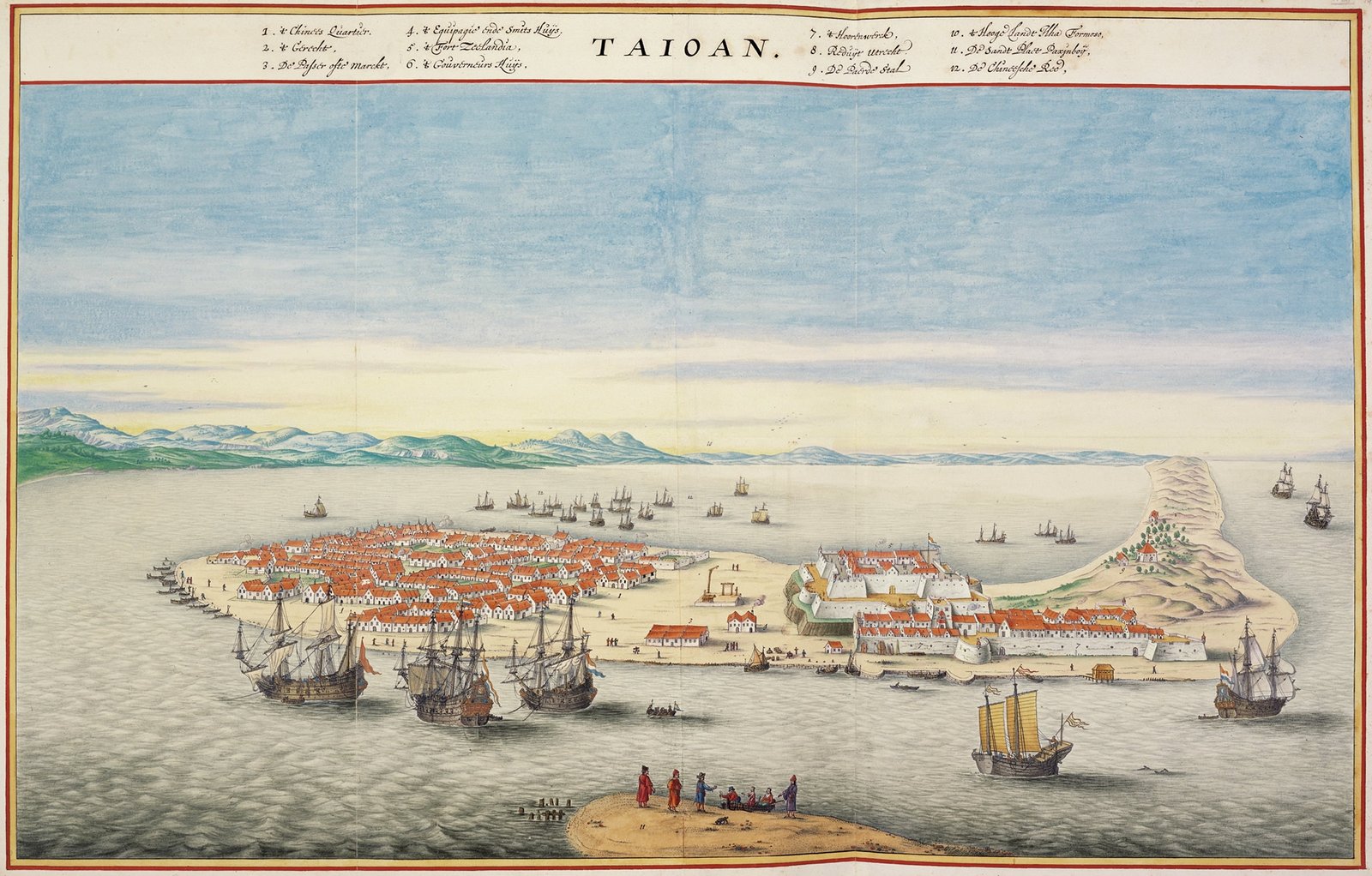
Joan Blaeu(Wikimedia Commons)・Public domain
Tuchengzi (土城仔) is not a single village but a cluster of jiaotou (角頭, neighborhood units): a piece of land that rose above the water only after 1823, divided into eleven jiaotou and today spread across ten villages.
What this hall is about
What local people call "Tuchengzi" (土城仔) is not any single village (li) on today's postal addresses. It is a piece of land that rose above the water only after the Zengwen River (曾文溪) changed course in 1823; internally it is divided into eleven jiaotou (角頭, neighborhood units), and today it spans ten villages.
This hall explains what "Tucheng" (土城) refers to: how the land formed, where the name came from, how the place is divided internally, and how it is drawn administratively. The other halls, on the incense procession, ecology, and current affairs, all take the scope set out here as their starting point. Its five subpages follow three threads:
Thread 1
How the land came to be and what it is called
From land formation and place names to the words left in poems and on steles.
- 1.1Place Names and Land FormationStart here533
The new land formed after 1823, the four accounts of the name "Tucheng," and the three layers of meaning of "Tuchengzi."
- 1.5Poems and Steles of Tucheng545
Poems on Luermen (鹿耳門) from the Qianlong era, and the steles and contracts scattered around Zhongzhoujiao (中洲角), Qingcaolun (青草崙), and Zhufagang (竹筏港).
- 1.1Place Names and Land FormationStart here533
- 1.2The Eleven Jiaotou and the Upper and Lower BaoStart here643
The difference between counting ten and eleven jiaotou, the lists of the four jiaotou of the Upper Bao (頂堡) and the seven of the Lower Bao (下堡), and the temple of each jiaotou.
- 1.2The Eleven Jiaotou and the Upper and Lower BaoStart here643
- 1.3Two Settlement SystemsStart here634
The Sixteen Liao of Taijiang (台江十六寮) and the Tuchengzi jiaotou as two parallel systems, and the three changes of jurisdiction in 1938, 1946, and 1947.
- 1.4Villages and Population632
Today's ten villages, their areas, the wording of their official histories, renamings and divisions, and population since 2005.
- 1.3Two Settlement SystemsStart here634
How things are marked
- Depending on context, "Tuchengzi" has three layers of meaning: the site of the earthen rampart, Tuchengzi Village (土城仔莊), and the Eleven Jiaotou; see 1.1 for details.
- Where there are differing accounts, such as the number of jiaotou or the origin of place names, all accounts are presented side by side with their sources
Sources used in this hall
Villages and old place names; official archives and the full text of the Gazetteer of Taiwanese Place Names (《臺灣地名辭書》); the history of 22 settlements, hamlet by hamlet, with population figures for 2005–2026; the Place-Name Trilogy and plates of old maps.