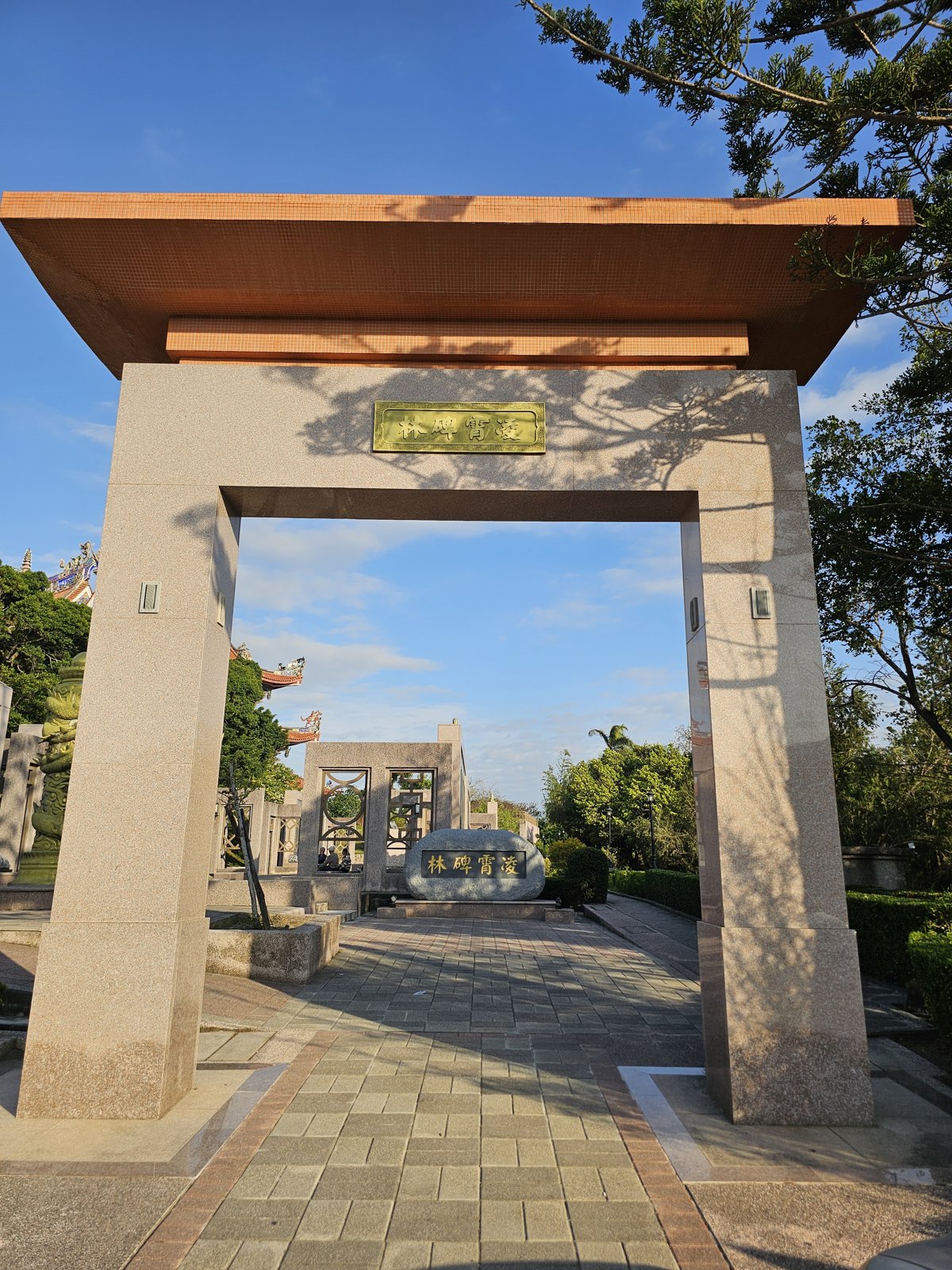
The Lingxiao Stele Forest of Nankunshen is a stele garden within the grounds of Nankunshen Daitian Temple, listed as facility no. 14 on the temple's guide map (R012). Its framed stone walls carry inscriptions on the Lingxiaobao Temple (2012), the renovation of the Wanshan Hall (2014), the restoration of the historic temple (2014), the Jiawu-cycle Luotian Grand Jiao, the Guihai southern tour to Kaohsiung, the Wuzi tour to Penghu, the tours of Tainan Prefectural City and Zhuluo (2015), and the alliance of Qingshan Temple with Mount Putuo and the division of incense to Thailand (2016); most were composed by Hung Kao-she of the Kunying Poetry Society of Tainan (R002–R011). There are also donor rolls of the Lingxiaobao Temple for donors across Taiwan, overseas donors and donors of building elements (R001).
The commemorative inscriptions here are the temple's own history in stone, set up for the major events of the past half century: the completion of the Lingxiaobao Temple, the renovation of the Wanshan Hall, the restoration of the historic temple, the Jiawu-cycle Luotian Grand Jiao, and several of the Kunshen Lords' famous tours each have a stele. Most of the texts were written by Hung Kao-she (洪高舌), general secretary of the Kunying Poetry Society of Tainan (臺南市鯤瀛詩社), and proofread by Wu Teng-shen (吳登神) of the Chinese Poets' Cultural Association. They are composed in an elegant classical style with parallel phrasing, yet they record events down to the double-hour, the sum of money and the winning contractor, so that they read like a construction and ritual log carved in stone R002Source〈南鯤鯓代天府凌霄寶殿碑記〉[Stele Record of the Lingxiaobao Temple of Nankunshen Daitian Temple], in the Lingxiao Stele Forest, set up in 2012 by the 11th Management Committee of Nankunshen Daitian Temple, composed by Wu Teng-shen (吳登神), chairman of the 中國詩人文化會 [Chinese Poets' Cultural Association]; photographed on site by the author on 2026-11-21Original URL—Retrieved2026-11-22Snapshot timestamp—Inscription set up by the temple itself (primary source).R004Source〈國定古蹟南鯤鯓代天府修復工程碑記〉[Stele Record of the Restoration of the National Monument Nankunshen Daitian Temple], in the Lingxiao Stele Forest, carved in 2014 by the 12th Management Committee of Nankunshen Daitian Temple, composed by Hung Kao-she (洪高舌), general secretary of the 臺南市鯤瀛詩社 [Kunying Poetry Society of Tainan], proofread by Wu Teng-shen; photographed on site by the author on 2026-11-21Original URL—Retrieved2026-11-22Snapshot timestamp—Inscription set up by the temple itself (primary source).R006Source〈南鯤鯓代天府代天巡狩池府千歲癸亥年南巡高雄市碑記〉[Stele Record of Lord Chi's Guihai-Year Southern Tour to Kaohsiung City], in the Lingxiao Stele Forest, carved in 2015 by the 12th Management Committee of Nankunshen Daitian Temple, composed by Hung Kao-she; photographed on site by the author on 2026-11-21Original URL—Retrieved2026-11-22Snapshot timestamp—Inscription set up by the temple itself (primary source)..
List of steles
First items: 〈南鯤鯓代天府凌霄寶殿碑記〉 (Stele Record of the Ling…〈國定古蹟南鯤鯓代天府修復工程碑記〉 (Stele Record of the …〈南鯤鯓代天府萬善堂、外部連絡走廊及龍泉井修建工程碑記〉 (Stele Reco…MoreLess
The steles are listed below in the order of the dates on their faces; titles follow the inscribed titles. Full transcriptions are in the local transcripts cited for each stele.
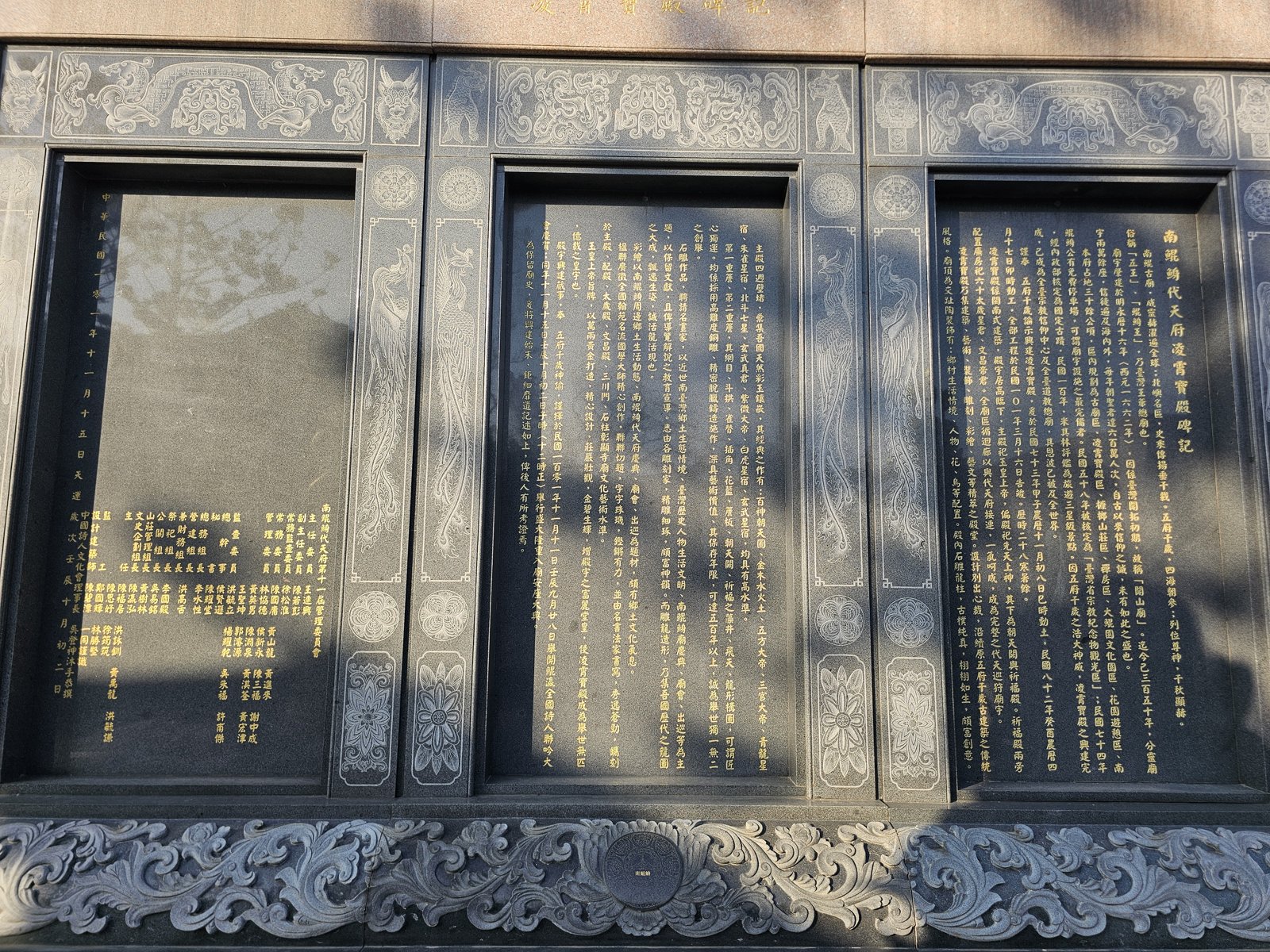
- 〈南鯤鯓代天府凌霄寶殿碑記〉 (Stele Record of the Lingxiaobao Temple of Nankunshen Daitian Temple) November 15, 2012 (early in the tenth lunar month of renchen), composed by Wu Teng-shen, chairman of the Chinese Poets' Cultural Association, and set up by the 11th Management Committee of Nankunshen Daitian Temple Account by an involved partyR002Source〈南鯤鯓代天府凌霄寶殿碑記〉[Stele Record of the Lingxiaobao Temple of Nankunshen Daitian Temple], in the Lingxiao Stele Forest, set up in 2012 by the 11th Management Committee of Nankunshen Daitian Temple, composed by Wu Teng-shen (吳登神), chairman of the 中國詩人文化會 [Chinese Poets' Cultural Association]; photographed on site by the author on 2026-11-21Original URL—Retrieved2026-11-22Snapshot timestamp—Inscription set up by the temple itself (primary source)..
- It records that the Lingxiaobao Temple was built at the instruction of the Five Royal Lords: ground was broken at the si hour on the eighth day of the eleventh lunar month of 1984, construction began at the mao hour on the seventeenth day of the fourth lunar month of 1993, and all work was completed on March 16, 2012, more than 28 years in all.
- The main hall enshrines the Jade Emperor and the side halls the primordial deities; below them are the Chaotian Gate and the Qifu (blessing) Hall, whose wings enshrine the Sixty Tai Sui Star Lords and Wenchang Dijun. The walls around the main hall are inlaid with natural colored jade in compositions such as "百神朝天圖" (the hundred gods paying court to Heaven), the eave elements are cast in bronze by the lost-wax process, and the Jade Emperor's decree tablet was "以萬兩黃金打造" ("made with ten thousand taels of gold").
- On November 11, 2012 a national poetry gathering of the Kunying society was held in celebration, and on November 15 (the second day of the tenth lunar month of renchen) the deities were installed at the zi hour.
- The stele says the temple grounds cover more than thirty hectares, divided into the historic temple area, the Lingxiaobao Temple area, the Kanglang Villa area, the meditation-room area, the Dakun Garden cultural park, the garden recreation area and a free public parking lot.
- At the end it lists the whole 11th Management Committee: chairman Wang Lien-hsing (王連興), general secretary Hou Hsien-hsun (侯賢遜), the committee members, supervisors, section heads, site supervisor Cheng Kuo-hui (鄭國輝) and architect Chen Pi-tan (陳碧潭).
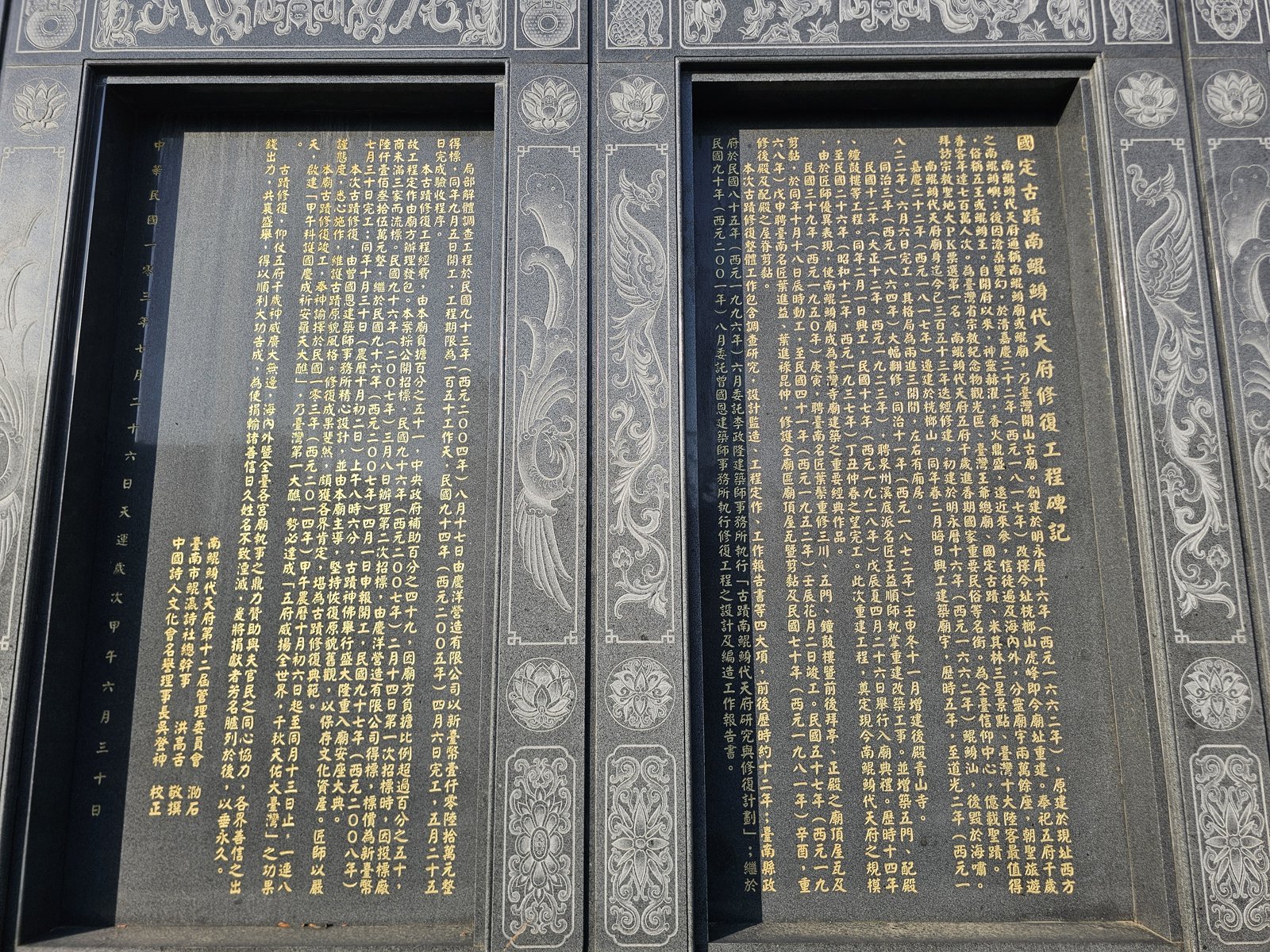
- 〈國定古蹟南鯤鯓代天府修復工程碑記〉 (Stele Record of the Restoration of the National Monument Nankunshen Daitian Temple) July 26, 2014 (the thirtieth day of the sixth lunar month of jiawu), carved by the 12th Management Committee, composed by Hung Kao-she and proofread by Wu Teng-shen Account by an involved partyR004Source〈國定古蹟南鯤鯓代天府修復工程碑記〉[Stele Record of the Restoration of the National Monument Nankunshen Daitian Temple], in the Lingxiao Stele Forest, carved in 2014 by the 12th Management Committee of Nankunshen Daitian Temple, composed by Hung Kao-she (洪高舌), general secretary of the 臺南市鯤瀛詩社 [Kunying Poetry Society of Tainan], proofread by Wu Teng-shen; photographed on site by the author on 2026-11-21Original URL—Retrieved2026-11-22Snapshot timestamp—Inscription set up by the temple itself (primary source)..
- It lists the successive building campaigns: first built in 1662 on Nankunshen islet; moved to Tiger Peak on Kanglang Hill in 1817 and completed on the sixth day of the sixth lunar month of 1822; extensively renovated in 1864; the rear hall, Qingshan Temple, added in 1872; rebuilt from 1923 by the Xidi-school master Wang Yi-shun (王益順), with the deities re-installed in 1928 and the work completed in 1937; roof tiles and cut-and-paste ceramics redone by Yeh Tsung (葉鬃) in 1950–1952; repairs by the brothers Yeh Chin-yi (葉進益) and Yeh Chin-lu (葉進祿) in 1968; and the ridges of the rear and side halls redone in 1981.
- The recent restoration took about 12 years: in 1996 Tainan County Government commissioned the Lee Cheng-lung Architects office to study the building, and in 2001 the Tseng Kuo-en Architects office to design the restoration; partial dismantling and investigation followed in 2004; in 2007 Ching Yang Construction won the contract at NT$61.35 million; the work was completed on July 30, 2008 and the deities were re-installed on October 30. The temple bore 51% of the cost and the central government 49%.
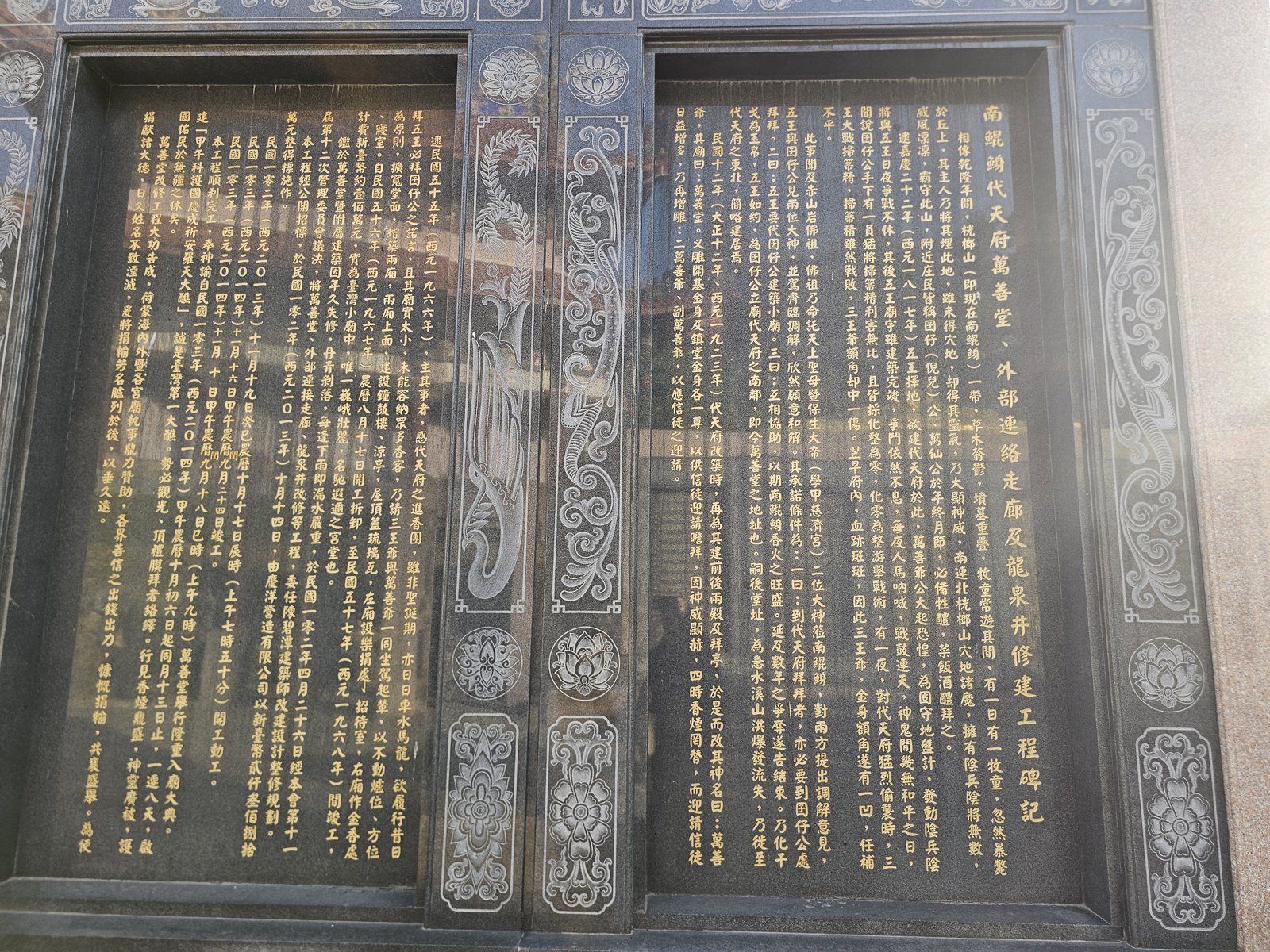
- 〈南鯤鯓代天府萬善堂、外部連絡走廊及龍泉井修建工程碑記〉 (Stele Record of the Renovation of the Wanshan Hall, the Outer Connecting Corridor and the Dragon Spring Well) after 2014 (the colophon lies outside the photo) Account by an involved partyR003Source〈南鯤鯓代天府萬善堂、外部連絡走廊及龍泉井修建工程碑記〉[Stele Record of the Renovation of the Wanshan Hall, the Outer Connecting Corridor and the Dragon Spring Well of Nankunshen Daitian Temple], in the Lingxiao Stele Forest, set up by Nankunshen Daitian Temple after 2014 (colophon outside the photo); photographed on site by the author on 2026-11-21Original URL—Retrieved2026-11-22Snapshot timestamp—Inscription set up by the temple itself (primary source)..
- The first half tells the legend of the land dispute between Gin-a-kong (囝仔公, the Child Lord, i.e. Wanshanye) of the Wanshan Hall and the Five Royal Lords, and how Buddha of Chishan Rock asked Mazu and Baosheng Dadi of Xuejia Tzu-chi Temple to mediate and settle three terms.
- The second half records that front and rear halls and a worship pavilion were built for the Wanshan Hall in 1923; that it was enlarged in 1966, with work from 1967 to 1968 costing about NT$1 million; and that in 2013 the 11th Management Committee resolved to renovate the Wanshan Hall, the outer connecting corridor and the Dragon Spring Well, designed by architect Chen Pi-tan, with Ching Yang Construction winning the contract at NT$23.8 million; the work was completed and the deities re-installed in November 2014.
- For the worship pavilion added to the Wanshan Hall in 1970, the custom of offering worship there after every festival, and Wanshanye's prosperity money, see Wanshan Hall of Nankunshen Daitian Temple.
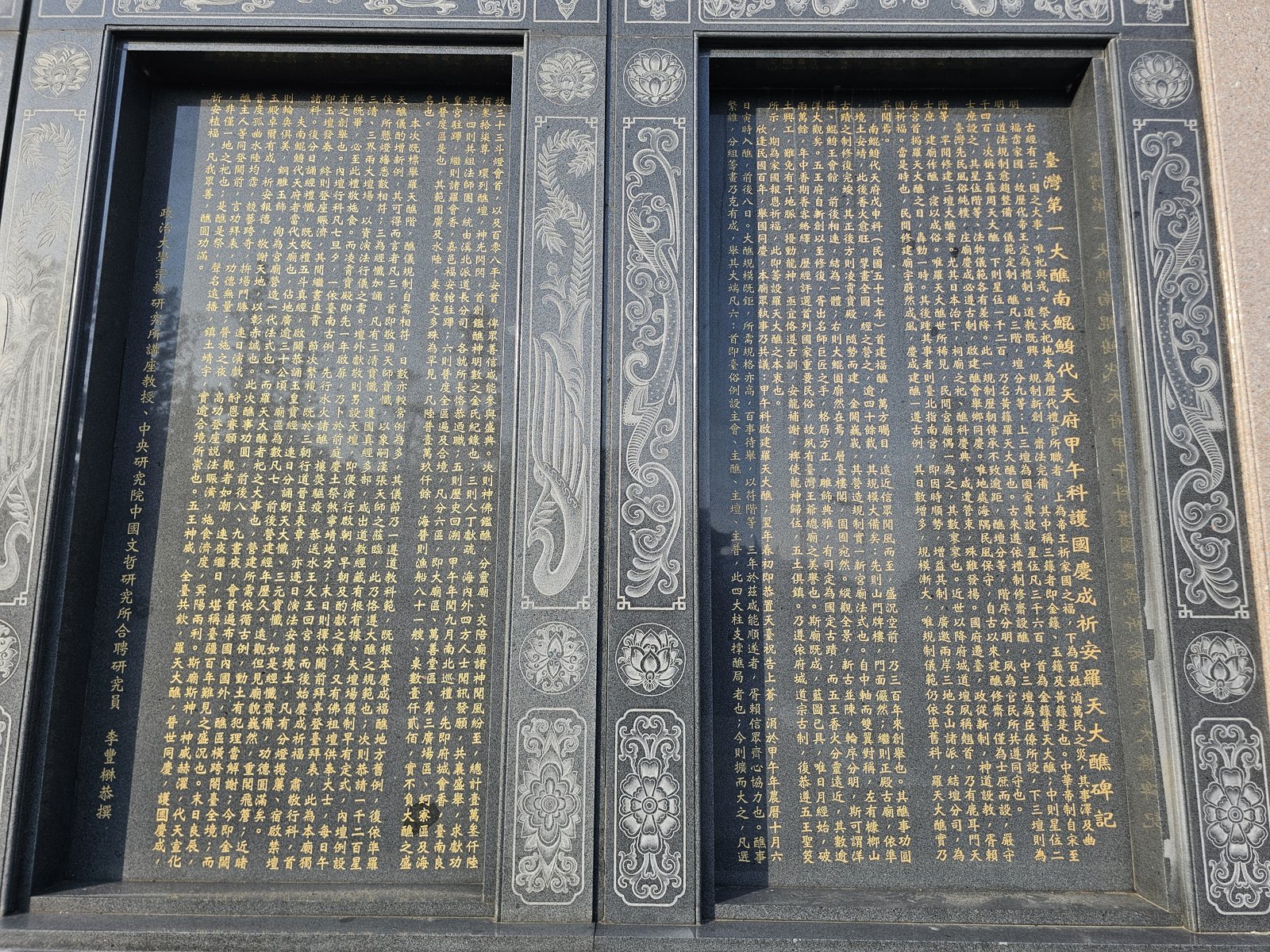
- 〈臺灣第一大醮南鯤鯓代天府甲午科護國慶成祈安羅天大醮碑記〉 (Stele Record of the Jiawu-Cycle Luotian Grand Jiao, Taiwan's Greatest Jiao) composed by Lee Fong-mao (李豐楙), chair professor at the Graduate Institute of Religious Studies, National Chengchi University, and joint research fellow at the Institute of Chinese Literature and Philosophy, Academia Sinica Account by an involved partyR005Source〈臺灣第一大醮南鯤鯓代天府甲午科護國慶成祈安羅天大醮碑記〉[Stele Record of the Jiawu-Cycle Luotian Grand Jiao of Nankunshen Daitian Temple, Taiwan's Greatest Jiao], in the Lingxiao Stele Forest, composed by Lee Fong-mao (李豐楙), chair professor at the Graduate Institute of Religious Studies, National Chengchi University (date outside the photo); photographed on site by the author on 2026-11-21Original URL—Retrieved2026-11-22Snapshot timestamp—Inscription set up by the temple itself (primary source).. It describes the classical system of "three grades and nine altars" for jiao rites, the wushen-cycle blessing jiao of 1968, and the preparations for the 2014 Jiawu Luotian Grand Jiao: 33 dipper-lamp chief donors and 108 peace donors, 13,637 deity images attending the jiao, Daoist priests of the Xibei (north-of-the-river) school, more than 19,000 tables of offerings for the land universal salvation and 81 fishing boats with 1,200 tables for the sea universal salvation.
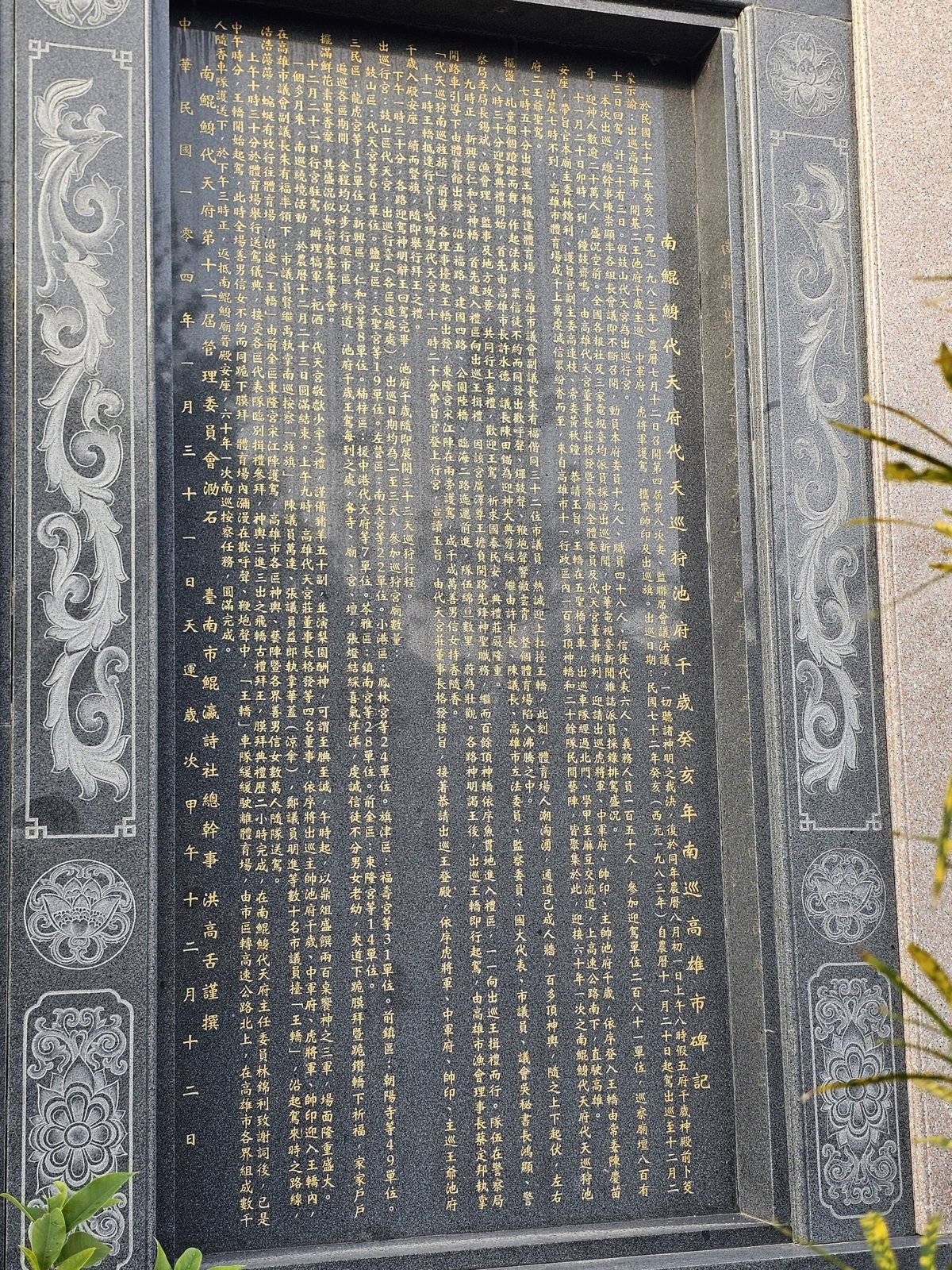
- 〈南鯤鯓代天府代天巡狩池府千歲癸亥年南巡高雄市碑記〉 (Stele Record of Lord Chi's Guihai-Year Southern Tour to Kaohsiung City) January 31, 2015 (the twelfth day of the twelfth lunar month of jiawu), carved by the 12th Management Committee and composed by Hung Kao-she Account by an involved partyR006Source〈南鯤鯓代天府代天巡狩池府千歲癸亥年南巡高雄市碑記〉[Stele Record of Lord Chi's Guihai-Year Southern Tour to Kaohsiung City], in the Lingxiao Stele Forest, carved in 2015 by the 12th Management Committee of Nankunshen Daitian Temple, composed by Hung Kao-she; photographed on site by the author on 2026-11-21Original URL—Retrieved2026-11-22Snapshot timestamp—Inscription set up by the temple itself (primary source).. It records that from the twentieth day of the eleventh lunar month to the twenty-third day of the twelfth lunar month of 1983, Lord Chi, the founding Second Lord, led a 33-day tour of Kaohsiung City with Daitian Temple in Gushan as the travelling palace; the chairman was Lin Chin-li (林錦利) and the general secretary Chen Chung-hsien (陳崇顯); 281 units took part in the welcome, more than eight hundred temples and altars were inspected and more than 200,000 people came out to greet the deity.
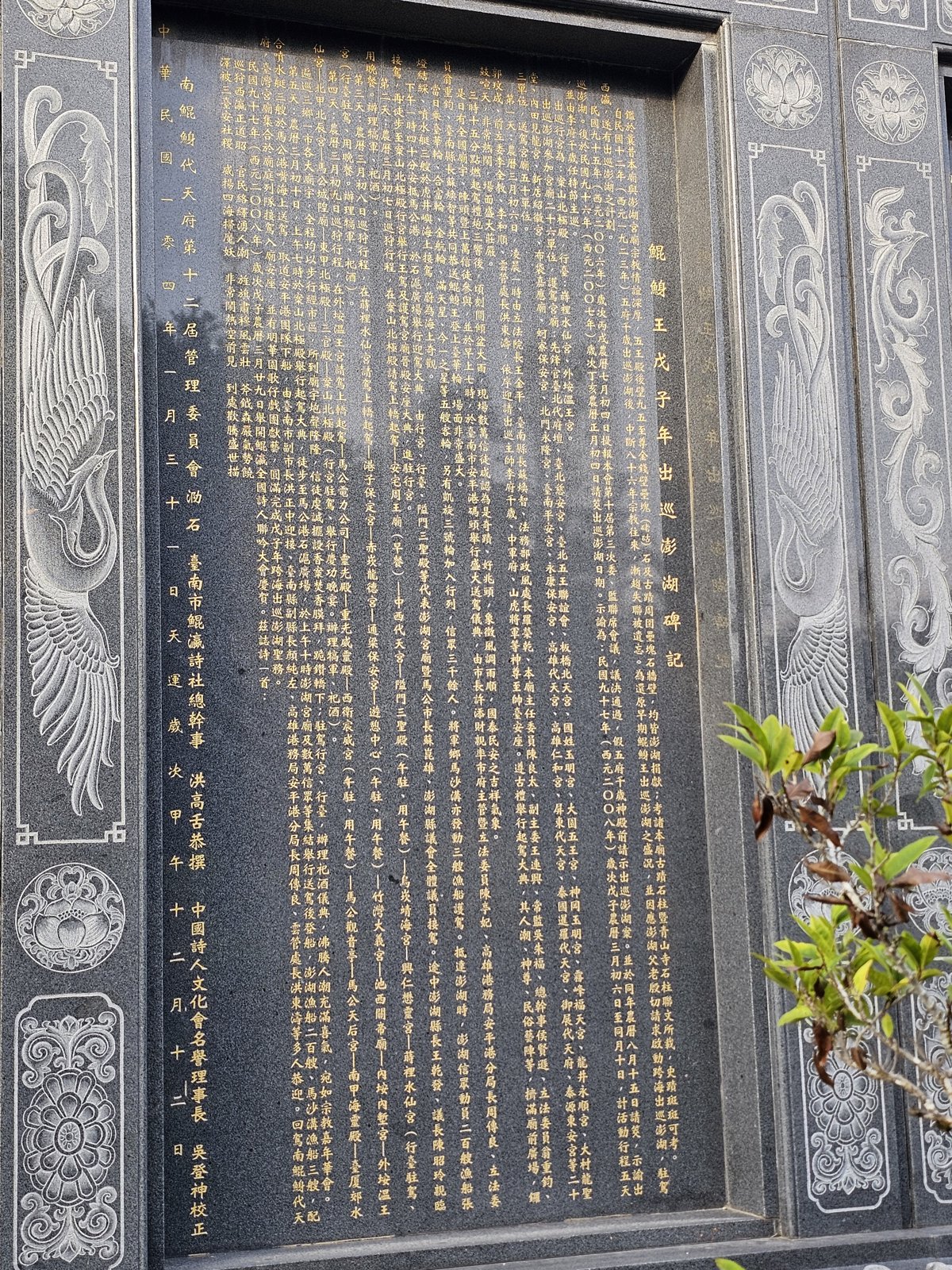
- 〈鯤鯓王戊子年出巡澎湖碑記〉 (Stele Record of the Kunshen Lords' Wuzi-Year Tour to Penghu) January 31, 2015, carved by the 12th Management Committee, composed by Hung Kao-she and proofread by Wu Teng-shen Account by an involved partyR007Source〈鯤鯓王戊子年出巡澎湖碑記〉[Stele Record of the Kunshen Lords' Wuzi-Year Tour to Penghu], in the Lingxiao Stele Forest, carved in 2015 by the 12th Management Committee of Nankunshen Daitian Temple, composed by Hung Kao-she and proofread by Wu Teng-shen; photographed on site by the author on 2026-11-21Original URL—Retrieved2026-11-22Snapshot timestamp—Inscription set up by the temple itself (primary source).. It records that after the tour to Penghu in 1923 there had been no such tour for 86 years, and that from the sixth to the tenth day of the third lunar month of 2008 Lord Li led a tour of Penghu with the Beiji Hall of Anshan as the travelling palace; the chairman was Chen Liang-tai (陳良太), the vice-chairman Wang Lien-hsing and the general secretary Hou Hsien-hsun. A celebratory poem closes the text.
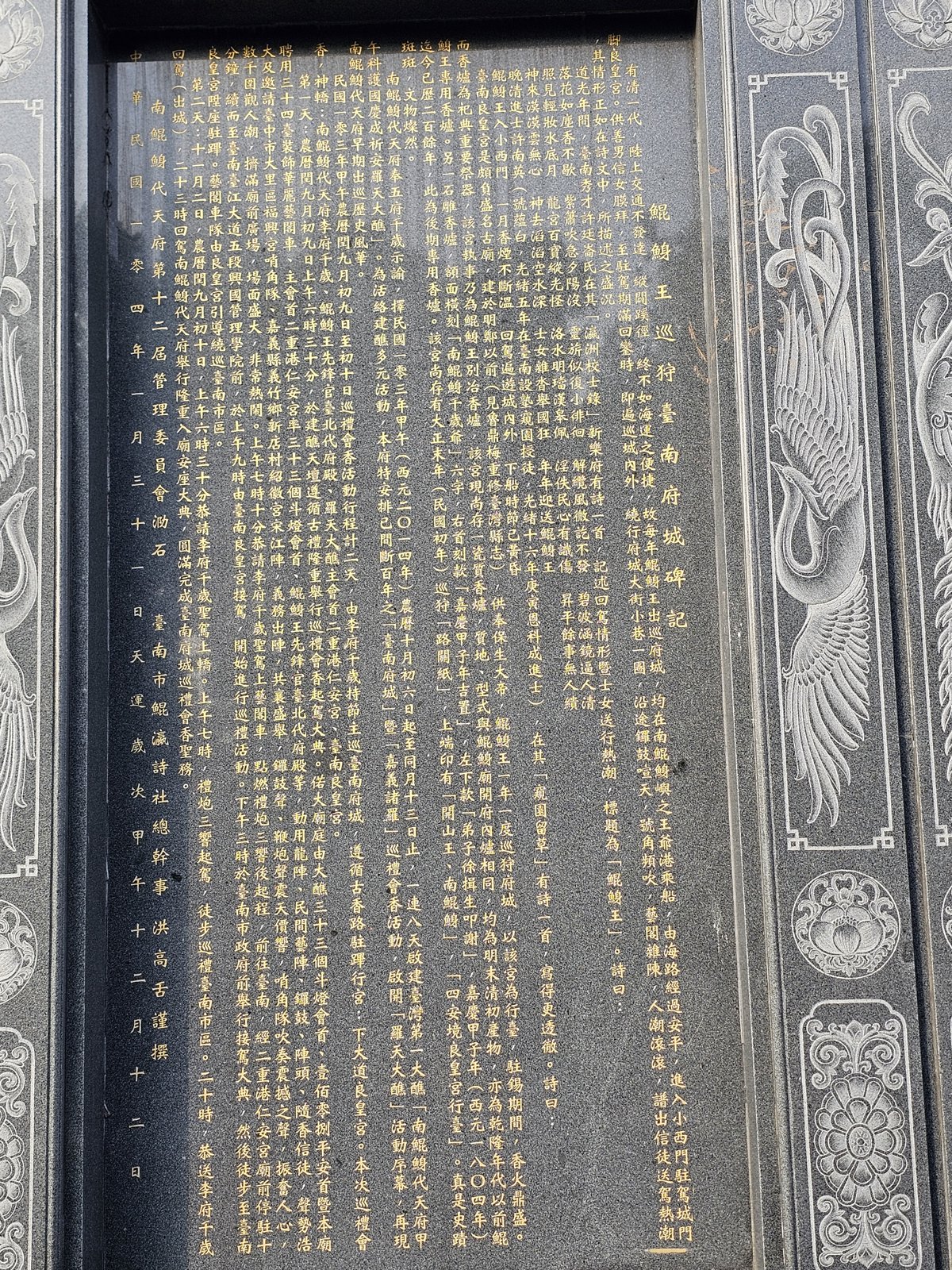
- 〈鯤鯓王巡狩臺南府城碑記〉 (Stele Record of the Kunshen Lords' Tour of Tainan Prefectural City) January 31, 2015, carved by the 12th Management Committee and composed by Hung Kao-she Account by an involved partyR008Source〈鯤鯓王巡狩臺南府城碑記〉[Stele Record of the Kunshen Lords' Tour of Tainan Prefectural City], in the Lingxiao Stele Forest, carved in 2015 by the 12th Management Committee of Nankunshen Daitian Temple, composed by Hung Kao-she; photographed on site by the author on 2026-11-21Original URL—Retrieved2026-11-22Snapshot timestamp—Inscription set up by the temple itself (primary source).. It records that in the Qing period the Kunshen Lords sailed every year from Wangye Harbor by way of Anping into the prefectural city, where they stayed at Lianghuang Temple by the Small West Gate; it quotes Hsu Ting-lun's (許廷崙) poem "鯤鯓王" (The Kunshen Lords) and a poem by Hsu Nan-ying (許南英); it notes that Lianghuang Temple keeps a stone censer inscribed "南鯤鯓千歲爺" (Lord of Nankunshen) dated Jiaqing jiazi (1804); and it records the tour and incense meeting in the prefectural city on the ninth and tenth days of the intercalary ninth lunar month of 2014.
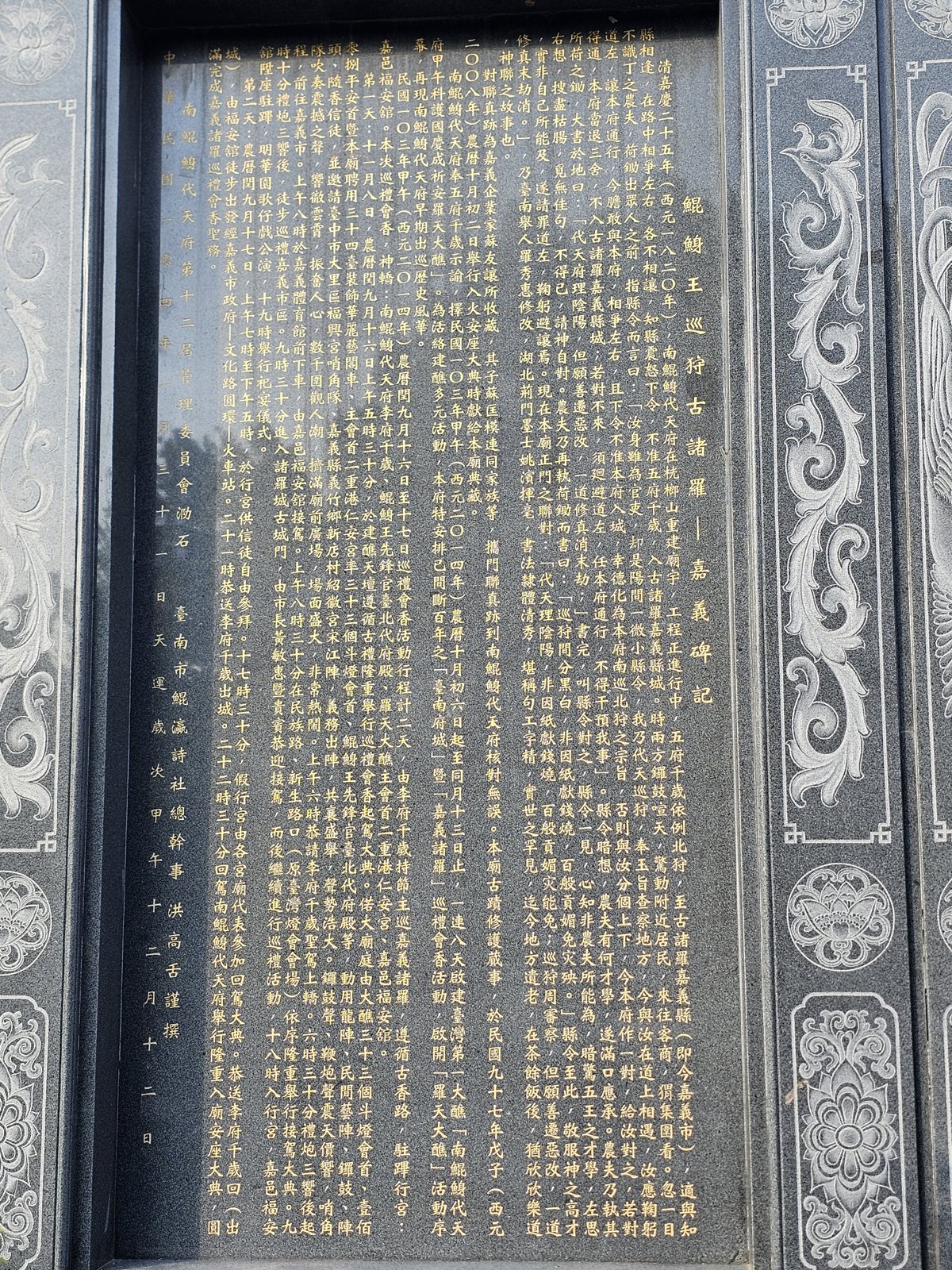
- 〈鯤鯓王巡狩古諸羅—嘉義碑記〉 (Stele Record of the Kunshen Lords' Tour of Old Zhuluo (Chiayi)) the colophon lies outside the photo; the three other steles in the same row were set up in 2015 Account by an involved partyR009Source〈鯤鯓王巡狩古諸羅—嘉義碑記〉[Stele Record of the Kunshen Lords' Tour of Old Zhuluo (Chiayi)], in the Lingxiao Stele Forest, set up by Nankunshen Daitian Temple (colophon outside the photo; the other steles in the same row date from 2015); photographed on site by the author on 2026-11-21Original URL—Retrieved2026-11-22Snapshot timestamp—Inscription set up by the temple itself (primary source).. It tells the story of Jiaqing 25 (1820), when the Five Royal Lords on their northern tour of Zhuluo disputed the road with the county magistrate and a farmer wrote a couplet on their behalf; it records that the couplet on the main gate was revised by the Tainan juren Lo Hsiu-hui (羅秀惠) and written by Yao Pin (姚濱), and that the original calligraphy was given to the temple in 2008 by the family of Su Yu-jang (蘇友讓) of Chiayi; and it records the tour and incense meeting in Zhuluo on the sixteenth and seventeenth days of the intercalary ninth lunar month of 2014, with Jiayi Fu'an Guild Hall as the travelling palace.
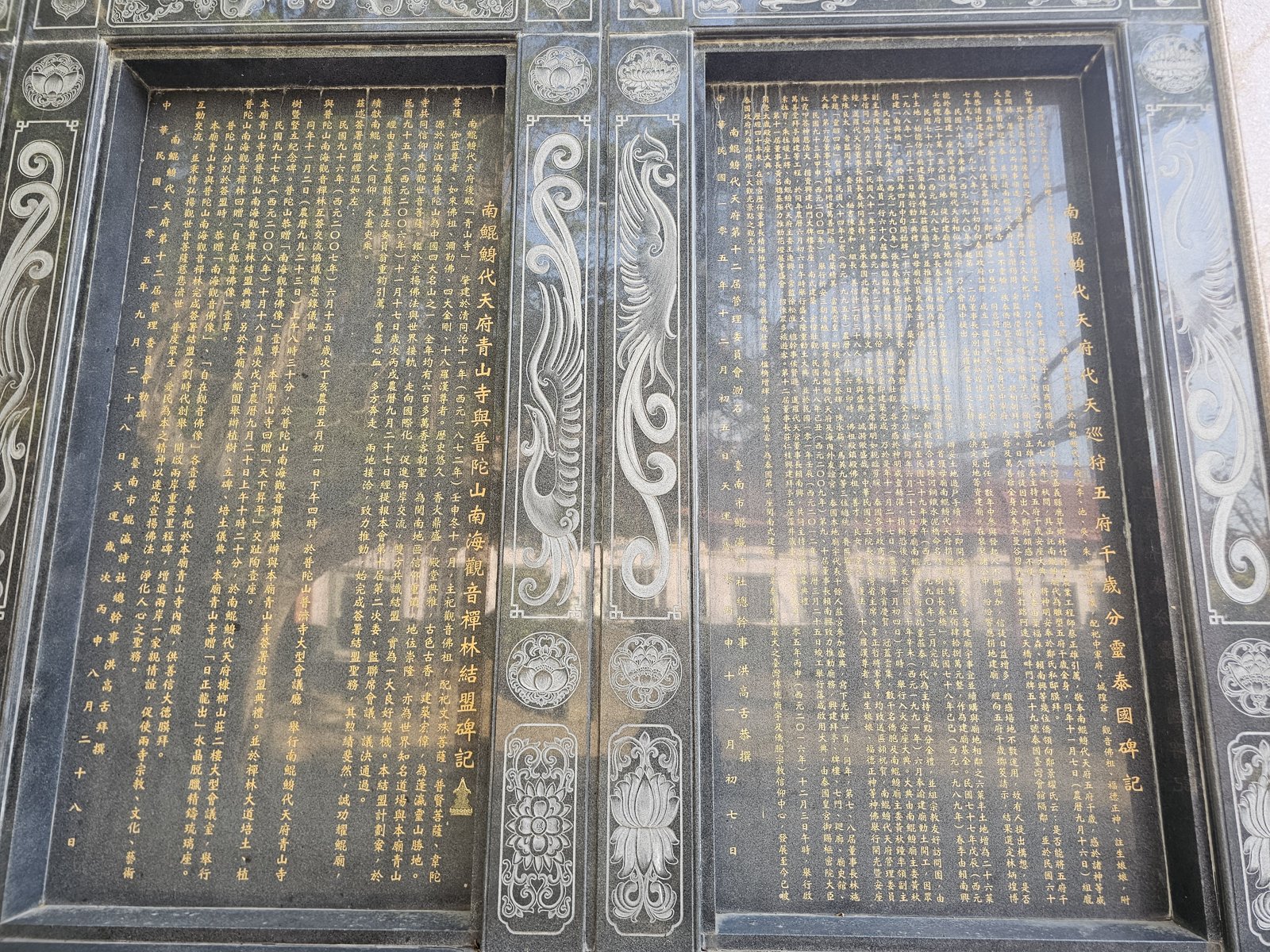
- 〈南鯤鯓代天府青山寺與普陀山南海觀音禪林結盟碑記〉 (Stele Record of the Alliance between Qingshan Temple and the Nanhai Guanyin Chan Grove of Mount Putuo) September 28, 2016 (the twenty-eighth day of the eighth lunar month of bingshen), carved by the 12th Management Committee and composed by Hung Kao-she Account by an involved partyR010Source〈南鯤鯓代天府青山寺與普陀山南海觀音禪林結盟碑記〉[Stele Record of the Alliance between Qingshan Temple of Nankunshen Daitian Temple and the Nanhai Guanyin Chan Grove of Mount Putuo], in the Lingxiao Stele Forest, carved in 2016 by the 12th Management Committee of Nankunshen Daitian Temple, composed by Hung Kao-she; photographed on site by the author on 2026-11-21Original URL—Retrieved2026-11-22Snapshot timestamp—Inscription set up by the temple itself (primary source).. It records that the rear hall, Qingshan Temple, was founded in 1872 and enshrines Guanyin; that the alliance was approved in 2006 on the introduction of legislator Weng Chung-chun (翁重鈞); that a memorandum of exchange was signed at Puji Temple on Mount Putuo on June 15, 2007 and an alliance ceremony held on Mount Putuo on November 2; and that the alliance ceremony at Nankunshen was held on October 18, 2008, with tree planting and a commemorative stele in the Dakun Garden.
- 〈南鯤鯓代天府代天巡狩五府千歲分靈泰國碑記〉 (Stele Record of the Division of the Five Royal Lords' Incense to Thailand) December 2016 (the seventh day of the eleventh lunar month of bingshen), carved by the 12th Management Committee and composed by Hung Kao-she Account by an involved partyR011Source〈南鯤鯓代天府代天巡狩五府千歲分靈泰國碑記〉[Stele Record of the Division of the Five Royal Lords' Incense to Thailand], in the Lingxiao Stele Forest, carved in 2016 by the 12th Management Committee of Nankunshen Daitian Temple, composed by Hung Kao-she; photographed on site by the author on 2026-11-21Original URL—Retrieved2026-11-22Snapshot timestamp—Inscription set up by the temple itself (primary source). The photo has glare; the reading of the later part is less certain.. It records that in 1976 the Thai-Chinese businessman Cheng Ching-yao (鄭景耀), introduced by Tsai Cheng-hsiung (蔡正雄) of Lucao, Chiayi, brought images of the Five Royal Lords to Thailand; that the "暹羅代天宮管理委員會" (Siam Daitian Temple Management Committee) was registered with the Thai government in 1978; that construction began in 1988 and the deities were installed on November 27, 1992; and it lists the additions made under successive chairmen. The Siam Daitian Temple is in Bang Phli District, Samut Prakan Province, and the stele calls it the first Minnan-style building in Thailand.
Donor rolls
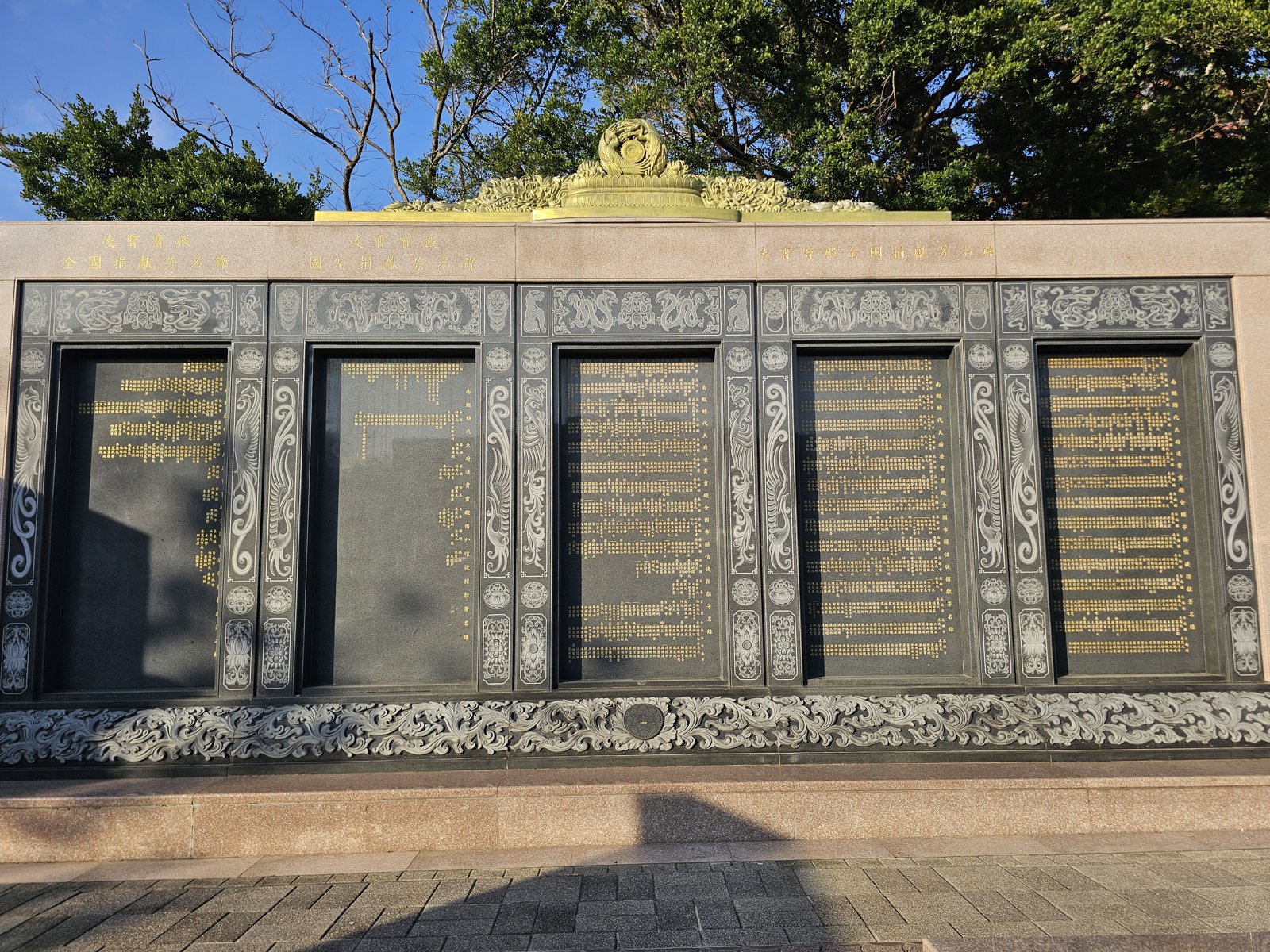
- Another part of the walls carries the donor rolls of the Lingxiaobao Temple in three groups, headed "凌霄寶殿全國捐獻芳名錄" (donors from across Taiwan), "凌霄寶殿國外捐獻芳名錄" (overseas donors) and "凌霄寶殿實物捐獻芳名錄" (donors of building elements) R001SourceGate plaque and name rock of the 凌霄碑林 [Lingxiao Stele Forest], overall views of the stele walls and the donor-roll walls of the Lingxiaobao Temple, within the grounds of Nankunshen Daitian Temple; photographed on site by the author on 2026-11-21Original URL—Retrieved2026-11-22Snapshot timestamp—Stele walls and name inscriptions set up by the temple itself (primary source). The donor rolls are in small characters and very long; they have not been transcribed name by name..
- Across Taiwan: the first line reads "南鯤鯓代天府凌霄寶殿全國市縣信徒捐獻芳名錄" (roll of devotees' donations from the cities and counties of the nation); the entries are grouped by city and county, each giving the sum and the name of a person, company or temple, several hundred in all.
- Overseas: grouped by country, including Thailand, Hong Kong, the United States, Indonesia, Japan, Macau and Germany.
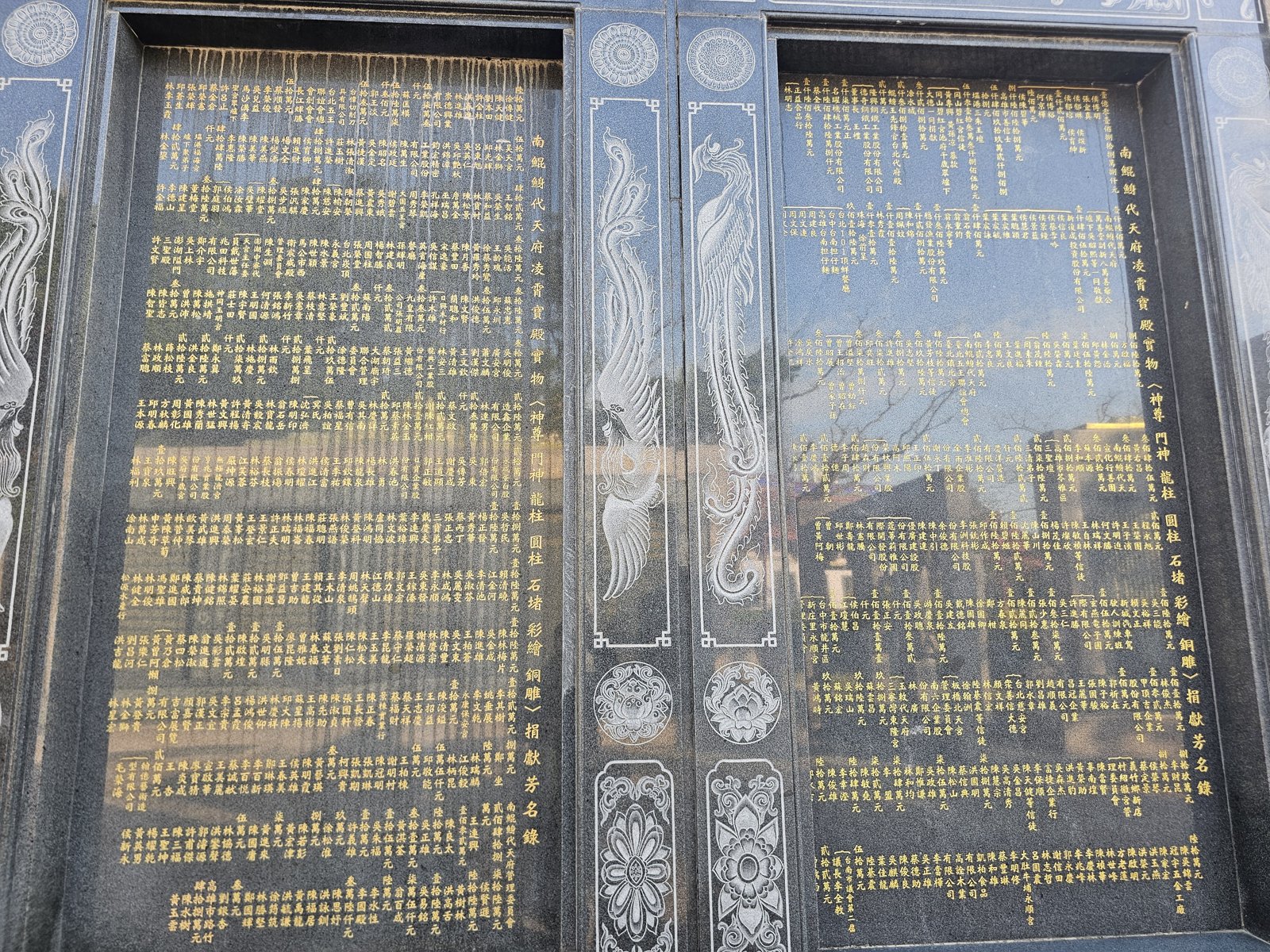
- Building elements: the first line lists items such as deity images, door gods, dragon columns, round columns, stone panels, paintings and bronze work.
- The temple's donation notice for the Lingxiaobao Temple states that donors of NT$30,000 or more are engraved on the "凌霄碑林捐獻功德榜" (merit roll of the Lingxiao Stele Forest) Account by an involved partyR013Source〈【凌霄寶殿建設待捐公告】〉[Notice of Items Open for Donation for the Construction of the Lingxiaobao Temple] board, set up by the Nankunshen Daitian Temple Foundation; photographed on site by the author on 2026-11-21Original URL—Retrieved2026-11-22Snapshot timestamp—Notice set up by the temple itself (primary source)..
See also
- Nankunshen Daitian TempleHead temple of the Wufu Qiansui in Beimen DistrictContains 19 items
- Lingxiaobao TempleNew hall of the Jade Emperor at Nankunshen Daitian Temple
- Wanshan Hall of Nankunshen Daitian TempleHall of Wanshanye beside Nankunshen Daitian Temple
- Jiawu-Cycle Luotian Grand Jiao of Nankunshen Daitian TempleThe 2014 Luotian Grand Jiao of the Nankunshen Daitian Temple
- 1987 to present・Scholars and local historiansHung Kao-sheKunying Poetry Society secretary; author of Nankunshen stele records
Photos on site
Taken on site by the author of this website (13 photos). Click a thumbnail to enlarge; use the arrow keys to browse.
Entrance
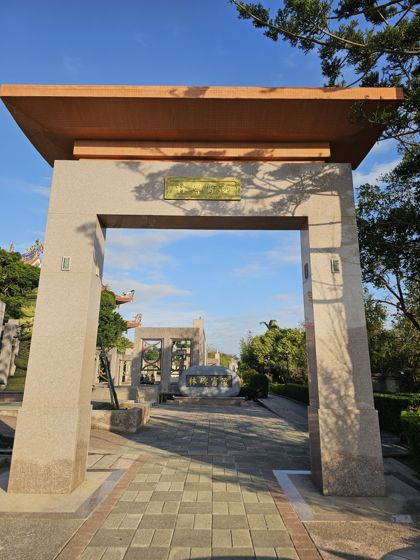
Entrance of the Lingxiao Stele Forest; the bronze plaque over the gate and the rock inside both read "凌霄碑林"
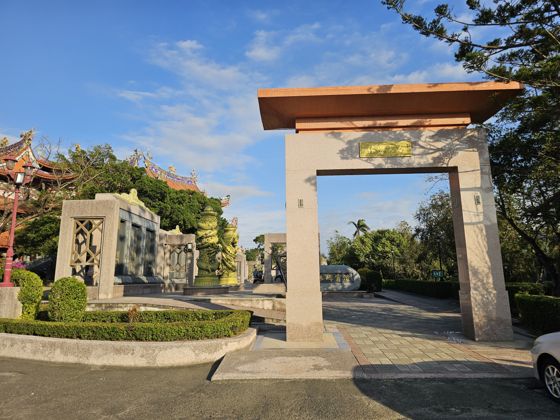
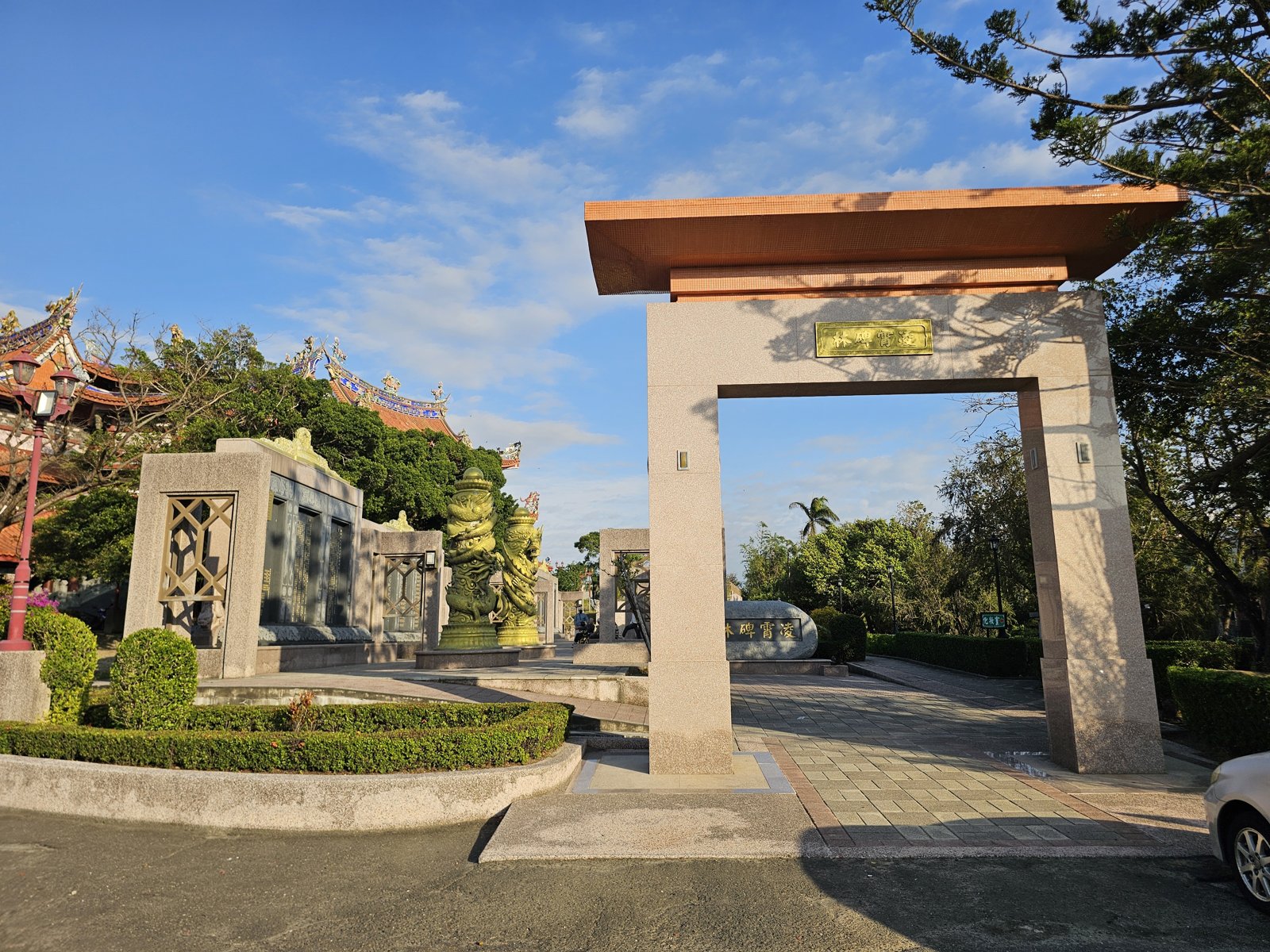
Oblique view of the entrance of the Lingxiao Stele Forest, with a stele wall at left and bronze dragon columns and the name rock in the center
Commemorative steles
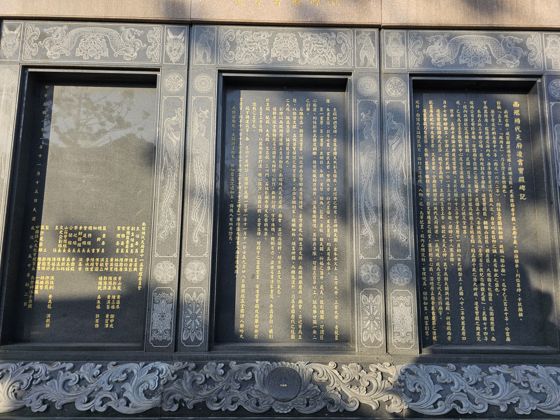
"Stele Record of the Lingxiaobao Temple of Nankunshen Daitian Temple", composed by Wu Teng-shen and set up by the 11th Management Committee, 2012
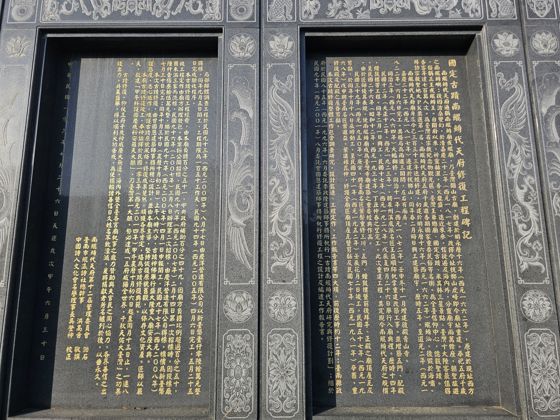
"Stele Record of the Restoration of the National Monument Nankunshen Daitian Temple", composed by Hung Kao-she and proofread by Wu Teng-shen, 2014
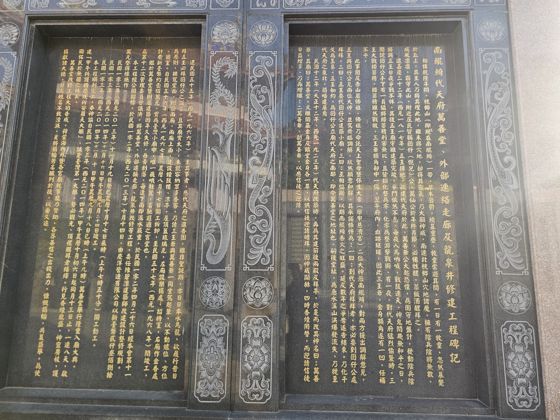
"Stele Record of the Renovation of the Wanshan Hall, the Outer Connecting Corridor and the Dragon Spring Well", set up after 2014
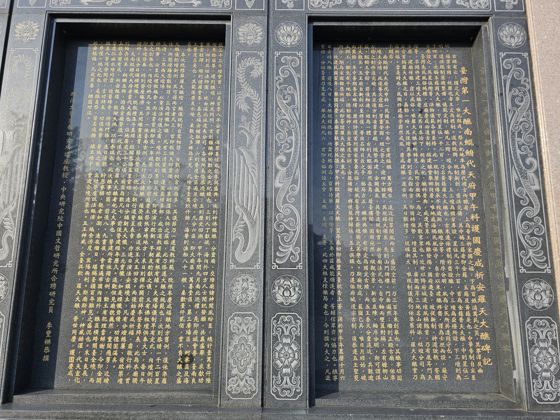
"Stele Record of the Jiawu-Cycle Luotian Grand Jiao", composed by Lee Fong-mao
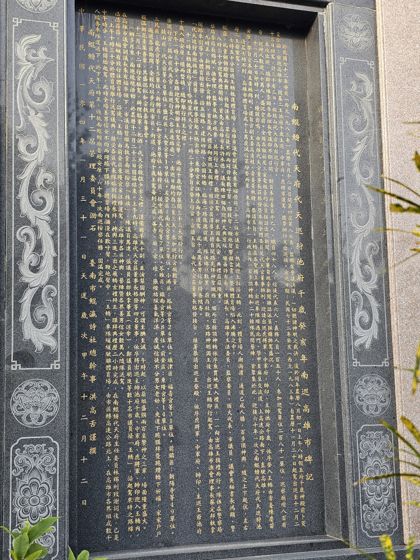
"Stele Record of Lord Chi's Guihai-Year Southern Tour to Kaohsiung City", composed by Hung Kao-she, 2015
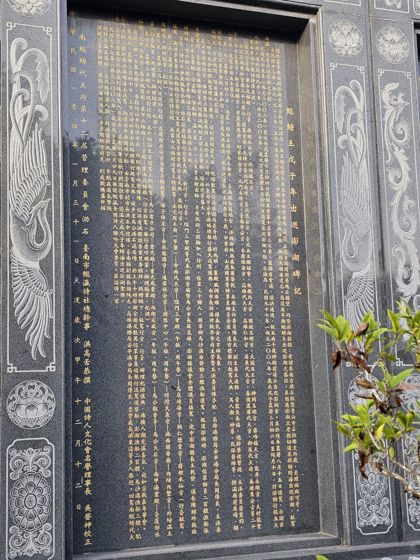
"Stele Record of the Kunshen Lords' Wuzi-Year Tour to Penghu", composed by Hung Kao-she and proofread by Wu Teng-shen, 2015
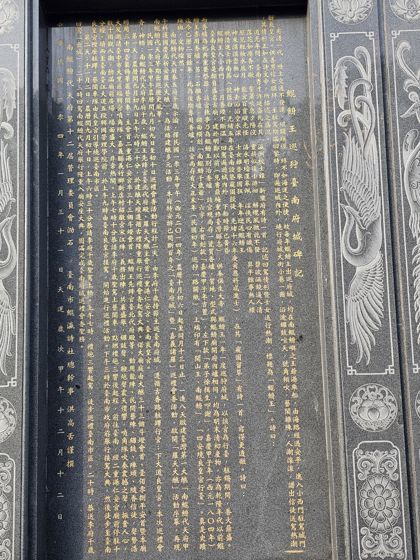
"Stele Record of the Kunshen Lords' Tour of Tainan Prefectural City", composed by Hung Kao-she, 2015
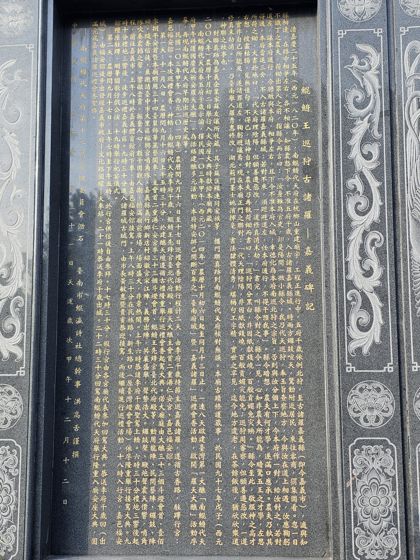
"Stele Record of the Kunshen Lords' Tour of Old Zhuluo (Chiayi)", in the same row as the Tainan, Kaohsiung and Penghu steles
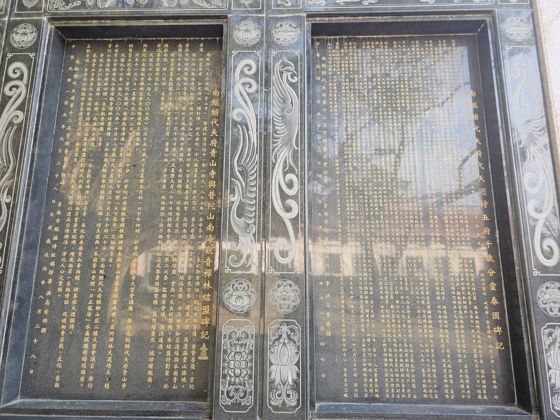
At right the "Stele Record of the Division of the Five Royal Lords' Incense to Thailand", at left the "Stele Record of the Alliance between Qingshan Temple and the Nanhai Guanyin Chan Grove of Mount Putuo", both composed by Hung Kao-she in 2016
Donor rolls
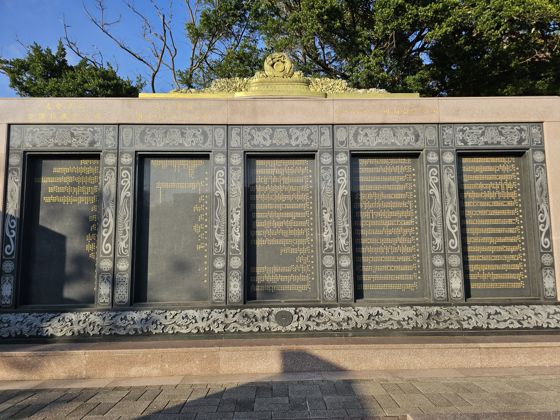
Donor-roll wall of the Lingxiaobao Temple, headed "凌霄寶殿全國捐獻芳名錄" and "凌霄寶殿國外捐獻芳名錄"
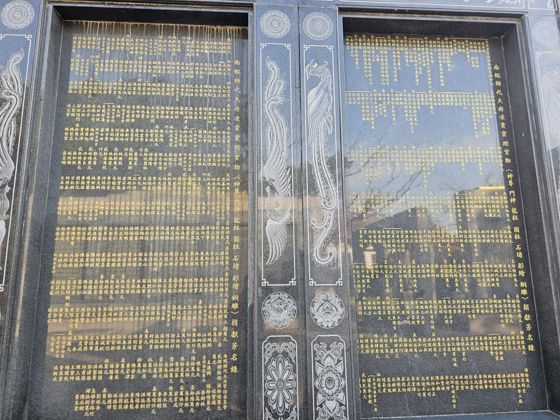
"Roll of Donors of Building Elements for the Lingxiaobao Temple", listing gifts of deity images, door gods, dragon columns, stone panels, paintings and bronze work
Continue from here
- Beimen: other PlacesSanliaowanA large village in southern Beimen DistrictContains 7 items
- Related entriesNankunshen Daitian TempleHead temple of the Wufu Qiansui in Beimen DistrictContains 19 items
- Entries in the same hallOrthodox Luermen Shengmu Temple⚖︎Mazu temple of Tuchengzi, host of the Tuchengzi Incense ProcessionContains 19 items