Guided reading
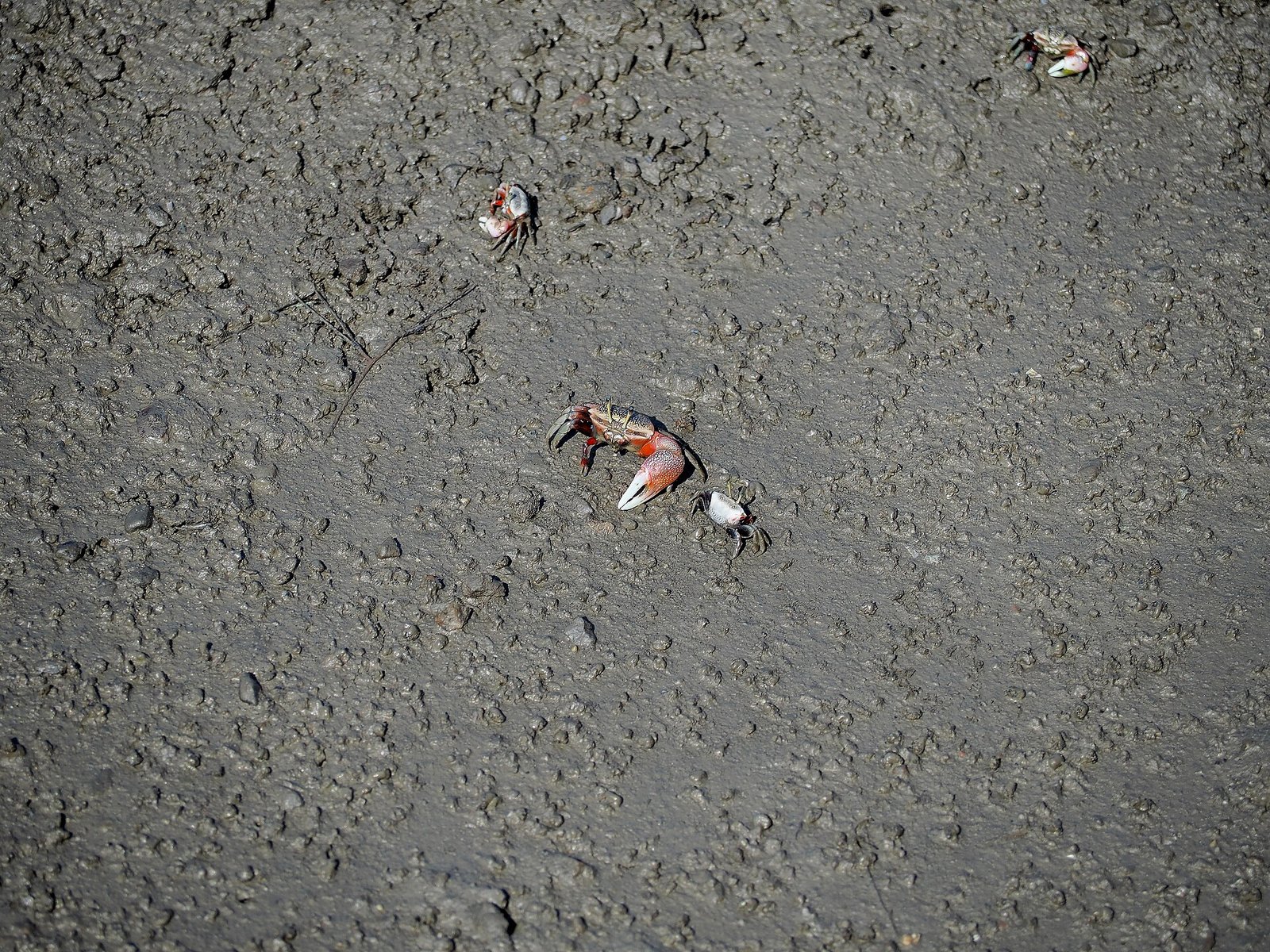
Behind the seawall lie land crabs and the windbreak forest; outside it lies the southernmost limit of the Formosan fiddler crab's range in Taiwan — a mudflat being squeezed between illegal fish farm ponds and a bridge pier about to go under construction.R001Source《109-110 年度曾文溪口重要濕地(國際級)生態及水質基礎調查計畫》[2020–2021 Baseline Survey of Ecology and Water Quality of the Zengwen River Estuary Wetland of Importance (International Level)], NCKU Research and Development Foundation (成大研究發展基金會), co-principal investigator Liu Ching-yu (劉靜榆), July 2021 (ROC year 110) (15 sampling sites, five sites outside the seawall, the Formosan fiddler crab, horn snails [海蜷], salinity across four seasons, management recommendations, final review minutes; printed pp. 10, 13–14, 54–55, 71, 73, 78, 80–84, 101–103, 107)Original URLhttps://www.tjnp.gov.tw/Retrieved2026-10-19Snapshot timestamp(None, or not applicable)
- Time span
- 1992–202634 years
- Current status
- The mudflat outside the seawall, the southernmost point of the Formosan fiddler crab's range in Taiwan, is squeezed between illegal fish ponds and the Provincial Highway 61 Zengwen River bridge project; the pier site lies 747 meters outside the national park zoning boundary R005SourceTaijiang National Park zoning vector data (the 「國家公園土地使用分區」[National Park Land Use Zoning] layer of the 國土規劃地理資訊圖台 [National Spatial Planning GIS Platform] of the 內政部國土管理署 [National Land Management Agency, Ministry of the Interior]; plan 「台江國家公園計畫(第一次通盤檢討)案」[Taijiang National Park Plan (First Comprehensive Review)]; 27 zone polygons; WGS84)Original URLhttps://nspi.nlma.gov.tw/Retrieved2026-10-20Snapshot timestamp—Areas follow the approved plan; locations follow the vector data., and behind the seawall the land-crab season still brings nightly traffic control each year, with 14,132 crabs recorded in ROC year 115 R008SourceThe Taijiang National Park Headquarters' 「陸蟹公民科學家計畫」[Land Crab Citizen Scientist Program] (run on commission by 社團法人台灣濕地保護聯盟 [Wetlands Taiwan] since 2022 [ROC year 111]; traffic-controlled section 「青草崙堤防防汛道路(自城西街三段 1105 巷至青草崙海巡哨所間約 2 公里路段)」 ["Qingcaolun Seawall flood-control road (the roughly 2 km section from Lane 1105, Section 3, Chengxi Street, to the Qingcaolun coast guard post)"]; 6:30 p.m. to 9:30 p.m.; July–September; 8,604 individuals in 2023 [ROC year 112], about 10,000 in 2025 [ROC year 114], a combined 14,132 in 2026 [ROC year 115])Original URLhttps://www.wetland.org.tw/Retrieved2026-10-20Snapshot timestamp—.
- Key figures
- 747 m (outside)Distance from the Highway 61 pier site to the national park zoning boundaryR005SourceTaijiang National Park zoning vector data (the 「國家公園土地使用分區」[National Park Land Use Zoning] layer of the 國土規劃地理資訊圖台 [National Spatial Planning GIS Platform] of the 內政部國土管理署 [National Land Management Agency, Ministry of the Interior]; plan 「台江國家公園計畫(第一次通盤檢討)案」[Taijiang National Park Plan (First Comprehensive Review)]; 27 zone polygons; WGS84)Original URLhttps://nspi.nlma.gov.tw/Retrieved2026-10-20Snapshot timestamp(None, or not applicable)Areas follow the approved plan; locations follow the vector data.
- 4,544Brown land crabs individually recorded on the seawall road, 2020–2022R004SourceTBN 臺灣生物多樣性網絡 [Taiwan Biodiversity Network], 「國家公園生物多樣性資料庫-物種調查點資料」[National Park Biodiversity Database – Species Survey Point Data] (4,544 individual records of brown land crabs at Qingcaolun, 2020–2022; datasetUUID 7e5a68cc-771e-42ef-8cf7-b68f2254d15b; publisher 內政部營建署 [Construction and Planning Agency, Ministry of the Interior]; data author Lee Chun-mei (李春美); license OGDL-Taiwan-1.0)Original URLhttps://www.tbn.org.tw/Retrieved2026-10-20Snapshot timestamp(None, or not applicable)Citizen-science records (sightings); coordinate error about 25 meters.
- 14,132 crabsLand Crab Citizen Scientist Program, ROC year 115R008SourceThe Taijiang National Park Headquarters' 「陸蟹公民科學家計畫」[Land Crab Citizen Scientist Program] (run on commission by 社團法人台灣濕地保護聯盟 [Wetlands Taiwan] since 2022 [ROC year 111]; traffic-controlled section 「青草崙堤防防汛道路(自城西街三段 1105 巷至青草崙海巡哨所間約 2 公里路段)」 ["Qingcaolun Seawall flood-control road (the roughly 2 km section from Lane 1105, Section 3, Chengxi Street, to the Qingcaolun coast guard post)"]; 6:30 p.m. to 9:30 p.m.; July–September; 8,604 individuals in 2023 [ROC year 112], about 10,000 in 2025 [ROC year 114], a combined 14,132 in 2026 [ROC year 115])Original URLhttps://www.wetland.org.tw/Retrieved2026-10-20Snapshot timestamp(None, or not applicable)
- about 2 kmRoad under nighttime traffic control in crab seasonR008SourceThe Taijiang National Park Headquarters' 「陸蟹公民科學家計畫」[Land Crab Citizen Scientist Program] (run on commission by 社團法人台灣濕地保護聯盟 [Wetlands Taiwan] since 2022 [ROC year 111]; traffic-controlled section 「青草崙堤防防汛道路(自城西街三段 1105 巷至青草崙海巡哨所間約 2 公里路段)」 ["Qingcaolun Seawall flood-control road (the roughly 2 km section from Lane 1105, Section 3, Chengxi Street, to the Qingcaolun coast guard post)"]; 6:30 p.m. to 9:30 p.m.; July–September; 8,604 individuals in 2023 [ROC year 112], about 10,000 in 2025 [ROC year 114], a combined 14,132 in 2026 [ROC year 115])Original URLhttps://www.wetland.org.tw/Retrieved2026-10-20Snapshot timestamp(None, or not applicable)
- Evidence mix
Why it matters
The Qingcaolun Seawall is the ecological front line of Tucheng's coast: the mudflat outside it is the southernmost point of the Formosan fiddler crab's range in Taiwan R001Source《109-110 年度曾文溪口重要濕地(國際級)生態及水質基礎調查計畫》[2020–2021 Baseline Survey of Ecology and Water Quality of the Zengwen River Estuary Wetland of Importance (International Level)], NCKU Research and Development Foundation (成大研究發展基金會), co-principal investigator Liu Ching-yu (劉靜榆), July 2021 (ROC year 110) (15 sampling sites, five sites outside the seawall, the Formosan fiddler crab, horn snails [海蜷], salinity across four seasons, management recommendations, final review minutes; printed pp. 10, 13–14, 54–55, 71, 73, 78, 80–84, 101–103, 107)Original URLhttps://www.tjnp.gov.tw/Retrieved2026-10-19Snapshot timestamp—, and the flood-control road behind it is the main crossing for brown land crabs R004SourceTBN 臺灣生物多樣性網絡 [Taiwan Biodiversity Network], 「國家公園生物多樣性資料庫-物種調查點資料」[National Park Biodiversity Database – Species Survey Point Data] (4,544 individual records of brown land crabs at Qingcaolun, 2020–2022; datasetUUID 7e5a68cc-771e-42ef-8cf7-b68f2254d15b; publisher 內政部營建署 [Construction and Planning Agency, Ministry of the Interior]; data author Lee Chun-mei (李春美); license OGDL-Taiwan-1.0)Original URLhttps://www.tbn.org.tw/Retrieved2026-10-20Snapshot timestamp—Citizen-science records (sightings); coordinate error about 25 meters..{{官方文獻}} The official survey lists illegal fish ponds, overgrown mangroves and engineering works as the three main threats, the works being the Provincial Highway 61 bridge over the Zengwen River R001Source《109-110 年度曾文溪口重要濕地(國際級)生態及水質基礎調查計畫》[2020–2021 Baseline Survey of Ecology and Water Quality of the Zengwen River Estuary Wetland of Importance (International Level)], NCKU Research and Development Foundation (成大研究發展基金會), co-principal investigator Liu Ching-yu (劉靜榆), July 2021 (ROC year 110) (15 sampling sites, five sites outside the seawall, the Formosan fiddler crab, horn snails [海蜷], salinity across four seasons, management recommendations, final review minutes; printed pp. 10, 13–14, 54–55, 71, 73, 78, 80–84, 101–103, 107)Original URLhttps://www.tjnp.gov.tw/Retrieved2026-10-19Snapshot timestamp—; yet the bridge's pier site is not inside the national park zoning R005SourceTaijiang National Park zoning vector data (the 「國家公園土地使用分區」[National Park Land Use Zoning] layer of the 國土規劃地理資訊圖台 [National Spatial Planning GIS Platform] of the 內政部國土管理署 [National Land Management Agency, Ministry of the Interior]; plan 「台江國家公園計畫(第一次通盤檢討)案」[Taijiang National Park Plan (First Comprehensive Review)]; 27 zone polygons; WGS84)Original URLhttps://nspi.nlma.gov.tw/Retrieved2026-10-20Snapshot timestamp—Areas follow the approved plan; locations follow the vector data.. This page shows what each side of the same seawall is facing.
Main actors
Authority 1
- Taijiang National Park HeadquartersCommissioned the surveys; since ROC year 111 has contracted Wetlands Taiwan to run the Land Crab Citizen Scientist ProgramR008SourceThe Taijiang National Park Headquarters' 「陸蟹公民科學家計畫」[Land Crab Citizen Scientist Program] (run on commission by 社團法人台灣濕地保護聯盟 [Wetlands Taiwan] since 2022 [ROC year 111]; traffic-controlled section 「青草崙堤防防汛道路(自城西街三段 1105 巷至青草崙海巡哨所間約 2 公里路段)」 ["Qingcaolun Seawall flood-control road (the roughly 2 km section from Lane 1105, Section 3, Chengxi Street, to the Qingcaolun coast guard post)"]; 6:30 p.m. to 9:30 p.m.; July–September; 8,604 individuals in 2023 [ROC year 112], about 10,000 in 2025 [ROC year 114], a combined 14,132 in 2026 [ROC year 115])Original URLhttps://www.wetland.org.tw/Retrieved2026-10-20Snapshot timestamp(None, or not applicable)
Engineering 1
- Builders of the Highway 61 Zengwen River bridgeThe survey recommends closer communication and monitoring of habitat changeR001Source《109-110 年度曾文溪口重要濕地(國際級)生態及水質基礎調查計畫》[2020–2021 Baseline Survey of Ecology and Water Quality of the Zengwen River Estuary Wetland of Importance (International Level)], NCKU Research and Development Foundation (成大研究發展基金會), co-principal investigator Liu Ching-yu (劉靜榆), July 2021 (ROC year 110) (15 sampling sites, five sites outside the seawall, the Formosan fiddler crab, horn snails [海蜷], salinity across four seasons, management recommendations, final review minutes; printed pp. 10, 13–14, 54–55, 71, 73, 78, 80–84, 101–103, 107)Original URLhttps://www.tjnp.gov.tw/Retrieved2026-10-19Snapshot timestamp(None, or not applicable)
Land users 1
- Illegal fish-pond operatorsTurned the Qingcaolun mudflat into private fish pondsR001Source《109-110 年度曾文溪口重要濕地(國際級)生態及水質基礎調查計畫》[2020–2021 Baseline Survey of Ecology and Water Quality of the Zengwen River Estuary Wetland of Importance (International Level)], NCKU Research and Development Foundation (成大研究發展基金會), co-principal investigator Liu Ching-yu (劉靜榆), July 2021 (ROC year 110) (15 sampling sites, five sites outside the seawall, the Formosan fiddler crab, horn snails [海蜷], salinity across four seasons, management recommendations, final review minutes; printed pp. 10, 13–14, 54–55, 71, 73, 78, 80–84, 101–103, 107)Original URLhttps://www.tjnp.gov.tw/Retrieved2026-10-19Snapshot timestamp(None, or not applicable)
Scholars 3
- Liu Ching-yuNCKU Research and Development Foundation; co-principal investigator of the Zengwen River estuary wetland baseline surveyR001Source《109-110 年度曾文溪口重要濕地(國際級)生態及水質基礎調查計畫》[2020–2021 Baseline Survey of Ecology and Water Quality of the Zengwen River Estuary Wetland of Importance (International Level)], NCKU Research and Development Foundation (成大研究發展基金會), co-principal investigator Liu Ching-yu (劉靜榆), July 2021 (ROC year 110) (15 sampling sites, five sites outside the seawall, the Formosan fiddler crab, horn snails [海蜷], salinity across four seasons, management recommendations, final review minutes; printed pp. 10, 13–14, 54–55, 71, 73, 78, 80–84, 101–103, 107)Original URLhttps://www.tjnp.gov.tw/Retrieved2026-10-19Snapshot timestamp(None, or not applicable)
- Liu Hung-changEcological Society of Taiwan; principal investigator of the Taijiang land crab surveyR002Source《台江國家公園陸蟹生態調查》[Land Crab Ecological Survey of Taijiang National Park], commissioned by the Taijiang National Park Headquarters (台江處) from the Ecological Society of Taiwan (臺灣生態學會), principal investigator Liu Hung-chang (劉烘昌), March–December 2020 (ROC year 109) (transect T3, the flood-control road behind the seawall, recommendation to close about 2 km in July–August, the Headquarters' completion of improvement works on an alternative road)Original URLhttps://www.tjnp.gov.tw/Retrieved2026-10-19Snapshot timestamp(None, or not applicable)
- Chiu Yu-wen, Huang Ta-chunPrincipal and co-investigator of the 2018 wetland baseline surveyR003Source《106-107 年度曾文溪口、四草、七股鹽田及鹽水溪口重要濕地(國際級、國家級)基礎調查》[Baseline Survey of the Zengwen River Estuary, Sicao, Qigu Salt Field and Yanshui River Estuary Wetlands of Importance (International and National Level), ROC Years 106–107], NCKU Research and Development Foundation, principal investigator Chiu Yu-wen (邱郁文), co-investigator Huang Ta-chun (黃大駿) (additional census site at Qingcaolun with 4 families and 8 species, the Qingcaolun Crab Protection Team, recommendation to make Qingcaolun an environmental-education observation site; printed pp. VIII, 44, 47–48, 60–61)Original URLhttps://www.tjnp.gov.tw/Retrieved2026-10-19Snapshot timestamp(None, or not applicable)
Environmental groups 1
- Wetlands TaiwanContracted to run the Land Crab Citizen Scientist ProgramR008SourceThe Taijiang National Park Headquarters' 「陸蟹公民科學家計畫」[Land Crab Citizen Scientist Program] (run on commission by 社團法人台灣濕地保護聯盟 [Wetlands Taiwan] since 2022 [ROC year 111]; traffic-controlled section 「青草崙堤防防汛道路(自城西街三段 1105 巷至青草崙海巡哨所間約 2 公里路段)」 ["Qingcaolun Seawall flood-control road (the roughly 2 km section from Lane 1105, Section 3, Chengxi Street, to the Qingcaolun coast guard post)"]; 6:30 p.m. to 9:30 p.m.; July–September; 8,604 individuals in 2023 [ROC year 112], about 10,000 in 2025 [ROC year 114], a combined 14,132 in 2026 [ROC year 115])Original URLhttps://www.wetland.org.tw/Retrieved2026-10-20Snapshot timestamp(None, or not applicable)
Citizen science 2
- Qingcaolun Crab Protection TeamIts survey data were folded into the official 2018 resultsR003Source《106-107 年度曾文溪口、四草、七股鹽田及鹽水溪口重要濕地(國際級、國家級)基礎調查》[Baseline Survey of the Zengwen River Estuary, Sicao, Qigu Salt Field and Yanshui River Estuary Wetlands of Importance (International and National Level), ROC Years 106–107], NCKU Research and Development Foundation, principal investigator Chiu Yu-wen (邱郁文), co-investigator Huang Ta-chun (黃大駿) (additional census site at Qingcaolun with 4 families and 8 species, the Qingcaolun Crab Protection Team, recommendation to make Qingcaolun an environmental-education observation site; printed pp. VIII, 44, 47–48, 60–61)Original URLhttps://www.tjnp.gov.tw/Retrieved2026-10-19Snapshot timestamp(None, or not applicable)
- Lee Chun-meiData author of the 2020–2022 individual-record dataset (recorders include several groups of crab-protection volunteers)R004SourceTBN 臺灣生物多樣性網絡 [Taiwan Biodiversity Network], 「國家公園生物多樣性資料庫-物種調查點資料」[National Park Biodiversity Database – Species Survey Point Data] (4,544 individual records of brown land crabs at Qingcaolun, 2020–2022; datasetUUID 7e5a68cc-771e-42ef-8cf7-b68f2254d15b; publisher 內政部營建署 [Construction and Planning Agency, Ministry of the Interior]; data author Lee Chun-mei (李春美); license OGDL-Taiwan-1.0)Original URLhttps://www.tbn.org.tw/Retrieved2026-10-20Snapshot timestamp(None, or not applicable)Citizen-science records (sightings); coordinate error about 25 meters.
Local residents 1
- Local residentsRemember the land crabs appearing most often on this stretch of seawall leading to Menghuan LakeR009SourceLocal oral account (the project author; personally witnessed)Original URL(None, or not applicable)Retrieved2026-10-19Snapshot timestamp(None, or not applicable)
Points of contention
These are the questions people have argued over. Each side's account is set out as stated; this site does not rule on them.
1The pier sits outside the national park boundary. Whose job is it to protect the fiddler crab mudflat?2
- National park zoning data
The survey points outside the seawall fall in Special Landscape Area 5 and General Control Area 7; only the Highway 61 pier site lies 747 m outside the boundaryR005SourceTaijiang National Park zoning vector data (the 「國家公園土地使用分區」[National Park Land Use Zoning] layer of the 國土規劃地理資訊圖台 [National Spatial Planning GIS Platform] of the 內政部國土管理署 [National Land Management Agency, Ministry of the Interior]; plan 「台江國家公園計畫(第一次通盤檢討)案」[Taijiang National Park Plan (First Comprehensive Review)]; 27 zone polygons; WGS84)Original URLhttps://nspi.nlma.gov.tw/Retrieved2026-10-20Snapshot timestamp(None, or not applicable)Areas follow the approved plan; locations follow the vector data.
- Zengwen River estuary wetland baseline survey
Engineering works are one of the three main threats to the fiddler crab; the bridge project must watch for habitat change and communicate more with the buildersR001Source《109-110 年度曾文溪口重要濕地(國際級)生態及水質基礎調查計畫》[2020–2021 Baseline Survey of Ecology and Water Quality of the Zengwen River Estuary Wetland of Importance (International Level)], NCKU Research and Development Foundation (成大研究發展基金會), co-principal investigator Liu Ching-yu (劉靜榆), July 2021 (ROC year 110) (15 sampling sites, five sites outside the seawall, the Formosan fiddler crab, horn snails [海蜷], salinity across four seasons, management recommendations, final review minutes; printed pp. 10, 13–14, 54–55, 71, 73, 78, 80–84, 101–103, 107)Original URLhttps://www.tjnp.gov.tw/Retrieved2026-10-19Snapshot timestamp(None, or not applicable)
- National park zoning data
2The fish ponds on the Qingcaolun mudflat: an ecological problem or an access problem?2
- Survey report text
The southernmost fiddler crab mudflat "has been turned into private fish ponds by illegal fish-pond operators", listed as a threatR001Source《109-110 年度曾文溪口重要濕地(國際級)生態及水質基礎調查計畫》[2020–2021 Baseline Survey of Ecology and Water Quality of the Zengwen River Estuary Wetland of Importance (International Level)], NCKU Research and Development Foundation (成大研究發展基金會), co-principal investigator Liu Ching-yu (劉靜榆), July 2021 (ROC year 110) (15 sampling sites, five sites outside the seawall, the Formosan fiddler crab, horn snails [海蜷], salinity across four seasons, management recommendations, final review minutes; printed pp. 10, 13–14, 54–55, 71, 73, 78, 80–84, 101–103, 107)Original URLhttps://www.tjnp.gov.tw/Retrieved2026-10-19Snapshot timestamp(None, or not applicable)
- Final review comments
"The problem of fish ponds occupying the road must be resolved to allow route planning": a matter of access routes, not land ownership or ecological encroachmentR001Source《109-110 年度曾文溪口重要濕地(國際級)生態及水質基礎調查計畫》[2020–2021 Baseline Survey of Ecology and Water Quality of the Zengwen River Estuary Wetland of Importance (International Level)], NCKU Research and Development Foundation (成大研究發展基金會), co-principal investigator Liu Ching-yu (劉靜榆), July 2021 (ROC year 110) (15 sampling sites, five sites outside the seawall, the Formosan fiddler crab, horn snails [海蜷], salinity across four seasons, management recommendations, final review minutes; printed pp. 10, 13–14, 54–55, 71, 73, 78, 80–84, 101–103, 107)Original URLhttps://www.tjnp.gov.tw/Retrieved2026-10-19Snapshot timestamp(None, or not applicable)
- Survey report text
3Protecting land crabs: close the road, or control traffic?2
- Taijiang land crab survey (Liu Hung-chang)
Recommended closing about 2 km of the road behind the seawall in July–August; the Headquarters has completed improvements to an alternative roadR002Source《台江國家公園陸蟹生態調查》[Land Crab Ecological Survey of Taijiang National Park], commissioned by the Taijiang National Park Headquarters (台江處) from the Ecological Society of Taiwan (臺灣生態學會), principal investigator Liu Hung-chang (劉烘昌), March–December 2020 (ROC year 109) (transect T3, the flood-control road behind the seawall, recommendation to close about 2 km in July–August, the Headquarters' completion of improvement works on an alternative road)Original URLhttps://www.tjnp.gov.tw/Retrieved2026-10-19Snapshot timestamp(None, or not applicable)
- Land Crab Citizen Scientist Program
Traffic control from 6:30 to 9:30 p.m. in July–September, with volunteers counting on siteR008SourceThe Taijiang National Park Headquarters' 「陸蟹公民科學家計畫」[Land Crab Citizen Scientist Program] (run on commission by 社團法人台灣濕地保護聯盟 [Wetlands Taiwan] since 2022 [ROC year 111]; traffic-controlled section 「青草崙堤防防汛道路(自城西街三段 1105 巷至青草崙海巡哨所間約 2 公里路段)」 ["Qingcaolun Seawall flood-control road (the roughly 2 km section from Lane 1105, Section 3, Chengxi Street, to the Qingcaolun coast guard post)"]; 6:30 p.m. to 9:30 p.m.; July–September; 8,604 individuals in 2023 [ROC year 112], about 10,000 in 2025 [ROC year 114], a combined 14,132 in 2026 [ROC year 115])Original URLhttps://www.wetland.org.tw/Retrieved2026-10-20Snapshot timestamp(None, or not applicable)
- Taijiang land crab survey (Liu Hung-chang)
Turning points
Click a year to jump to it in the full timeline below.
- 2011The Qingcaolun Forest Trail was planned; no sign of completion to dateR007Source《台江國家公園整體遊憩資源調查及規劃案》[Overall Survey and Planning of Recreational Resources in Taijiang National Park], 中華民國國家公園學會 [National Park Society of the Republic of China], December 2011 (the 「青草崙森林步道營造計畫」[Qingcaolun Forest Trail Construction Plan]: trail 1,600 m × 2 m, viewing platform 80 m², total plan length 5.09 km, budget NT$20,495,000, daily recreational carrying capacity capped at 1,312 people; printed pp. 4-61, 5-49, 6-31, App.-34, App.-37)Original URLhttps://www.tjnp.gov.tw/Retrieved2026-10-20Snapshot timestamp(None, or not applicable)
- 2018Wetland baseline survey incorporated the crab protection team's records and proposed Qingcaolun as an environmental-education siteR003Source《106-107 年度曾文溪口、四草、七股鹽田及鹽水溪口重要濕地(國際級、國家級)基礎調查》[Baseline Survey of the Zengwen River Estuary, Sicao, Qigu Salt Field and Yanshui River Estuary Wetlands of Importance (International and National Level), ROC Years 106–107], NCKU Research and Development Foundation, principal investigator Chiu Yu-wen (邱郁文), co-investigator Huang Ta-chun (黃大駿) (additional census site at Qingcaolun with 4 families and 8 species, the Qingcaolun Crab Protection Team, recommendation to make Qingcaolun an environmental-education observation site; printed pp. VIII, 44, 47–48, 60–61)Original URLhttps://www.tjnp.gov.tw/Retrieved2026-10-19Snapshot timestamp(None, or not applicable)
- 2020Individual census of brown land crabs on the seawall road, 2020–2022: 4,544 crabsR004SourceTBN 臺灣生物多樣性網絡 [Taiwan Biodiversity Network], 「國家公園生物多樣性資料庫-物種調查點資料」[National Park Biodiversity Database – Species Survey Point Data] (4,544 individual records of brown land crabs at Qingcaolun, 2020–2022; datasetUUID 7e5a68cc-771e-42ef-8cf7-b68f2254d15b; publisher 內政部營建署 [Construction and Planning Agency, Ministry of the Interior]; data author Lee Chun-mei (李春美); license OGDL-Taiwan-1.0)Original URLhttps://www.tbn.org.tw/Retrieved2026-10-20Snapshot timestamp(None, or not applicable)Citizen-science records (sightings); coordinate error about 25 meters.
- 2021-07Zengwen River estuary survey confirmed the fiddler crab's southernmost range and named the Highway 61 bridge worksR001Source《109-110 年度曾文溪口重要濕地(國際級)生態及水質基礎調查計畫》[2020–2021 Baseline Survey of Ecology and Water Quality of the Zengwen River Estuary Wetland of Importance (International Level)], NCKU Research and Development Foundation (成大研究發展基金會), co-principal investigator Liu Ching-yu (劉靜榆), July 2021 (ROC year 110) (15 sampling sites, five sites outside the seawall, the Formosan fiddler crab, horn snails [海蜷], salinity across four seasons, management recommendations, final review minutes; printed pp. 10, 13–14, 54–55, 71, 73, 78, 80–84, 101–103, 107)Original URLhttps://www.tjnp.gov.tw/Retrieved2026-10-19Snapshot timestamp(None, or not applicable)
- 2022Taijiang National Park Headquarters contracted Wetlands Taiwan to run the Land Crab Citizen Scientist Program (from ROC year 111)R008SourceThe Taijiang National Park Headquarters' 「陸蟹公民科學家計畫」[Land Crab Citizen Scientist Program] (run on commission by 社團法人台灣濕地保護聯盟 [Wetlands Taiwan] since 2022 [ROC year 111]; traffic-controlled section 「青草崙堤防防汛道路(自城西街三段 1105 巷至青草崙海巡哨所間約 2 公里路段)」 ["Qingcaolun Seawall flood-control road (the roughly 2 km section from Lane 1105, Section 3, Chengxi Street, to the Qingcaolun coast guard post)"]; 6:30 p.m. to 9:30 p.m.; July–September; 8,604 individuals in 2023 [ROC year 112], about 10,000 in 2025 [ROC year 114], a combined 14,132 in 2026 [ROC year 115])Original URLhttps://www.wetland.org.tw/Retrieved2026-10-20Snapshot timestamp(None, or not applicable)
Where to start reading
- Reports 5.6Climate Change and the Legal FrameworkSea level is rising 3.4 mm per year, and under a 2℃ scenario 3.29 percent of Tainan would be flooded. The Provincial Highway 61 controversy now has an added layer: its bridge piers land on the southernmost habitat of the Formosan fiddler crab in Taiwan.
- EntryFormosan fiddler crab (Xeruca formosensis)The Formosan fiddler crab (Xeruca formosensis) is an endangered (EN) fiddler crab of the family Ocypodidae endemic to Taiwan; the Qingcaolun flats on the south bank of the Zengwen River mouth are the southernmost point of its range in Taiwan.
- EntryProvincial Highway 61Provincial Highway 61 (the West Coast Expressway) is an expressway along Taiwan's west coast whose Tainan section currently ends at the Shifen Interchange in Qigu District; the Zengwen River Bridge, which will cross the river to meet Taijiang Boulevard in Annan District, broke ground in December 2022 and is expected to be finished by the end of 2029.
- Reports 5.3cCollecting Memories by the SeaThe ecological side of the story: the identity, distribution, and conservation status of the moon crab, the mud crab, and the brown land crab in the official survey series. The full oral accounts of collecting memories are in 9.6.
Full recordBelow is the item-by-item record; every item cites its source.
What it is
Two faces of an ecosystem
First items: Outside the seawall: the southernmost limit of the Formosan fiddler crab in TaiwanBehind the seawall: an official count crab by crabMoreLess
Outside the seawall: the southernmost limit of the Formosan fiddler crab in Taiwan
Official recordThe official text reads: 「曾文溪濕地青草崙灘地是臺灣旱招潮蟹在臺分布的最南邊,卻被非法魚塭戶開闢成私人魚塭」 ("the Qingcaolun mudflat of the Zengwen River wetlands is the southernmost point of the Formosan fiddler crab's distribution in Taiwan, yet it has been cleared by illegal fish farmers into private fish farm ponds") R001Source《109-110 年度曾文溪口重要濕地(國際級)生態及水質基礎調查計畫》[2020–2021 Baseline Survey of Ecology and Water Quality of the Zengwen River Estuary Wetland of Importance (International Level)], NCKU Research and Development Foundation (成大研究發展基金會), co-principal investigator Liu Ching-yu (劉靜榆), July 2021 (ROC year 110) (15 sampling sites, five sites outside the seawall, the Formosan fiddler crab, horn snails [海蜷], salinity across four seasons, management recommendations, final review minutes; printed pp. 10, 13–14, 54–55, 71, 73, 78, 80–84, 101–103, 107)Original URLhttps://www.tjnp.gov.tw/Retrieved2026-10-19Snapshot timestamp—. The three main threats are illegal fish farm ponds, overgrowth of mangroves, and construction projects; the management recommendation concerning construction reads: 「台 61 線跨曾文溪橋工程需多加留意棲地環境的變化,加強與施工單位的溝通」 ("the Provincial Highway 61 bridge works across the Zengwen River require closer attention to changes in the habitat environment and stronger communication with the construction contractor") R001Source《109-110 年度曾文溪口重要濕地(國際級)生態及水質基礎調查計畫》[2020–2021 Baseline Survey of Ecology and Water Quality of the Zengwen River Estuary Wetland of Importance (International Level)], NCKU Research and Development Foundation (成大研究發展基金會), co-principal investigator Liu Ching-yu (劉靜榆), July 2021 (ROC year 110) (15 sampling sites, five sites outside the seawall, the Formosan fiddler crab, horn snails [海蜷], salinity across four seasons, management recommendations, final review minutes; printed pp. 10, 13–14, 54–55, 71, 73, 78, 80–84, 101–103, 107)Original URLhttps://www.tjnp.gov.tw/Retrieved2026-10-19Snapshot timestamp—.
Official recordThe final review also raised the fish farm ponds from a management standpoint: 「南岸青草崙灘地,必須解決魚塭占用道路問題以利動線規劃」 ("on the Qingcaolun mudflat on the south bank, the problem of fish farm ponds occupying the road must be resolved to facilitate circulation planning") R001Source《109-110 年度曾文溪口重要濕地(國際級)生態及水質基礎調查計畫》[2020–2021 Baseline Survey of Ecology and Water Quality of the Zengwen River Estuary Wetland of Importance (International Level)], NCKU Research and Development Foundation (成大研究發展基金會), co-principal investigator Liu Ching-yu (劉靜榆), July 2021 (ROC year 110) (15 sampling sites, five sites outside the seawall, the Formosan fiddler crab, horn snails [海蜷], salinity across four seasons, management recommendations, final review minutes; printed pp. 10, 13–14, 54–55, 71, 73, 78, 80–84, 101–103, 107)Original URLhttps://www.tjnp.gov.tw/Retrieved2026-10-19Snapshot timestamp—. UnverifiedThis sentence concerns visitor circulation; it is neither a land-ownership dispute nor an ecological encroachment R001Source《109-110 年度曾文溪口重要濕地(國際級)生態及水質基礎調查計畫》[2020–2021 Baseline Survey of Ecology and Water Quality of the Zengwen River Estuary Wetland of Importance (International Level)], NCKU Research and Development Foundation (成大研究發展基金會), co-principal investigator Liu Ching-yu (劉靜榆), July 2021 (ROC year 110) (15 sampling sites, five sites outside the seawall, the Formosan fiddler crab, horn snails [海蜷], salinity across four seasons, management recommendations, final review minutes; printed pp. 10, 13–14, 54–55, 71, 73, 78, 80–84, 101–103, 107)Original URLhttps://www.tjnp.gov.tw/Retrieved2026-10-19Snapshot timestamp—.
Official recordAll five sampling sites outside the seawall have coordinates, ranging from the soft mudflat at Sluice Gate No. 2 to the mudflat beyond Provincial Highway 17B (台 17 乙) where the Formosan fiddler crab has been sighted many times; another 12 species new to the Taijiang record were found on this mudflat R001Source《109-110 年度曾文溪口重要濕地(國際級)生態及水質基礎調查計畫》[2020–2021 Baseline Survey of Ecology and Water Quality of the Zengwen River Estuary Wetland of Importance (International Level)], NCKU Research and Development Foundation (成大研究發展基金會), co-principal investigator Liu Ching-yu (劉靜榆), July 2021 (ROC year 110) (15 sampling sites, five sites outside the seawall, the Formosan fiddler crab, horn snails [海蜷], salinity across four seasons, management recommendations, final review minutes; printed pp. 10, 13–14, 54–55, 71, 73, 78, 80–84, 101–103, 107)Original URLhttps://www.tjnp.gov.tw/Retrieved2026-10-19Snapshot timestamp—. The combined abundance of the three main fiddler crab species peaks in May — the question "Which month should I go to Qingcaolun to see fiddler crabs?" has an official answer: May R001Source《109-110 年度曾文溪口重要濕地(國際級)生態及水質基礎調查計畫》[2020–2021 Baseline Survey of Ecology and Water Quality of the Zengwen River Estuary Wetland of Importance (International Level)], NCKU Research and Development Foundation (成大研究發展基金會), co-principal investigator Liu Ching-yu (劉靜榆), July 2021 (ROC year 110) (15 sampling sites, five sites outside the seawall, the Formosan fiddler crab, horn snails [海蜷], salinity across four seasons, management recommendations, final review minutes; printed pp. 10, 13–14, 54–55, 71, 73, 78, 80–84, 101–103, 107)Original URLhttps://www.tjnp.gov.tw/Retrieved2026-10-19Snapshot timestamp—. Salinity follows a seasonal curve: the shoreward mudflat measured 10.0/25.1/34.2/30.0 psu across the four seasons — fresh and salt are not a spatial boundary but a seasonal swing R001Source《109-110 年度曾文溪口重要濕地(國際級)生態及水質基礎調查計畫》[2020–2021 Baseline Survey of Ecology and Water Quality of the Zengwen River Estuary Wetland of Importance (International Level)], NCKU Research and Development Foundation (成大研究發展基金會), co-principal investigator Liu Ching-yu (劉靜榆), July 2021 (ROC year 110) (15 sampling sites, five sites outside the seawall, the Formosan fiddler crab, horn snails [海蜷], salinity across four seasons, management recommendations, final review minutes; printed pp. 10, 13–14, 54–55, 71, 73, 78, 80–84, 101–103, 107)Original URLhttps://www.tjnp.gov.tw/Retrieved2026-10-19Snapshot timestamp—.
Behind the seawall: an official count crab by crab
Official recordFrom 2020 to 2022, brown land crabs on this seawall road were recorded one by one, 4,544 in total; the records cover exactly the two kilometers of this seawall, with June to August accounting for 89.5 percent R004SourceTBN 臺灣生物多樣性網絡 [Taiwan Biodiversity Network], 「國家公園生物多樣性資料庫-物種調查點資料」[National Park Biodiversity Database – Species Survey Point Data] (4,544 individual records of brown land crabs at Qingcaolun, 2020–2022; datasetUUID 7e5a68cc-771e-42ef-8cf7-b68f2254d15b; publisher 內政部營建署 [Construction and Planning Agency, Ministry of the Interior]; data author Lee Chun-mei (李春美); license OGDL-Taiwan-1.0)Original URLhttps://www.tbn.org.tw/Retrieved2026-10-20Snapshot timestamp—Citizen-science records (sightings); coordinate error about 25 meters.. The recorders include the principal investigator of the Land Crab Ecological Survey (《陸蟹生態調查》) and many sets of three to four names listed together — records of crab-protection volunteers patrolling in groups R004SourceTBN 臺灣生物多樣性網絡 [Taiwan Biodiversity Network], 「國家公園生物多樣性資料庫-物種調查點資料」[National Park Biodiversity Database – Species Survey Point Data] (4,544 individual records of brown land crabs at Qingcaolun, 2020–2022; datasetUUID 7e5a68cc-771e-42ef-8cf7-b68f2254d15b; publisher 內政部營建署 [Construction and Planning Agency, Ministry of the Interior]; data author Lee Chun-mei (李春美); license OGDL-Taiwan-1.0)Original URLhttps://www.tbn.org.tw/Retrieved2026-10-20Snapshot timestamp—Citizen-science records (sightings); coordinate error about 25 meters..
Local oral account「在地人記得,凶狠圓軸蟹最常出現的地方,是前往青草崙夢幻湖的那段路,也就是這條青草崙堤防」 Locals remember that the brown land crabs appear most often on the stretch of road leading to Menghuan Lake (夢幻湖) at Qingcaolun (青草崙), that is, on this Qingcaolun Seawall (青草崙堤防) R009SourceLocal oral account (the project author; personally witnessed)Original URL—Retrieved2026-10-19Snapshot timestamp—.
Three layers of crab-protection records
MoreLess
Official recordThe first layer is the local team. The 2018 baseline survey states 「整合本案及本案團隊合作協助之青草崙護蟹小隊之調查,共記錄到 4 科 8 種」 ("integrating the surveys of this project and of the Qingcaolun Crab Protection Team, which cooperated with and assisted this project's team, a total of 4 families and 8 species were recorded"); in this way the crab protection team's survey data were incorporated into the official results R003Source《106-107 年度曾文溪口、四草、七股鹽田及鹽水溪口重要濕地(國際級、國家級)基礎調查》[Baseline Survey of the Zengwen River Estuary, Sicao, Qigu Salt Field and Yanshui River Estuary Wetlands of Importance (International and National Level), ROC Years 106–107], NCKU Research and Development Foundation, principal investigator Chiu Yu-wen (邱郁文), co-investigator Huang Ta-chun (黃大駿) (additional census site at Qingcaolun with 4 families and 8 species, the Qingcaolun Crab Protection Team, recommendation to make Qingcaolun an environmental-education observation site; printed pp. VIII, 44, 47–48, 60–61)Original URLhttps://www.tjnp.gov.tw/Retrieved2026-10-19Snapshot timestamp—.
Official recordThe second layer is the crab-by-crab count of 2020 to 2022 R004SourceTBN 臺灣生物多樣性網絡 [Taiwan Biodiversity Network], 「國家公園生物多樣性資料庫-物種調查點資料」[National Park Biodiversity Database – Species Survey Point Data] (4,544 individual records of brown land crabs at Qingcaolun, 2020–2022; datasetUUID 7e5a68cc-771e-42ef-8cf7-b68f2254d15b; publisher 內政部營建署 [Construction and Planning Agency, Ministry of the Interior]; data author Lee Chun-mei (李春美); license OGDL-Taiwan-1.0)Original URLhttps://www.tbn.org.tw/Retrieved2026-10-20Snapshot timestamp—Citizen-science records (sightings); coordinate error about 25 meters.. The third layer is the "Land Crab Citizen Scientist Program" (「陸蟹公民科學家計畫」), which the Taijiang National Park Headquarters (台江處) has commissioned Wetlands Taiwan (濕盟) to run since 2022 (ROC year 111). The traffic-controlled section is described in the original as 「青草崙堤防防汛道路(自城西街三段 1105 巷至青草崙海巡哨所間約 2 公里路段)」 ("Qingcaolun Seawall flood-control road (the roughly 2 km section from Lane 1105, Section 3, Chengxi Street, to the Qingcaolun coast guard post)"), from 6:30 p.m. to 9:30 p.m.; results over the years include 8,604 individuals in 2023 (ROC year 112) and a combined 14,132 in 2026 (ROC year 115) R008SourceThe Taijiang National Park Headquarters' 「陸蟹公民科學家計畫」[Land Crab Citizen Scientist Program] (run on commission by 社團法人台灣濕地保護聯盟 [Wetlands Taiwan] since 2022 [ROC year 111]; traffic-controlled section 「青草崙堤防防汛道路(自城西街三段 1105 巷至青草崙海巡哨所間約 2 公里路段)」 ["Qingcaolun Seawall flood-control road (the roughly 2 km section from Lane 1105, Section 3, Chengxi Street, to the Qingcaolun coast guard post)"]; 6:30 p.m. to 9:30 p.m.; July–September; 8,604 individuals in 2023 [ROC year 112], about 10,000 in 2025 [ROC year 114], a combined 14,132 in 2026 [ROC year 115])Original URLhttps://www.wetland.org.tw/Retrieved2026-10-20Snapshot timestamp—. UnverifiedThe three counts use different methods and cannot be added to or subtracted from one another R002Source《台江國家公園陸蟹生態調查》[Land Crab Ecological Survey of Taijiang National Park], commissioned by the Taijiang National Park Headquarters (台江處) from the Ecological Society of Taiwan (臺灣生態學會), principal investigator Liu Hung-chang (劉烘昌), March–December 2020 (ROC year 109) (transect T3, the flood-control road behind the seawall, recommendation to close about 2 km in July–August, the Headquarters' completion of improvement works on an alternative road)Original URLhttps://www.tjnp.gov.tw/Retrieved2026-10-19Snapshot timestamp—R004SourceTBN 臺灣生物多樣性網絡 [Taiwan Biodiversity Network], 「國家公園生物多樣性資料庫-物種調查點資料」[National Park Biodiversity Database – Species Survey Point Data] (4,544 individual records of brown land crabs at Qingcaolun, 2020–2022; datasetUUID 7e5a68cc-771e-42ef-8cf7-b68f2254d15b; publisher 內政部營建署 [Construction and Planning Agency, Ministry of the Interior]; data author Lee Chun-mei (李春美); license OGDL-Taiwan-1.0)Original URLhttps://www.tbn.org.tw/Retrieved2026-10-20Snapshot timestamp—Citizen-science records (sightings); coordinate error about 25 meters.R008SourceThe Taijiang National Park Headquarters' 「陸蟹公民科學家計畫」[Land Crab Citizen Scientist Program] (run on commission by 社團法人台灣濕地保護聯盟 [Wetlands Taiwan] since 2022 [ROC year 111]; traffic-controlled section 「青草崙堤防防汛道路(自城西街三段 1105 巷至青草崙海巡哨所間約 2 公里路段)」 ["Qingcaolun Seawall flood-control road (the roughly 2 km section from Lane 1105, Section 3, Chengxi Street, to the Qingcaolun coast guard post)"]; 6:30 p.m. to 9:30 p.m.; July–September; 8,604 individuals in 2023 [ROC year 112], about 10,000 in 2025 [ROC year 114], a combined 14,132 in 2026 [ROC year 115])Original URLhttps://www.wetland.org.tw/Retrieved2026-10-20Snapshot timestamp—.
Official recordAs early as 2018 the authorities twice recommended that 「陸蟹觀察則可選擇青草崙作為環境教育的觀察體驗樣點,為進出動線及當地的釣客的垂釣行為必須同步進行保育宣導」 ("for land crab observation, Qingcaolun may be chosen as an environmental-education observation and experience site, but conservation outreach must proceed in parallel regarding access routes and the fishing behavior of local anglers") — of those two accompanying conditions, one is the road the section chief asked about three years later, and the other is the subject of 5.3c Collecting Memories by the Sea R003Source《106-107 年度曾文溪口、四草、七股鹽田及鹽水溪口重要濕地(國際級、國家級)基礎調查》[Baseline Survey of the Zengwen River Estuary, Sicao, Qigu Salt Field and Yanshui River Estuary Wetlands of Importance (International and National Level), ROC Years 106–107], NCKU Research and Development Foundation, principal investigator Chiu Yu-wen (邱郁文), co-investigator Huang Ta-chun (黃大駿) (additional census site at Qingcaolun with 4 families and 8 species, the Qingcaolun Crab Protection Team, recommendation to make Qingcaolun an environmental-education observation site; printed pp. VIII, 44, 47–48, 60–61)Original URLhttps://www.tjnp.gov.tw/Retrieved2026-10-19Snapshot timestamp—.
Legal zoning and two more faces
Official recordUnder the national park zoning, the sampling sites outside the seawall fall respectively within Special Landscape Area 5 – Zengwen River Estuary (特(五)曾文溪口特別景觀區) and General Control Area 7 – Zengwen River (管(七)曾文溪一般管制區), while the land crab road section described in local accounts lies in Special Landscape Area 4 (特(四)) R005SourceTaijiang National Park zoning vector data (the 「國家公園土地使用分區」[National Park Land Use Zoning] layer of the 國土規劃地理資訊圖台 [National Spatial Planning GIS Platform] of the 內政部國土管理署 [National Land Management Agency, Ministry of the Interior]; plan 「台江國家公園計畫(第一次通盤檢討)案」[Taijiang National Park Plan (First Comprehensive Review)]; 27 zone polygons; WGS84)Original URLhttps://nspi.nlma.gov.tw/Retrieved2026-10-20Snapshot timestamp—Areas follow the approved plan; locations follow the vector data.. Only the Provincial Highway 61 pier site lies outside the boundary, by 747 meters R005SourceTaijiang National Park zoning vector data (the 「國家公園土地使用分區」[National Park Land Use Zoning] layer of the 國土規劃地理資訊圖台 [National Spatial Planning GIS Platform] of the 內政部國土管理署 [National Land Management Agency, Ministry of the Interior]; plan 「台江國家公園計畫(第一次通盤檢討)案」[Taijiang National Park Plan (First Comprehensive Review)]; 27 zone polygons; WGS84)Original URLhttps://nspi.nlma.gov.tw/Retrieved2026-10-20Snapshot timestamp—Areas follow the approved plan; locations follow the vector data.. UnverifiedThe pier site is not on the boundary line: the works are outside the boundary, the impacts inside it R005SourceTaijiang National Park zoning vector data (the 「國家公園土地使用分區」[National Park Land Use Zoning] layer of the 國土規劃地理資訊圖台 [National Spatial Planning GIS Platform] of the 內政部國土管理署 [National Land Management Agency, Ministry of the Interior]; plan 「台江國家公園計畫(第一次通盤檢討)案」[Taijiang National Park Plan (First Comprehensive Review)]; 27 zone polygons; WGS84)Original URLhttps://nspi.nlma.gov.tw/Retrieved2026-10-20Snapshot timestamp—Areas follow the approved plan; locations follow the vector data..
Official recordThis seawall also has a third and a fourth face. The third is the open sea: three stations in another report lie only 677 to 1,171 meters from the seawall, and the microhabitat of one of them is recorded as 「防風林、沙洲、漂流木、人工養殖蚵架」 ("windbreak forest, sandbar, driftwood, artificial oyster-farming racks") R006Source《台江國家公園曾文溪口濕地核心區棲地評估與保育研究計畫》[Habitat Assessment and Conservation Research for the Core Area of the Zengwen River Estuary Wetland in Taijiang National Park], commissioned by the Taijiang National Park Headquarters from National Chiayi University (國立嘉義大學), principal investigator Chiu Yu-wen, December 2020 (ROC year 109) (Table 4.2-1, coordinates and microhabitats of 13 stations, ST.8/ST.9/ST.10)Original URLhttps://www.tjnp.gov.tw/Retrieved2026-10-20Snapshot timestamp—. The fourth is the "Qingcaolun Forest Trail" (「青草崙森林步道」), planned in 2011 and still showing no sign of completion (trail 1,600 meters, budget NT$20,495,000) R007Source《台江國家公園整體遊憩資源調查及規劃案》[Overall Survey and Planning of Recreational Resources in Taijiang National Park], 中華民國國家公園學會 [National Park Society of the Republic of China], December 2011 (the 「青草崙森林步道營造計畫」[Qingcaolun Forest Trail Construction Plan]: trail 1,600 m × 2 m, viewing platform 80 m², total plan length 5.09 km, budget NT$20,495,000, daily recreational carrying capacity capped at 1,312 people; printed pp. 4-61, 5-49, 6-31, App.-34, App.-37)Original URLhttps://www.tjnp.gov.tw/Retrieved2026-10-20Snapshot timestamp—.
Chronology: surveys and crab protection at the Qingcaolun Seawall
First items: A survey of Taiwanese fiddler crabs (the…A project by the Endemic Species Researc…The recreation planning study proposed t…MoreLess
- 1992
A survey of Taiwanese fiddler crabs (the…MoreLess
A survey of Taiwanese fiddler crabs (the Formosan fiddler crab) in the estuaries of Tainan County became the baseline for later comparison R014Source政府研究資訊系統 GRB [Government Research Bulletin]: summary of results of the 2008 (ROC year 97) project 「台南縣河口域台灣招潮蟹」 [Formosan Fiddler Crabs in the Estuaries of Tainan County] (project no. 1607081)Original URLhttps://www.grb.gov.tw/search/planDetail?id=1607081Retrieved2026-11-01Snapshot timestamp—Summary: the population of Formosan fiddler crabs in the estuaries of Tainan County was less than one-thousandth of its 1992 level, with only 3 stable populations of about 1,000 individuals or fewer..
- 2008
A project by the Endemic Species Researc…MoreLess
A project by the Endemic Species Research Institute (特有生物研究保育中心) found that the population of Taiwanese fiddler crabs in the estuaries of Tainan County was less than one-thousandth of its 1992 level, with only 3 stable populations left, of about 1,000 individuals or fewer R014Source政府研究資訊系統 GRB [Government Research Bulletin]: summary of results of the 2008 (ROC year 97) project 「台南縣河口域台灣招潮蟹」 [Formosan Fiddler Crabs in the Estuaries of Tainan County] (project no. 1607081)Original URLhttps://www.grb.gov.tw/search/planDetail?id=1607081Retrieved2026-11-01Snapshot timestamp—Summary: the population of Formosan fiddler crabs in the estuaries of Tainan County was less than one-thousandth of its 1992 level, with only 3 stable populations of about 1,000 individuals or fewer..
- 2011
The recreation planning study proposed t…MoreLess
The recreation planning study proposed the "Qingcaolun Forest Trail Construction Plan" R007Source《台江國家公園整體遊憩資源調查及規劃案》[Overall Survey and Planning of Recreational Resources in Taijiang National Park], 中華民國國家公園學會 [National Park Society of the Republic of China], December 2011 (the 「青草崙森林步道營造計畫」[Qingcaolun Forest Trail Construction Plan]: trail 1,600 m × 2 m, viewing platform 80 m², total plan length 5.09 km, budget NT$20,495,000, daily recreational carrying capacity capped at 1,312 people; printed pp. 4-61, 5-49, 6-31, App.-34, App.-37)Original URLhttps://www.tjnp.gov.tw/Retrieved2026-10-20Snapshot timestamp—.
- 2015
More than 4,500 egg-bearing female crabs…MoreLess
More than 4,500 egg-bearing female crabs went down to the sea at Qingcaolun to release their larvae R010SourceLiu Hung-chang (劉烘昌), principal investigator, 《台江國家公園陸蟹生態調查》[Land Crab Ecological Survey of Taijiang National Park], contracted to the 臺灣生態學會 [Ecological Society of Taiwan], commissioned by the 台江國家公園管理處 [Taijiang National Park Headquarters], December 2020 (ROC year 109)Original URLhttps://ws.moi.gov.tw/001/Upload/OldFile_TJNP/Result/20210507111826852905.pdfRetrieved2026-11-01Snapshot timestamp—SourceFrom 《Land Crab Ecological Survey of Taijiang National Park (台江國家公園陸蟹生態調查)》p. 7、54、84、95、100、107–108Pages 7 and 95 relay that in 2017 Chuang Yang-te (莊陽德) and others recorded 15 land crab species during crab protection at Qingcaolun; page 84: hotspot species; page 100: egg-bearing females in 2015 and 2020..
- 2017
Chuang Yang-te (莊陽德) and others, protect…MoreLess
Chuang Yang-te (莊陽德) and others, protecting crabs at Qingcaolun, recorded 15 species of land crabs R010SourceLiu Hung-chang (劉烘昌), principal investigator, 《台江國家公園陸蟹生態調查》[Land Crab Ecological Survey of Taijiang National Park], contracted to the 臺灣生態學會 [Ecological Society of Taiwan], commissioned by the 台江國家公園管理處 [Taijiang National Park Headquarters], December 2020 (ROC year 109)Original URLhttps://ws.moi.gov.tw/001/Upload/OldFile_TJNP/Result/20210507111826852905.pdfRetrieved2026-11-01Snapshot timestamp—SourceFrom 《Land Crab Ecological Survey of Taijiang National Park (台江國家公園陸蟹生態調查)》p. 7、54、84、95、100、107–108Pages 7 and 95 relay that in 2017 Chuang Yang-te (莊陽德) and others recorded 15 land crab species during crab protection at Qingcaolun; page 84: hotspot species; page 100: egg-bearing females in 2015 and 2020..The Taiwan Roadkill Observation Network …MoreLess
The Taiwan Roadkill Observation Network (路殺社) received 27 reports of brown land crabs in the Qingcaolun area R019SourceTBN 臺灣生物多樣性網絡 [Taiwan Biodiversity Network] open API query: brown land crab (taxonUUID 789b8243-a985-49ca-b04d-b3bc4e9bde90), 120.00–120.20°E, 22.98–23.18°N, aggregated by dataset and yearOriginal URLhttps://www.tbn.org.tw/api/v26/occurrence?taxonUUID=789b8243-a985-49ca-b04d-b3bc4e9bde90&boundedBy=120.20%2023.18%2C120.00%2022.98&limit=1000Retrieved2026-11-01Snapshot timestamp—Qingcaolun area (west of 120.09°E, north of 23.03°N): 33 records from the Taiwan Roadkill Observation Network, 27 of them in 2017; national park database 1,296/2,479/1,496 records in 2020/2021/2022 (2,067/2,965/5,126 individual sightings). Citizen-science records..2017–2018The baseline survey of four wetlands of …MoreLess
The baseline survey of four wetlands of importance worked with the Qingcaolun Crab Protection Team, recorded 4 families and 8 species of land crabs, and recommended Qingcaolun as an environmental-education site for land crab observation R003Source《106-107 年度曾文溪口、四草、七股鹽田及鹽水溪口重要濕地(國際級、國家級)基礎調查》[Baseline Survey of the Zengwen River Estuary, Sicao, Qigu Salt Field and Yanshui River Estuary Wetlands of Importance (International and National Level), ROC Years 106–107], NCKU Research and Development Foundation, principal investigator Chiu Yu-wen (邱郁文), co-investigator Huang Ta-chun (黃大駿) (additional census site at Qingcaolun with 4 families and 8 species, the Qingcaolun Crab Protection Team, recommendation to make Qingcaolun an environmental-education observation site; printed pp. VIII, 44, 47–48, 60–61)Original URLhttps://www.tjnp.gov.tw/Retrieved2026-10-19Snapshot timestamp—R012SourceChiu Yu-wen (邱郁文), principal investigator, with co-investigator Huang Ta-chun (黃大駿), 《106-107 年度曾文溪口、四草、七股鹽田及鹽水溪口重要濕地(國際級、國家級)基礎調查計畫》[2017–2018 Baseline Survey of the Wetlands of Importance (International and National Grade) at the Zengwen River Estuary, Sicao, the Qigu Salt Fields and the Yanshui River Estuary], contracted to the 財團法人成大研究發展基金會 [NCKU Research and Development Foundation], commissioned by the 台江國家公園管理處 [Taijiang National Park Headquarters], 2018 (ROC year 107)Original URLhttps://ws.moi.gov.tw/001/Upload/OldFile_TJNP/Result/2019011117253336040.pdfRetrieved2026-11-01Snapshot timestamp—SourceFrom 《Baseline Survey of the Zengwen River Estuary, Sicao, Qigu Salt Field and Yanshui River Estuary Wetlands of Importance (International and National Level), ROC Years 106–107 (106-107年度曾文溪口、四草、七股鹽田及鹽水溪口重要濕地(國際級、國家級)基礎調查計畫)》p. 44、60–61The text layer of this report has corrupted fonts; the species fields follow this site's visual check record (資料統整研究/raw/29_濕地調查四本平行冊精讀.md)..
- 2020
The land crab ecological survey counted …MoreLess
The land crab ecological survey counted 1,728 egg-bearing females at Qingcaolun and recommended closing about 2 km of the flood-control road behind the seawall in July and August R010SourceLiu Hung-chang (劉烘昌), principal investigator, 《台江國家公園陸蟹生態調查》[Land Crab Ecological Survey of Taijiang National Park], contracted to the 臺灣生態學會 [Ecological Society of Taiwan], commissioned by the 台江國家公園管理處 [Taijiang National Park Headquarters], December 2020 (ROC year 109)Original URLhttps://ws.moi.gov.tw/001/Upload/OldFile_TJNP/Result/20210507111826852905.pdfRetrieved2026-11-01Snapshot timestamp—SourceFrom 《Land Crab Ecological Survey of Taijiang National Park (台江國家公園陸蟹生態調查)》p. 7、54、84、95、100、107–108Pages 7 and 95 relay that in 2017 Chuang Yang-te (莊陽德) and others recorded 15 land crab species during crab protection at Qingcaolun; page 84: hotspot species; page 100: egg-bearing females in 2015 and 2020..Individual records of brown land crabs o…MoreLess
Individual records of brown land crabs on the seawall road for 2020–2022 totaled 4,544 R004SourceTBN 臺灣生物多樣性網絡 [Taiwan Biodiversity Network], 「國家公園生物多樣性資料庫-物種調查點資料」[National Park Biodiversity Database – Species Survey Point Data] (4,544 individual records of brown land crabs at Qingcaolun, 2020–2022; datasetUUID 7e5a68cc-771e-42ef-8cf7-b68f2254d15b; publisher 內政部營建署 [Construction and Planning Agency, Ministry of the Interior]; data author Lee Chun-mei (李春美); license OGDL-Taiwan-1.0)Original URLhttps://www.tbn.org.tw/Retrieved2026-10-20Snapshot timestamp—Citizen-science records (sightings); coordinate error about 25 meters..2020–2021The baseline survey of the Zengwen River…MoreLess
The baseline survey of the Zengwen River Estuary Wetland of Importance: 35 species in four-season quantitative sampling on the Qingcaolun mudflat and 78 species in the census of nine sites; it confirmed that the Qingcaolun mudflat is the southernmost point of the Formosan fiddler crab's range R011SourcePeng Shao-hung (彭紹宏), principal investigator (co-investigators Chiu Yu-wen (邱郁文) and Liu Ching-yu (劉靜榆)), 《109-110 年度曾文溪口重要濕地(國際級)生態及水質基礎調查計畫》[2020–2021 Baseline Survey of Ecology and Water Quality of the Zengwen River Estuary Wetland of Importance (International Level)], contracted to the 財團法人成大研究發展基金會 [NCKU Research and Development Foundation], commissioned by the 台江國家公園管理處 [Taijiang National Park Headquarters], July 2021 (ROC year 110)Original URLhttps://ws.moi.gov.tw/001/Upload/OldFile_TJNP/Result/20211110144901095556.pdfRetrieved2026-11-01Snapshot timestamp—SourceFrom 《2020–2021 Baseline Ecological and Water Quality Survey of the Zengwen River Estuary Wetland of Importance (International Level) (109-110年度曾文溪口重要濕地(國際級)生態及水質基礎調查計畫)》p. 13、52、58、60–61、78Page 52: four-season quantitative sampling on the Qingcaolun mudflat, 3 phyla, 22 families, 35 species, 1,572 individuals; page 58: census of nine sites, 4 phyla, 45 families, 78 species; Tables 10, 11 and 13..
- 2022
From 2022 (ROC year 111) the Taijiang Na…MoreLess
From 2022 (ROC year 111) the Taijiang National Park Headquarters commissioned Wetlands Taiwan (台灣濕地保護聯盟) to run the Land Crab Citizen Scientist Program; that year 9 days of traffic control protected 3,945 egg-bearing females R008SourceThe Taijiang National Park Headquarters' 「陸蟹公民科學家計畫」[Land Crab Citizen Scientist Program] (run on commission by 社團法人台灣濕地保護聯盟 [Wetlands Taiwan] since 2022 [ROC year 111]; traffic-controlled section 「青草崙堤防防汛道路(自城西街三段 1105 巷至青草崙海巡哨所間約 2 公里路段)」 ["Qingcaolun Seawall flood-control road (the roughly 2 km section from Lane 1105, Section 3, Chengxi Street, to the Qingcaolun coast guard post)"]; 6:30 p.m. to 9:30 p.m.; July–September; 8,604 individuals in 2023 [ROC year 112], about 10,000 in 2025 [ROC year 114], a combined 14,132 in 2026 [ROC year 115])Original URLhttps://www.wetland.org.tw/Retrieved2026-10-20Snapshot timestamp—R016Source台灣濕地保護聯盟 [Wetlands Taiwan], 〈2022年台江國家公園青草崙地區陸蟹守護成果〉 [Results of Land Crab Protection in the Qingcaolun Area of Taijiang National Park, 2022]Original URLhttps://www.wetland.org.tw/news/1/276Retrieved2026-11-01Snapshot timestamp—In 2022, 9 days of traffic control protected a total of 3,945 egg-bearing female crabs..
- 2023
8,604 crabs recorded in the crab protect…MoreLess
8,604 crabs recorded in the crab protection season R008SourceThe Taijiang National Park Headquarters' 「陸蟹公民科學家計畫」[Land Crab Citizen Scientist Program] (run on commission by 社團法人台灣濕地保護聯盟 [Wetlands Taiwan] since 2022 [ROC year 111]; traffic-controlled section 「青草崙堤防防汛道路(自城西街三段 1105 巷至青草崙海巡哨所間約 2 公里路段)」 ["Qingcaolun Seawall flood-control road (the roughly 2 km section from Lane 1105, Section 3, Chengxi Street, to the Qingcaolun coast guard post)"]; 6:30 p.m. to 9:30 p.m.; July–September; 8,604 individuals in 2023 [ROC year 112], about 10,000 in 2025 [ROC year 114], a combined 14,132 in 2026 [ROC year 115])Original URLhttps://www.wetland.org.tw/Retrieved2026-10-20Snapshot timestamp—R017Source中央社 [Central News Agency (CNA)], 〈曾文溪口凶狠圓軸蟹繁殖期 台江處護蟹逾8000隻〉 [Brown Land Crab Breeding Season at the Zengwen River Mouth: Taijiang Headquarters Protects More Than 8,000 Crabs], 2023-10-21, reporter Chang Jung-hsiang (張榮祥)Original URLhttps://www.cna.com.tw/news/ahel/202310210035.aspxRetrieved2026-11-01Snapshot timestamp—.
- 2024
2024–2025Liu Ching-yu led research on crabs of th…MoreLess
Liu Ching-yu led research on crabs of the Chiayi–Tainan coast, with 25 sampling stations including Qingcaolun and Chengxi, monitoring monthly the impact of the Zengwen River bridge works on the Formosan fiddler crab R015Source政府研究資訊系統 GRB [Government Research Bulletin]: Liu Ching-yu (劉靜榆), principal investigator, summary of results of the 2024 (ROC year 113) Chiayi–Tainan coastal crab research project (project no. 16800723); 2025 (ROC year 114) continuation (project no. 18183704)Original URLhttps://www.grb.gov.tw/search/planDetail?id=16800723Retrieved2026-11-01Snapshot timestamp—2025 (ROC year 114) continuation: https://www.grb.gov.tw/search/planDetail?id=18183704 . The 25 sampling stations include Qingcaolun and Chengxi; the impact of the Zengwen River bridge works on the Formosan fiddler crab is monitored monthly..
- 2026
A record combined total of 14,132 crabs …MoreLess
A record combined total of 14,132 crabs in the crab protection season R008SourceThe Taijiang National Park Headquarters' 「陸蟹公民科學家計畫」[Land Crab Citizen Scientist Program] (run on commission by 社團法人台灣濕地保護聯盟 [Wetlands Taiwan] since 2022 [ROC year 111]; traffic-controlled section 「青草崙堤防防汛道路(自城西街三段 1105 巷至青草崙海巡哨所間約 2 公里路段)」 ["Qingcaolun Seawall flood-control road (the roughly 2 km section from Lane 1105, Section 3, Chengxi Street, to the Qingcaolun coast guard post)"]; 6:30 p.m. to 9:30 p.m.; July–September; 8,604 individuals in 2023 [ROC year 112], about 10,000 in 2025 [ROC year 114], a combined 14,132 in 2026 [ROC year 115])Original URLhttps://www.wetland.org.tw/Retrieved2026-10-20Snapshot timestamp—R018Source中華日報 [China Daily News], 〈台江護蟹創紀錄!逾1.4萬隻凶狠圓軸蟹翻越海堤釋幼〉 [Record Crab Protection in Taijiang! More Than 14,000 Brown Land Crabs Cross the Seawall to Release Larvae], 2026-09-07, reporter Chen Chih-chiao (陳治交)Original URLhttps://www.cdns.com.tw/articles/1456075Retrieved2026-11-01Snapshot timestamp—.
Species recorded in this area
First items: Crabs and mollusksPlantsBirds, fish and terrestrial animals: the…MoreLess
- Crabs and mollusks
- The coastal forest and flood-control road behind the seawall are a land crab hotspot (23 land crab species) R002Source《台江國家公園陸蟹生態調查》[Land Crab Ecological Survey of Taijiang National Park], commissioned by the Taijiang National Park Headquarters (台江處) from the Ecological Society of Taiwan (臺灣生態學會), principal investigator Liu Hung-chang (劉烘昌), March–December 2020 (ROC year 109) (transect T3, the flood-control road behind the seawall, recommendation to close about 2 km in July–August, the Headquarters' completion of improvement works on an alternative road)Original URLhttps://www.tjnp.gov.tw/Retrieved2026-10-19Snapshot timestamp—R010SourceLiu Hung-chang (劉烘昌), principal investigator, 《台江國家公園陸蟹生態調查》[Land Crab Ecological Survey of Taijiang National Park], contracted to the 臺灣生態學會 [Ecological Society of Taiwan], commissioned by the 台江國家公園管理處 [Taijiang National Park Headquarters], December 2020 (ROC year 109)Original URLhttps://ws.moi.gov.tw/001/Upload/OldFile_TJNP/Result/20210507111826852905.pdfRetrieved2026-11-01Snapshot timestamp—SourceFrom 《Land Crab Ecological Survey of Taijiang National Park (台江國家公園陸蟹生態調查)》p. 7、54、84、95、100、107–108Pages 7 and 95 relay that in 2017 Chuang Yang-te (莊陽德) and others recorded 15 land crab species during crab protection at Qingcaolun; page 84: hotspot species; page 100: egg-bearing females in 2015 and 2020.:
- The 5 largest populations: brown land crab (Cardisoma carnifex, 凶狠圓軸蟹), Discoplax hirtipes (毛足圓軸蟹), Epigrapsus notatus (橙螯隱蟹), purple land crab (Gecarcoidea lalandii, 紫地蟹) and Metasesarma aubryi (奧氏後相手蟹).
- Recorded only here: Discoplax hirtipes, Epigrapsus notatus, Geograpsus crinipes (毛足陸方蟹) and Pseudohelice subquadrata (似方假厚蟹).
- Beach: the smooth-handed ghost crab (平掌沙蟹) has been recorded only on this stretch of beach; there are also the horned ghost crab (角眼沙蟹), the Chinese ghost crab (中華沙蟹) and the grey land hermit crab (灰白陸寄居蟹).
- The Qingcaolun mudflat outside the seawall (sampling sites D and E) R011SourcePeng Shao-hung (彭紹宏), principal investigator (co-investigators Chiu Yu-wen (邱郁文) and Liu Ching-yu (劉靜榆)), 《109-110 年度曾文溪口重要濕地(國際級)生態及水質基礎調查計畫》[2020–2021 Baseline Survey of Ecology and Water Quality of the Zengwen River Estuary Wetland of Importance (International Level)], contracted to the 財團法人成大研究發展基金會 [NCKU Research and Development Foundation], commissioned by the 台江國家公園管理處 [Taijiang National Park Headquarters], July 2021 (ROC year 110)Original URLhttps://ws.moi.gov.tw/001/Upload/OldFile_TJNP/Result/20211110144901095556.pdfRetrieved2026-11-01Snapshot timestamp—SourceFrom 《2020–2021 Baseline Ecological and Water Quality Survey of the Zengwen River Estuary Wetland of Importance (International Level) (109-110年度曾文溪口重要濕地(國際級)生態及水質基礎調查計畫)》p. 13、52、58、60–61、78Page 52: four-season quantitative sampling on the Qingcaolun mudflat, 3 phyla, 22 families, 35 species, 1,572 individuals; page 58: census of nine sites, 4 phyla, 45 families, 78 species; Tables 10, 11 and 13.:
- Snails and bivalves: Cerithideopsilla djadjariensis (鐵尖海蜷), Cerithidea cingulata (栓海蜷), Batillaria zonalis (燒酒海蜷), Batillaria cumingii (瘦海蜷), Cyclina sinensis (環文蛤, rare) and Moerella rutila (花瓣櫻蛤).
- Fiddler crabs and other crabs: Austruca lactea (乳白南方招潮), Gelasimus borealis (北方丑招潮蟹), the arcuate fiddler crab (Tubuca arcuata, 弧邊管招潮蟹), the Formosan fiddler crab (Xeruca formosensis, 臺灣旱招潮; site E), the soldier crab Mictyris brevidactylus (短指和尚蟹; site E), Parasesarma bidens (雙齒近相手蟹) and the hermit crab Clibanarius longitarsus (長指細螯寄居蟹).
- Sluice Gate No. 2: arched fiddler crab (Tubuca arcuata, 弧邊招潮蟹), Parasesarma bidens and pale periwinkle (Littoraria pallescens, 多彩玉黍螺); at Sluice Gate No. 3 the pygmy squid Idiosepius pygmaeus (微小微鰭烏賊) was recorded preying on the sergestid shrimp Acetes intermedius (間型毛蝦) R012SourceChiu Yu-wen (邱郁文), principal investigator, with co-investigator Huang Ta-chun (黃大駿), 《106-107 年度曾文溪口、四草、七股鹽田及鹽水溪口重要濕地(國際級、國家級)基礎調查計畫》[2017–2018 Baseline Survey of the Wetlands of Importance (International and National Grade) at the Zengwen River Estuary, Sicao, the Qigu Salt Fields and the Yanshui River Estuary], contracted to the 財團法人成大研究發展基金會 [NCKU Research and Development Foundation], commissioned by the 台江國家公園管理處 [Taijiang National Park Headquarters], 2018 (ROC year 107)Original URLhttps://ws.moi.gov.tw/001/Upload/OldFile_TJNP/Result/2019011117253336040.pdfRetrieved2026-11-01Snapshot timestamp—SourceFrom 《Baseline Survey of the Zengwen River Estuary, Sicao, Qigu Salt Field and Yanshui River Estuary Wetlands of Importance (International and National Level), ROC Years 106–107 (106-107年度曾文溪口、四草、七股鹽田及鹽水溪口重要濕地(國際級、國家級)基礎調查計畫)》p. 44、60–61The text layer of this report has corrupted fonts; the species fields follow this site's visual check record (資料統整研究/raw/29_濕地調查四本平行冊精讀.md)..
- The coastal forest and flood-control road behind the seawall are a land crab hotspot (23 land crab species) R002Source《台江國家公園陸蟹生態調查》[Land Crab Ecological Survey of Taijiang National Park], commissioned by the Taijiang National Park Headquarters (台江處) from the Ecological Society of Taiwan (臺灣生態學會), principal investigator Liu Hung-chang (劉烘昌), March–December 2020 (ROC year 109) (transect T3, the flood-control road behind the seawall, recommendation to close about 2 km in July–August, the Headquarters' completion of improvement works on an alternative road)Original URLhttps://www.tjnp.gov.tw/Retrieved2026-10-19Snapshot timestamp—R010SourceLiu Hung-chang (劉烘昌), principal investigator, 《台江國家公園陸蟹生態調查》[Land Crab Ecological Survey of Taijiang National Park], contracted to the 臺灣生態學會 [Ecological Society of Taiwan], commissioned by the 台江國家公園管理處 [Taijiang National Park Headquarters], December 2020 (ROC year 109)Original URLhttps://ws.moi.gov.tw/001/Upload/OldFile_TJNP/Result/20210507111826852905.pdfRetrieved2026-11-01Snapshot timestamp—SourceFrom 《Land Crab Ecological Survey of Taijiang National Park (台江國家公園陸蟹生態調查)》p. 7、54、84、95、100、107–108Pages 7 and 95 relay that in 2017 Chuang Yang-te (莊陽德) and others recorded 15 land crab species during crab protection at Qingcaolun; page 84: hotspot species; page 100: egg-bearing females in 2015 and 2020.:
- Plants
- On the sandy ground outside the seawall, beach morning glory (Ipomoea pes-caprae, 馬鞍藤), beach spinifex (Spinifex littoreus, 濱刺麥), bay bean (Canavalia rosea, 濱刀豆), beach cowpea (Vigna marina, 濱豇豆), large-flowered beggar-ticks (大花咸豐草) and southern sandbur (蒺藜草) are common, with grass-leaved eulophia (禾草芋蘭) and fiddle-leaf morning glory (厚葉牽牛) also growing R013SourceHsieh Tsung-hsin (謝宗欣), principal investigator, 《台江國家公園植物資源調查》[Taijiang National Park Plant Resources Survey], contracted to the 國立臺南大學 [National University of Tainan], commissioned by the 台江國家公園管理處 [Taijiang National Park Headquarters], December 2019 (ROC year 108)Original URLhttps://ws.moi.gov.tw/001/Upload/OldFile_TJNP/Result/20200116115150609996.pdfRetrieved2026-11-01Snapshot timestamp—SourceFrom 《Taijiang National Park Plant Resources Survey (台江國家公園植物資源調查)》p. 16Area around the Luermen River mouth (T3): 「海堤外側為沙地,主要以馬鞍藤、濱刺麥、濱刀豆、濱豇豆、大花咸豐草、蒺藜草等較為常見,另生有禾草芋蘭及厚葉牽牛」 ("the outer side of the seawall is sandy ground, where beach morning glory, beach spinifex, bay bean, beach cowpea, large-flowered beggar-ticks and southern sandbur are the most common, with grass-leaved eulophia and fiddle-leaf morning glory also growing")..
- On the inner side of the seawall is a windbreak forest dominated by beach she-oak (Casuarina equisetifolia, 木麻黃) and white-flowered black mangrove (Lumnitzera racemosa, 欖李); see 5.3 The Chengxi Windbreak Forest.
- Birds, fish and terrestrial animals: the seawall itself has no separate survey site; for records from the Chengxi area see 5.3 The Chengxi Windbreak Forest, and for the fish of the Zengwen River mouth see 5.3c Collecting Memories by the Sea.
Long-term changes in numbers
Brown land crab
Each row uses a different counting method (survey counts of egg-bearing females, individual sighting records, crab protection season counts); they cannot be added together or compared directly.
| Year | Number | Counting method | Source |
|---|---|---|---|
| 2015 | More than 4,500 | Egg-bearing females | R010SourceLiu Hung-chang (劉烘昌), principal investigator, 《台江國家公園陸蟹生態調查》[Land Crab Ecological Survey of Taijiang National Park], contracted to the 臺灣生態學會 [Ecological Society of Taiwan], commissioned by the 台江國家公園管理處 [Taijiang National Park Headquarters], December 2020 (ROC year 109)Original URLhttps://ws.moi.gov.tw/001/Upload/OldFile_TJNP/Result/20210507111826852905.pdfRetrieved2026-11-01Snapshot timestamp—SourceFrom 《Land Crab Ecological Survey of Taijiang National Park (台江國家公園陸蟹生態調查)》p. 7、54、84、95、100、107–108Pages 7 and 95 relay that in 2017 Chuang Yang-te (莊陽德) and others recorded 15 land crab species during crab protection at Qingcaolun; page 84: hotspot species; page 100: egg-bearing females in 2015 and 2020. |
| 2020 | 1,728 | Egg-bearing females (survey count) | R010SourceLiu Hung-chang (劉烘昌), principal investigator, 《台江國家公園陸蟹生態調查》[Land Crab Ecological Survey of Taijiang National Park], contracted to the 臺灣生態學會 [Ecological Society of Taiwan], commissioned by the 台江國家公園管理處 [Taijiang National Park Headquarters], December 2020 (ROC year 109)Original URLhttps://ws.moi.gov.tw/001/Upload/OldFile_TJNP/Result/20210507111826852905.pdfRetrieved2026-11-01Snapshot timestamp—SourceFrom 《Land Crab Ecological Survey of Taijiang National Park (台江國家公園陸蟹生態調查)》p. 7、54、84、95、100、107–108Pages 7 and 95 relay that in 2017 Chuang Yang-te (莊陽德) and others recorded 15 land crab species during crab protection at Qingcaolun; page 84: hotspot species; page 100: egg-bearing females in 2015 and 2020. |
| 2020–2022 | 4,544 | Individual records on the seawall road | R004SourceTBN 臺灣生物多樣性網絡 [Taiwan Biodiversity Network], 「國家公園生物多樣性資料庫-物種調查點資料」[National Park Biodiversity Database – Species Survey Point Data] (4,544 individual records of brown land crabs at Qingcaolun, 2020–2022; datasetUUID 7e5a68cc-771e-42ef-8cf7-b68f2254d15b; publisher 內政部營建署 [Construction and Planning Agency, Ministry of the Interior]; data author Lee Chun-mei (李春美); license OGDL-Taiwan-1.0)Original URLhttps://www.tbn.org.tw/Retrieved2026-10-20Snapshot timestamp—Citizen-science records (sightings); coordinate error about 25 meters. |
| 2022 | 3,945 | Egg-bearing females (9 days of traffic control) | R016Source台灣濕地保護聯盟 [Wetlands Taiwan], 〈2022年台江國家公園青草崙地區陸蟹守護成果〉 [Results of Land Crab Protection in the Qingcaolun Area of Taijiang National Park, 2022]Original URLhttps://www.wetland.org.tw/news/1/276Retrieved2026-11-01Snapshot timestamp—In 2022, 9 days of traffic control protected a total of 3,945 egg-bearing female crabs. |
| 2023 | 8,604 | Crab protection season count | R008SourceThe Taijiang National Park Headquarters' 「陸蟹公民科學家計畫」[Land Crab Citizen Scientist Program] (run on commission by 社團法人台灣濕地保護聯盟 [Wetlands Taiwan] since 2022 [ROC year 111]; traffic-controlled section 「青草崙堤防防汛道路(自城西街三段 1105 巷至青草崙海巡哨所間約 2 公里路段)」 ["Qingcaolun Seawall flood-control road (the roughly 2 km section from Lane 1105, Section 3, Chengxi Street, to the Qingcaolun coast guard post)"]; 6:30 p.m. to 9:30 p.m.; July–September; 8,604 individuals in 2023 [ROC year 112], about 10,000 in 2025 [ROC year 114], a combined 14,132 in 2026 [ROC year 115])Original URLhttps://www.wetland.org.tw/Retrieved2026-10-20Snapshot timestamp—R017Source中央社 [Central News Agency (CNA)], 〈曾文溪口凶狠圓軸蟹繁殖期 台江處護蟹逾8000隻〉 [Brown Land Crab Breeding Season at the Zengwen River Mouth: Taijiang Headquarters Protects More Than 8,000 Crabs], 2023-10-21, reporter Chang Jung-hsiang (張榮祥)Original URLhttps://www.cna.com.tw/news/ahel/202310210035.aspxRetrieved2026-11-01Snapshot timestamp— |
| 2026 | 14,132 | Crab protection season count | R008SourceThe Taijiang National Park Headquarters' 「陸蟹公民科學家計畫」[Land Crab Citizen Scientist Program] (run on commission by 社團法人台灣濕地保護聯盟 [Wetlands Taiwan] since 2022 [ROC year 111]; traffic-controlled section 「青草崙堤防防汛道路(自城西街三段 1105 巷至青草崙海巡哨所間約 2 公里路段)」 ["Qingcaolun Seawall flood-control road (the roughly 2 km section from Lane 1105, Section 3, Chengxi Street, to the Qingcaolun coast guard post)"]; 6:30 p.m. to 9:30 p.m.; July–September; 8,604 individuals in 2023 [ROC year 112], about 10,000 in 2025 [ROC year 114], a combined 14,132 in 2026 [ROC year 115])Original URLhttps://www.wetland.org.tw/Retrieved2026-10-20Snapshot timestamp—R018Source中華日報 [China Daily News], 〈台江護蟹創紀錄!逾1.4萬隻凶狠圓軸蟹翻越海堤釋幼〉 [Record Crab Protection in Taijiang! More Than 14,000 Brown Land Crabs Cross the Seawall to Release Larvae], 2026-09-07, reporter Chen Chih-chiao (陳治交)Original URLhttps://www.cdns.com.tw/articles/1456075Retrieved2026-11-01Snapshot timestamp— |
Snails, bivalves and fiddler crabs on the mudflat outside the seawall
- Formosan fiddler crab: in 2008 the population in the estuaries of Tainan County was less than one-thousandth of its 1992 level R014Source政府研究資訊系統 GRB [Government Research Bulletin]: summary of results of the 2008 (ROC year 97) project 「台南縣河口域台灣招潮蟹」 [Formosan Fiddler Crabs in the Estuaries of Tainan County] (project no. 1607081)Original URLhttps://www.grb.gov.tw/search/planDetail?id=1607081Retrieved2026-11-01Snapshot timestamp—Summary: the population of Formosan fiddler crabs in the estuaries of Tainan County was less than one-thousandth of its 1992 level, with only 3 stable populations of about 1,000 individuals or fewer..
- Cyclina sinensis at Qingcaolun sampling site D averaged only 0.06 ind./m² across the four seasons of 2020–2021 (ROC years 109–110) R011SourcePeng Shao-hung (彭紹宏), principal investigator (co-investigators Chiu Yu-wen (邱郁文) and Liu Ching-yu (劉靜榆)), 《109-110 年度曾文溪口重要濕地(國際級)生態及水質基礎調查計畫》[2020–2021 Baseline Survey of Ecology and Water Quality of the Zengwen River Estuary Wetland of Importance (International Level)], contracted to the 財團法人成大研究發展基金會 [NCKU Research and Development Foundation], commissioned by the 台江國家公園管理處 [Taijiang National Park Headquarters], July 2021 (ROC year 110)Original URLhttps://ws.moi.gov.tw/001/Upload/OldFile_TJNP/Result/20211110144901095556.pdfRetrieved2026-11-01Snapshot timestamp—SourceFrom 《2020–2021 Baseline Ecological and Water Quality Survey of the Zengwen River Estuary Wetland of Importance (International Level) (109-110年度曾文溪口重要濕地(國際級)生態及水質基礎調查計畫)》p. 13、52、58、60–61、78Page 52: four-season quantitative sampling on the Qingcaolun mudflat, 3 phyla, 22 families, 35 species, 1,572 individuals; page 58: census of nine sites, 4 phyla, 45 families, 78 species; Tables 10, 11 and 13..
- At the same site the abundances of the three horn snails were Cerithideopsilla djadjariensis 54.88, Cerithidea cingulata 14.63 and Batillaria zonalis 7.50 ind./m², the reverse of the dominance order in the Black-faced Spoonbill Reserve at Qigu (for the reserve see 5.2 Qigu) R011SourcePeng Shao-hung (彭紹宏), principal investigator (co-investigators Chiu Yu-wen (邱郁文) and Liu Ching-yu (劉靜榆)), 《109-110 年度曾文溪口重要濕地(國際級)生態及水質基礎調查計畫》[2020–2021 Baseline Survey of Ecology and Water Quality of the Zengwen River Estuary Wetland of Importance (International Level)], contracted to the 財團法人成大研究發展基金會 [NCKU Research and Development Foundation], commissioned by the 台江國家公園管理處 [Taijiang National Park Headquarters], July 2021 (ROC year 110)Original URLhttps://ws.moi.gov.tw/001/Upload/OldFile_TJNP/Result/20211110144901095556.pdfRetrieved2026-11-01Snapshot timestamp—SourceFrom 《2020–2021 Baseline Ecological and Water Quality Survey of the Zengwen River Estuary Wetland of Importance (International Level) (109-110年度曾文溪口重要濕地(國際級)生態及水質基礎調查計畫)》p. 13、52、58、60–61、78Page 52: four-season quantitative sampling on the Qingcaolun mudflat, 3 phyla, 22 families, 35 species, 1,572 individuals; page 58: census of nine sites, 4 phyla, 45 families, 78 species; Tables 10, 11 and 13..
Differing accounts
- UnverifiedThe location corresponding to the Provincial Highway 61 pier site: one account says sampling site E, another says a different water-quality station; the two are about 440 meters apart R001Source《109-110 年度曾文溪口重要濕地(國際級)生態及水質基礎調查計畫》[2020–2021 Baseline Survey of Ecology and Water Quality of the Zengwen River Estuary Wetland of Importance (International Level)], NCKU Research and Development Foundation (成大研究發展基金會), co-principal investigator Liu Ching-yu (劉靜榆), July 2021 (ROC year 110) (15 sampling sites, five sites outside the seawall, the Formosan fiddler crab, horn snails [海蜷], salinity across four seasons, management recommendations, final review minutes; printed pp. 10, 13–14, 54–55, 71, 73, 78, 80–84, 101–103, 107)Original URLhttps://www.tjnp.gov.tw/Retrieved2026-10-19Snapshot timestamp—.
- UnverifiedThe number of brown land crab records in the Qingcaolun area in 2020–2022:
- Individual records on the seawall road total 4,544 R004SourceTBN 臺灣生物多樣性網絡 [Taiwan Biodiversity Network], 「國家公園生物多樣性資料庫-物種調查點資料」[National Park Biodiversity Database – Species Survey Point Data] (4,544 individual records of brown land crabs at Qingcaolun, 2020–2022; datasetUUID 7e5a68cc-771e-42ef-8cf7-b68f2254d15b; publisher 內政部營建署 [Construction and Planning Agency, Ministry of the Interior]; data author Lee Chun-mei (李春美); license OGDL-Taiwan-1.0)Original URLhttps://www.tbn.org.tw/Retrieved2026-10-20Snapshot timestamp—Citizen-science records (sightings); coordinate error about 25 meters..
- Another TBN query (with a different area and count field) returned 1,296/2,479/1,496 records and 2,067/2,965/5,126 individual sightings for 2020/2021/2022 from the national park database R019SourceTBN 臺灣生物多樣性網絡 [Taiwan Biodiversity Network] open API query: brown land crab (taxonUUID 789b8243-a985-49ca-b04d-b3bc4e9bde90), 120.00–120.20°E, 22.98–23.18°N, aggregated by dataset and yearOriginal URLhttps://www.tbn.org.tw/api/v26/occurrence?taxonUUID=789b8243-a985-49ca-b04d-b3bc4e9bde90&boundedBy=120.20%2023.18%2C120.00%2022.98&limit=1000Retrieved2026-11-01Snapshot timestamp—Qingcaolun area (west of 120.09°E, north of 23.03°N): 33 records from the Taiwan Roadkill Observation Network, 27 of them in 2017; national park database 1,296/2,479/1,496 records in 2020/2021/2022 (2,067/2,965/5,126 individual sightings). Citizen-science records..
Behind this door is the internal site, with profiles of people and local comments. The internal site is deployed separately.