What it is
The Chengxi Windbreak Forest (城西防風林) is not simply a stand of beach she-oak; it is a woodland wetland where salt and fresh water intermingle — and beneath it lives the largest population of large land crabs currently known in Taiwan.
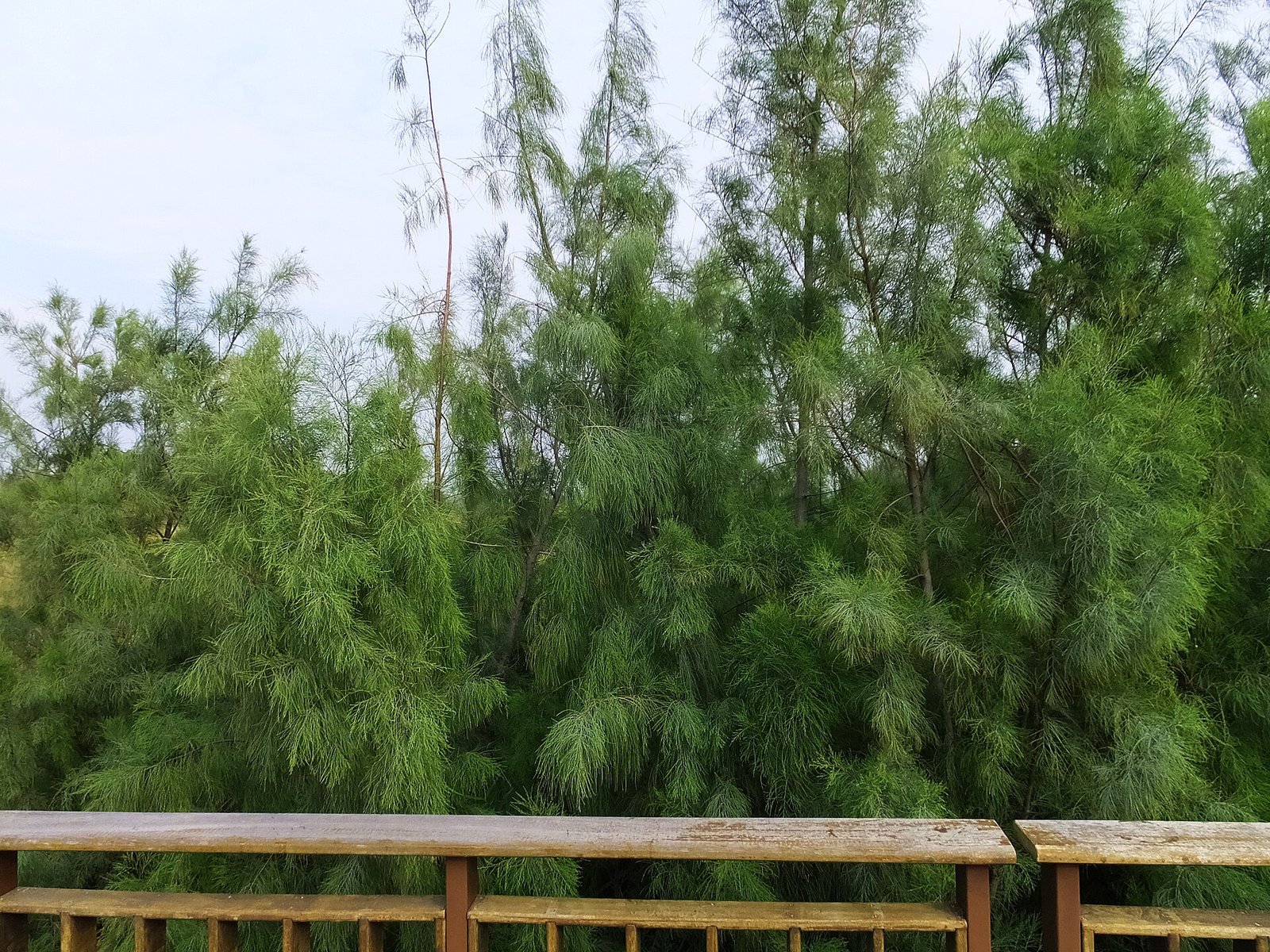
For local memories of the species here, see also the Hall of Local Memory.
History
Official recordThe official description reads: 「城西防風林位於曾文溪以南、鹿耳門溪以北的海岸線旁,最早日治時期(1910 年)即開始栽植木賊葉木麻黃,主要為飛砂防止保安林」 ("The Chengxi Windbreak Forest lies along the coastline south of the Zengwen River and north of the Luermen River; planting of Casuarina equisetifolia began as early as the Japanese colonial period (1910), and it is chiefly a sand-drift prevention protection forest") R001Source《台江國家公園植物資源調查》[Taijiang National Park Plant Resources Survey], commissioned by the Taijiang National Park Headquarters (台江處) from National University of Tainan (國立臺南大學), principal investigator Hsieh Tsung-hsin (謝宗欣), December 2019 (ROC year 108) (p. 16 species composition; p. 82 origins of the Chengxi Windbreak Forest and the Hoppo cicada; Table 14 long-term monitoring plots; rare plants and Asian nakedwood [亞洲濱棗])Original URLhttps://www.tjnp.gov.tw/Retrieved2026-10-19Snapshot timestamp—The report gives no source for the year in "1910 年開始栽植木賊葉木麻黃" ("planting of Casuarina equisetifolia began in 1910").. UnverifiedAfforestation (1910) and designation as a protection forest (1937-12-03) are two separate events, 27 years apart R001Source《台江國家公園植物資源調查》[Taijiang National Park Plant Resources Survey], commissioned by the Taijiang National Park Headquarters (台江處) from National University of Tainan (國立臺南大學), principal investigator Hsieh Tsung-hsin (謝宗欣), December 2019 (ROC year 108) (p. 16 species composition; p. 82 origins of the Chengxi Windbreak Forest and the Hoppo cicada; Table 14 long-term monitoring plots; rare plants and Asian nakedwood [亞洲濱棗])Original URLhttps://www.tjnp.gov.tw/Retrieved2026-10-19Snapshot timestamp—The report gives no source for the year in "1910 年開始栽植木賊葉木麻黃" ("planting of Casuarina equisetifolia began in 1910").R007SourceThe legal chain of the protection forest: incorporated by notice of the Office of the Governor-General of Taiwan (總督府) on 1937-12-03 (the two ōaza [大字] of Qingcaolun [青草崙] and Tuchengzi [土城子]); Forestry and Nature Conservation Agency (林業及自然保育署), 《全臺保安林分布概略圖》[Sketch Map of the Distribution of Protection Forests in Taiwan], edition 1151, No. 2105, 223.593830 ha; 《臺江國家公園計畫(第 1 次通盤檢討)核定本》[Taijiang National Park Plan (First Comprehensive Review), Approved Edition], Special Landscape Area 4 (特四), 213.90 ha (approved by the Executive Yuan [行政院] on 2018-06-05 [ROC 107.6.5], 院臺建字第 1070017849 號; promulgated by the Ministry of the Interior [內政部] on 2018-08-22 [ROC 107.8.22], 台內營字第 1070813932 號); Council of Agriculture, Executive Yuan (行政院農業委員會), 2023-05-30 (ROC 112.5.30), 農林務字第 1121607348 號, release of 0.779724 haOriginal URLhttps://gazette.nat.gov.tw/Retrieved2026-10-19Snapshot timestamp行政院公報第 029 卷第 100 期(metaid 140885),含 11 筆地號明細表與位置圖The agency itself notes that "保安林圖僅以概略圖稱之" ("the protection forest map is referred to only as a sketch map"); it may not be used to determine boundaries..
Official recordIn current map data, No. 2105 is the Chengxi forest proper, covering 223.59 hectares R007SourceThe legal chain of the protection forest: incorporated by notice of the Office of the Governor-General of Taiwan (總督府) on 1937-12-03 (the two ōaza [大字] of Qingcaolun [青草崙] and Tuchengzi [土城子]); Forestry and Nature Conservation Agency (林業及自然保育署), 《全臺保安林分布概略圖》[Sketch Map of the Distribution of Protection Forests in Taiwan], edition 1151, No. 2105, 223.593830 ha; 《臺江國家公園計畫(第 1 次通盤檢討)核定本》[Taijiang National Park Plan (First Comprehensive Review), Approved Edition], Special Landscape Area 4 (特四), 213.90 ha (approved by the Executive Yuan [行政院] on 2018-06-05 [ROC 107.6.5], 院臺建字第 1070017849 號; promulgated by the Ministry of the Interior [內政部] on 2018-08-22 [ROC 107.8.22], 台內營字第 1070813932 號); Council of Agriculture, Executive Yuan (行政院農業委員會), 2023-05-30 (ROC 112.5.30), 農林務字第 1121607348 號, release of 0.779724 haOriginal URLhttps://gazette.nat.gov.tw/Retrieved2026-10-19Snapshot timestamp行政院公報第 029 卷第 100 期(metaid 140885),含 11 筆地號明細表與位置圖The agency itself notes that "保安林圖僅以概略圖稱之" ("the protection forest map is referred to only as a sketch map"); it may not be used to determine boundaries.. The 2018 comprehensive review upgraded it to the 「特四-安南區沿岸保安林特別景觀區」 ("Special Landscape Area 4 – Annan District Coastal Protection Forest"), 213.90 hectares, with the stated rationale 「為維護海岸線,減緩海岸侵蝕」 ("to maintain the coastline and slow coastal erosion"); in 2023 the Council of Agriculture (農委會), citing the same plan, released 0.78 hectares of it as land for an environmental education site R007SourceThe legal chain of the protection forest: incorporated by notice of the Office of the Governor-General of Taiwan (總督府) on 1937-12-03 (the two ōaza [大字] of Qingcaolun [青草崙] and Tuchengzi [土城子]); Forestry and Nature Conservation Agency (林業及自然保育署), 《全臺保安林分布概略圖》[Sketch Map of the Distribution of Protection Forests in Taiwan], edition 1151, No. 2105, 223.593830 ha; 《臺江國家公園計畫(第 1 次通盤檢討)核定本》[Taijiang National Park Plan (First Comprehensive Review), Approved Edition], Special Landscape Area 4 (特四), 213.90 ha (approved by the Executive Yuan [行政院] on 2018-06-05 [ROC 107.6.5], 院臺建字第 1070017849 號; promulgated by the Ministry of the Interior [內政部] on 2018-08-22 [ROC 107.8.22], 台內營字第 1070813932 號); Council of Agriculture, Executive Yuan (行政院農業委員會), 2023-05-30 (ROC 112.5.30), 農林務字第 1121607348 號, release of 0.779724 haOriginal URLhttps://gazette.nat.gov.tw/Retrieved2026-10-19Snapshot timestamp行政院公報第 029 卷第 100 期(metaid 140885),含 11 筆地號明細表與位置圖The agency itself notes that "保安林圖僅以概略圖稱之" ("the protection forest map is referred to only as a sketch map"); it may not be used to determine boundaries.. UnverifiedThe release amounts to only 0.35 percent, while the upgraded area is 179.31 hectares R007SourceThe legal chain of the protection forest: incorporated by notice of the Office of the Governor-General of Taiwan (總督府) on 1937-12-03 (the two ōaza [大字] of Qingcaolun [青草崙] and Tuchengzi [土城子]); Forestry and Nature Conservation Agency (林業及自然保育署), 《全臺保安林分布概略圖》[Sketch Map of the Distribution of Protection Forests in Taiwan], edition 1151, No. 2105, 223.593830 ha; 《臺江國家公園計畫(第 1 次通盤檢討)核定本》[Taijiang National Park Plan (First Comprehensive Review), Approved Edition], Special Landscape Area 4 (特四), 213.90 ha (approved by the Executive Yuan [行政院] on 2018-06-05 [ROC 107.6.5], 院臺建字第 1070017849 號; promulgated by the Ministry of the Interior [內政部] on 2018-08-22 [ROC 107.8.22], 台內營字第 1070813932 號); Council of Agriculture, Executive Yuan (行政院農業委員會), 2023-05-30 (ROC 112.5.30), 農林務字第 1121607348 號, release of 0.779724 haOriginal URLhttps://gazette.nat.gov.tw/Retrieved2026-10-19Snapshot timestamp行政院公報第 029 卷第 100 期(metaid 140885),含 11 筆地號明細表與位置圖The agency itself notes that "保安林圖僅以概略圖稱之" ("the protection forest map is referred to only as a sketch map"); it may not be used to determine boundaries..
A woodland wetland of mingled salt and fresh water
MoreLess
Official recordThree mutually independent reports point to the same mechanism. The plant survey writes that the low-lying ground and channels inside the forest are 「易受漲退潮和夏季雨量影響,形成水域、陸地交互錯綜的地景」 ("readily affected by the rising and falling tides and by summer rainfall, forming a landscape in which water and land are intricately interwoven") R001Source《台江國家公園植物資源調查》[Taijiang National Park Plant Resources Survey], commissioned by the Taijiang National Park Headquarters (台江處) from National University of Tainan (國立臺南大學), principal investigator Hsieh Tsung-hsin (謝宗欣), December 2019 (ROC year 108) (p. 16 species composition; p. 82 origins of the Chengxi Windbreak Forest and the Hoppo cicada; Table 14 long-term monitoring plots; rare plants and Asian nakedwood [亞洲濱棗])Original URLhttps://www.tjnp.gov.tw/Retrieved2026-10-19Snapshot timestamp—The report gives no source for the year in "1910 年開始栽植木賊葉木麻黃" ("planting of Casuarina equisetifolia began in 1910").; the amphibian and reptile survey recorded four coastal frog species breeding in saline water bodies (1.05–7.25 ppt) R003Source《台江國家公園兩棲爬蟲類資源調查》[Taijiang National Park Amphibian and Reptile Resources Survey] (co-principal investigator Chang Yuan-mou (張原謀); pp. 2, 11, 48, 55, 79–80: four salt-tolerant frog species, the Chengxi population, the block with the highest species richness, Menghuan Lake salinity of 36 ppt and coordinates 23.04381/120.06829)Original URLhttps://www.tjnp.gov.tw/Retrieved2026-10-19Snapshot timestamp—; and the land crab survey states that 「北邊接近曾文溪的防風林內有感潮的溝渠及許多低漥積水區域,而南邊的防風林內則沒有」 ("the windbreak forest to the north, near the Zengwen River, has tidal ditches and many low-lying waterlogged areas, whereas the windbreak forest to the south does not") R002Source《台江國家公園陸蟹生態調查》[Land Crab Ecological Survey of Taijiang National Park], commissioned by the Taijiang National Park Headquarters from the Ecological Society of Taiwan (臺灣生態學會), principal investigator Liu Hung-chang (劉烘昌), March–December 2020 (ROC year 109), budget NT$975,000 (pp. 7, 11, 28, 98, 100, 106, 107, 132–134: population collapse, hotspots, measured body sizes, microhabitat factors, threats item by item, recommendation to close the flood-control road)Original URLhttps://www.tjnp.gov.tw/Retrieved2026-10-19Snapshot timestamp—.
Local oral account「不過「鹹淡交錯」四個字容易讓人誤會。在地人記得的是另一半:城西防風林裡其實沒有自己的淡水,這一帶的淡水是嘉南大圳引來灌溉的;林子本身隨潮汐起落,林間的水幾乎都是潮間帶的鹽度」 The phrase 「鹹淡交錯」 ("salt and fresh water intermingling"), however, is easily misread. Locals remember the other half of the picture: the Chengxi Windbreak Forest actually has no fresh water of its own; the fresh water in this area is brought in for irrigation by the Chianan Irrigation Canal (嘉南大圳). The forest itself rises and falls with the tides, and the water among the trees is almost all at intertidal salinity R008SourceLocal oral account (the project author; personally witnessed/personal judgment)Original URL—Retrieved2026-10-19Snapshot timestamp—.
Official recordOnly the tadpoles of the "Chengxi population" (「城西族群」) of the Indian rice frog (澤蛙) can successfully complete metamorphosis at a salinity of 9 ppt — a population name formally identified in the scientific literature R003Source《台江國家公園兩棲爬蟲類資源調查》[Taijiang National Park Amphibian and Reptile Resources Survey] (co-principal investigator Chang Yuan-mou (張原謀); pp. 2, 11, 48, 55, 79–80: four salt-tolerant frog species, the Chengxi population, the block with the highest species richness, Menghuan Lake salinity of 36 ppt and coordinates 23.04381/120.06829)Original URLhttps://www.tjnp.gov.tw/Retrieved2026-10-19Snapshot timestamp—. UnverifiedIn addition, Menghuan Lake (夢幻湖) at Qingcaolun (青草崙) measured a salinity of 36 ppt, and its water-body type is listed as a "tidal creek" (「潮溝」); it is not a freshwater lake R003Source《台江國家公園兩棲爬蟲類資源調查》[Taijiang National Park Amphibian and Reptile Resources Survey] (co-principal investigator Chang Yuan-mou (張原謀); pp. 2, 11, 48, 55, 79–80: four salt-tolerant frog species, the Chengxi population, the block with the highest species richness, Menghuan Lake salinity of 36 ppt and coordinates 23.04381/120.06829)Original URLhttps://www.tjnp.gov.tw/Retrieved2026-10-19Snapshot timestamp—.
Five years of change in the land crab population
MoreLess
Official recordThe official characterization is: 「曾文溪口南岸的城西里海岸防風林下更有龐大的兇狠圓軸蟹族群,每年有超過 4500 隻抱卵雌蟹進行降海釋幼的遷徙,是臺灣目前已知的大型陸蟹最大族群」 ("beneath the coastal windbreak forest of Chengxi Village on the south bank of the Zengwen River estuary lives a huge population of brown land crabs; every year more than 4,500 egg-bearing females migrate to the sea to release their larvae, making it the largest population of large land crabs currently known in Taiwan") R002Source《台江國家公園陸蟹生態調查》[Land Crab Ecological Survey of Taijiang National Park], commissioned by the Taijiang National Park Headquarters from the Ecological Society of Taiwan (臺灣生態學會), principal investigator Liu Hung-chang (劉烘昌), March–December 2020 (ROC year 109), budget NT$975,000 (pp. 7, 11, 28, 98, 100, 106, 107, 132–134: population collapse, hotspots, measured body sizes, microhabitat factors, threats item by item, recommendation to close the flood-control road)Original URLhttps://www.tjnp.gov.tw/Retrieved2026-10-19Snapshot timestamp—. Yet the same report measured a decline: egg-bearing females fell from 4,500 in 2015 to 1,728 counted in 2020. The official conclusion is 「5 年間族群數量已有顯著的下降」 ("the population has declined significantly over five years"), attributed directly to poaching R002Source《台江國家公園陸蟹生態調查》[Land Crab Ecological Survey of Taijiang National Park], commissioned by the Taijiang National Park Headquarters from the Ecological Society of Taiwan (臺灣生態學會), principal investigator Liu Hung-chang (劉烘昌), March–December 2020 (ROC year 109), budget NT$975,000 (pp. 7, 11, 28, 98, 100, 106, 107, 132–134: population collapse, hotspots, measured body sizes, microhabitat factors, threats item by item, recommendation to close the flood-control road)Original URLhttps://www.tjnp.gov.tw/Retrieved2026-10-19Snapshot timestamp—.
Official recordThe extent of the hotspot and its species count: Menghuan Lake at Qingcaolun and the surrounding coastal forest cover about 50 hectares, with 23 species of supratidal land crabs, 85.2 percent of all species in the park R002Source《台江國家公園陸蟹生態調查》[Land Crab Ecological Survey of Taijiang National Park], commissioned by the Taijiang National Park Headquarters from the Ecological Society of Taiwan (臺灣生態學會), principal investigator Liu Hung-chang (劉烘昌), March–December 2020 (ROC year 109), budget NT$975,000 (pp. 7, 11, 28, 98, 100, 106, 107, 132–134: population collapse, hotspots, measured body sizes, microhabitat factors, threats item by item, recommendation to close the flood-control road)Original URLhttps://www.tjnp.gov.tw/Retrieved2026-10-19Snapshot timestamp—. What determines where they live is not vegetation: 「洞內的水以具有鹽度的半鹹水為主……植被類型並不重要」 ("the water in the burrows is mainly saline brackish water ... the vegetation type is not important") R002Source《台江國家公園陸蟹生態調查》[Land Crab Ecological Survey of Taijiang National Park], commissioned by the Taijiang National Park Headquarters from the Ecological Society of Taiwan (臺灣生態學會), principal investigator Liu Hung-chang (劉烘昌), March–December 2020 (ROC year 109), budget NT$975,000 (pp. 7, 11, 28, 98, 100, 106, 107, 132–134: population collapse, hotspots, measured body sizes, microhabitat factors, threats item by item, recommendation to close the flood-control road)Original URLhttps://www.tjnp.gov.tw/Retrieved2026-10-19Snapshot timestamp—. The official recommendation is to close about 2 kilometers of the flood-control road during the peak of the larval-release migration; the Taijiang National Park Headquarters (台江處) replied that the improvement works on an alternative road have been completed — the works are done; what remains is a timetable for the closures R002Source《台江國家公園陸蟹生態調查》[Land Crab Ecological Survey of Taijiang National Park], commissioned by the Taijiang National Park Headquarters from the Ecological Society of Taiwan (臺灣生態學會), principal investigator Liu Hung-chang (劉烘昌), March–December 2020 (ROC year 109), budget NT$975,000 (pp. 7, 11, 28, 98, 100, 106, 107, 132–134: population collapse, hotspots, measured body sizes, microhabitat factors, threats item by item, recommendation to close the flood-control road)Original URLhttps://www.tjnp.gov.tw/Retrieved2026-10-19Snapshot timestamp—.
Local oral account「在地人看見陸蟹最多的那條路段,正是官方認定的熱點」 The stretch of road where locals see the most land crabs is exactly the hotspot identified by the authorities R008SourceLocal oral account (the project author; personally witnessed/personal judgment)Original URL—Retrieved2026-10-19Snapshot timestamp—; for material on both sides of the seawall, see 5.3b The Two Faces of the Qingcaolun Seawall. Unverified「另一條口述說角眼沙蟹的體型變小了」 Another oral account says that horned ghost crabs (角眼沙蟹) have become smaller R008SourceLocal oral account (the project author; personally witnessed/personal judgment)Original URL—Retrieved2026-10-19Snapshot timestamp—.
Cicadas, frogs, and insects
MoreLess
Official recordThe official record on the Hoppo cicada (臺灣暗蟬) reads: 「防風林區內還是臺灣暗蟬主要的棲地,還有眾多的凶狠圓軸蟹生存其間,實值得加以監測保護」 ("the windbreak forest area is also the main habitat of the Hoppo cicada, and large numbers of brown land crabs live there too; it truly merits monitoring and protection") R001Source《台江國家公園植物資源調查》[Taijiang National Park Plant Resources Survey], commissioned by the Taijiang National Park Headquarters (台江處) from National University of Tainan (國立臺南大學), principal investigator Hsieh Tsung-hsin (謝宗欣), December 2019 (ROC year 108) (p. 16 species composition; p. 82 origins of the Chengxi Windbreak Forest and the Hoppo cicada; Table 14 long-term monitoring plots; rare plants and Asian nakedwood [亞洲濱棗])Original URLhttps://www.tjnp.gov.tw/Retrieved2026-10-19Snapshot timestamp—The report gives no source for the year in "1910 年開始栽植木賊葉木麻黃" ("planting of Casuarina equisetifolia began in 1910").. UnverifiedA member of the official review committee rejected on the spot a habitat-creation proposal to 「刻意種植木麻黃等外來種」 ("deliberately plant beach she-oak and other non-native species") R005Source《台江國家公園昆蟲相及北埔蟬先期調查》[Preliminary Survey of the Insect Fauna and the Hoppo Cicada of Taijiang National Park], 2014 (ROC year 103), Chang Yuan-mou, National University of Tainan (9 orders, 49 families, 107 species; Table 5; Appendix 6; mid-term and final review comments; printed pp. 12, 38, 42)Original URLhttps://www.tjnp.gov.tw/Retrieved2026-10-19Snapshot timestamp—.
Official recordWithin Taijiang National Park, the banded bullfrog (亞洲錦蛙) is found mainly in Chengxi R020SourceChen Ching-chi (陳清旗), 《台江國家公園外來入侵種亞洲錦蛙監測移除計畫》成果報告書 [Final Report of the Project for Monitoring and Removing the Invasive Alien Banded Bullfrog in Taijiang National Park], commissioned by the 台江國家公園管理處 [Taijiang National Park Headquarters], 2019-12Original URLhttps://ws.moi.gov.tw/001/Upload/OldFile_TJNP/Result/20200116142251508489.pdfRetrieved2026-11-01Snapshot timestamp—SourceFrom 《Monitoring and Removal Project for the Invasive Alien Asian Painted Frog in Taijiang National Park (台江國家公園外來入侵種亞洲錦蛙監測移除計畫)》p. 摘要、1、5–7R021SourceChen Ching-chi (陳清旗), 《109年台江國家公園外來入侵種亞洲錦蛙監測移除計畫》成果報告書 [Final Report of the 2020 Project for Monitoring and Removing the Invasive Alien Banded Bullfrog in Taijiang National Park], commissioned by the 台江國家公園管理處 [Taijiang National Park Headquarters], 2020-12Original URLhttps://ws.moi.gov.tw/001/Upload/OldFile_TJNP/Result/20210118153039575530.pdfRetrieved2026-11-01Snapshot timestamp—SourceFrom 《2020 (ROC Year 109) Monitoring and Removal Plan for the Invasive Alien Asian Painted Frog in Taijiang National Park (109年台江國家公園外來入侵種亞洲錦蛙監測移除計畫)》p. 5–7、12–13Table 2 (p. 12): numbers removed in each round; Table 5 (p. 13): the three sections of the flood-control road. The sex subtotals in Table 5 do not match Table 3, so this site cites only the totals column.: in 2020 the authorities walked the flood-control road seven times and removed 1,176 individuals, 715 of them from the bicycle-path section alone R006SourceTwo official reports on the removal of the banded bullfrog (亞洲錦蛙) (2019 [ROC year 108], Chen Ching-chi (陳清旗); 2020 [ROC year 109], three rounds from May to September, 9 grid cells, 151 visit-counts, 1,176 individuals removed, three flood-control road sections A 247/B 195/C 715, age-class composition, official recommendations and three points that cannot be stated)Original URLhttps://www.tjnp.gov.tw/Retrieved2026-10-19Snapshot timestamp—. The same report also recorded calling males, eggs and tadpoles near the Taijiang National Park Headquarters (grid cell 166), suggesting that a population may already have become established there R021SourceChen Ching-chi (陳清旗), 《109年台江國家公園外來入侵種亞洲錦蛙監測移除計畫》成果報告書 [Final Report of the 2020 Project for Monitoring and Removing the Invasive Alien Banded Bullfrog in Taijiang National Park], commissioned by the 台江國家公園管理處 [Taijiang National Park Headquarters], 2020-12Original URLhttps://ws.moi.gov.tw/001/Upload/OldFile_TJNP/Result/20210118153039575530.pdfRetrieved2026-11-01Snapshot timestamp—SourceFrom 《2020 (ROC Year 109) Monitoring and Removal Plan for the Invasive Alien Asian Painted Frog in Taijiang National Park (109年台江國家公園外來入侵種亞洲錦蛙監測移除計畫)》p. 5–7、12–13Table 2 (p. 12): numbers removed in each round; Table 5 (p. 13): the three sections of the flood-control road. The sex subtotals in Table 5 do not match Table 3, so this site cites only the totals column.; Secondhand accounta citizen-science platform also has a record from Zhongjia Village (忠嘉里), Jiangjun District, in June 2026 R025SourceiNaturalist observation records: Kaloula pulchra (亞洲錦蛙, banded bullfrog), 297926207 (2025-07-12, Chengxi Village, Annan District, emily_chang, CC BY), 385963368 (2026-07-28, Chengxi Village, Annan District, bales20147, CC BY-NC), 368303437 (2026-06-04, Zhongjia Village, Jiangjun District, edwardlin, CC BY-NC), all Research GradeOriginal URLhttps://www.inaturalist.org/observations/368303437Retrieved2026-11-01Snapshot timestamp—The other two records: https://www.inaturalist.org/observations/297926207 and https://www.inaturalist.org/observations/385963368 . Citizen-science records, not official surveys.. This bicycle path is at once the officially identified land crab hotspot section, the section where locals have personally seen the most land crabs, and the one visitors walk R002Source《台江國家公園陸蟹生態調查》[Land Crab Ecological Survey of Taijiang National Park], commissioned by the Taijiang National Park Headquarters from the Ecological Society of Taiwan (臺灣生態學會), principal investigator Liu Hung-chang (劉烘昌), March–December 2020 (ROC year 109), budget NT$975,000 (pp. 7, 11, 28, 98, 100, 106, 107, 132–134: population collapse, hotspots, measured body sizes, microhabitat factors, threats item by item, recommendation to close the flood-control road)Original URLhttps://www.tjnp.gov.tw/Retrieved2026-10-19Snapshot timestamp—R006SourceTwo official reports on the removal of the banded bullfrog (亞洲錦蛙) (2019 [ROC year 108], Chen Ching-chi (陳清旗); 2020 [ROC year 109], three rounds from May to September, 9 grid cells, 151 visit-counts, 1,176 individuals removed, three flood-control road sections A 247/B 195/C 715, age-class composition, official recommendations and three points that cannot be stated)Original URLhttps://www.tjnp.gov.tw/Retrieved2026-10-19Snapshot timestamp—R008SourceLocal oral account (the project author; personally witnessed/personal judgment)Original URL—Retrieved2026-10-19Snapshot timestamp—. UnverifiedOn the banded bullfrog's impact on native frogs, the authorities state plainly that it 「尚無法評估」 ("cannot yet be assessed") R006SourceTwo official reports on the removal of the banded bullfrog (亞洲錦蛙) (2019 [ROC year 108], Chen Ching-chi (陳清旗); 2020 [ROC year 109], three rounds from May to September, 9 grid cells, 151 visit-counts, 1,176 individuals removed, three flood-control road sections A 247/B 195/C 715, age-class composition, official recommendations and three points that cannot be stated)Original URLhttps://www.tjnp.gov.tw/Retrieved2026-10-19Snapshot timestamp—. The removed animals are euthanized R006SourceTwo official reports on the removal of the banded bullfrog (亞洲錦蛙) (2019 [ROC year 108], Chen Ching-chi (陳清旗); 2020 [ROC year 109], three rounds from May to September, 9 grid cells, 151 visit-counts, 1,176 individuals removed, three flood-control road sections A 247/B 195/C 715, age-class composition, official recommendations and three points that cannot be stated)Original URLhttps://www.tjnp.gov.tw/Retrieved2026-10-19Snapshot timestamp—.
Local oral account「螢火蟲在城西有在地目擊,只是品種不確定」 Fireflies have been sighted locally in Chengxi, though the species is uncertain R008SourceLocal oral account (the project author; personally witnessed/personal judgment)Original URL—Retrieved2026-10-19Snapshot timestamp—. Official recordOn aquatic insects, the authorities recorded two water scavenger beetles (水生牙蟲), both in the Chengxi Village Windbreak Forest R005Source《台江國家公園昆蟲相及北埔蟬先期調查》[Preliminary Survey of the Insect Fauna and the Hoppo Cicada of Taijiang National Park], 2014 (ROC year 103), Chang Yuan-mou, National University of Tainan (9 orders, 49 families, 107 species; Table 5; Appendix 6; mid-term and final review comments; printed pp. 12, 38, 42)Original URLhttps://www.tjnp.gov.tw/Retrieved2026-10-19Snapshot timestamp—.
Plants, bats, and birds
Official recordThree rare plants in Taijiang grow only in the Chengxi Windbreak Forest; it is also the site of the newly discovered endangered Asian nakedwood (亞洲濱棗), and it has been designated the representative monitoring plot for windbreak-forest vegetation R001Source《台江國家公園植物資源調查》[Taijiang National Park Plant Resources Survey], commissioned by the Taijiang National Park Headquarters (台江處) from National University of Tainan (國立臺南大學), principal investigator Hsieh Tsung-hsin (謝宗欣), December 2019 (ROC year 108) (p. 16 species composition; p. 82 origins of the Chengxi Windbreak Forest and the Hoppo cicada; Table 14 long-term monitoring plots; rare plants and Asian nakedwood [亞洲濱棗])Original URLhttps://www.tjnp.gov.tw/Retrieved2026-10-19Snapshot timestamp—The report gives no source for the year in "1910 年開始栽植木賊葉木麻黃" ("planting of Casuarina equisetifolia began in 1910").. On the mammal side, echolocation calls of the Formosan golden bat (金黃鼠耳蝠), listed as Nationally Vulnerable, were recorded in plot A5 R004Source《台江國家公園陸域哺乳類生態資源基礎調查》[Baseline Survey of Terrestrial Mammal Ecological Resources in Taijiang National Park], commissioned by the Taijiang National Park Headquarters from National Chiayi University (國立嘉義大學), principal investigator Liu Chien-nan (劉建男), December 2019 (ROC year 108), 121 pp. (plots A5/A6; the Formosan golden bat [金黃鼠耳蝠] listed as Nationally Vulnerable (NVU); masked palm civet absent from Chengxi; pp. 37, 50, 54, 68)Original URLhttps://www.tjnp.gov.tw/Retrieved2026-10-19Snapshot timestamp—. UnverifiedThe masked palm civet is absent from Chengxi: seven cameras over four seasons logged more than 10,000 working hours in the Chengxi section with zero records R004Source《台江國家公園陸域哺乳類生態資源基礎調查》[Baseline Survey of Terrestrial Mammal Ecological Resources in Taijiang National Park], commissioned by the Taijiang National Park Headquarters from National Chiayi University (國立嘉義大學), principal investigator Liu Chien-nan (劉建男), December 2019 (ROC year 108), 121 pp. (plots A5/A6; the Formosan golden bat [金黃鼠耳蝠] listed as Nationally Vulnerable (NVU); masked palm civet absent from Chengxi; pp. 37, 50, 54, 68)Original URLhttps://www.tjnp.gov.tw/Retrieved2026-10-19Snapshot timestamp—.
Official recordThe birds offer a clear contrast: there are 21 legally protected species here, and the most frequently recorded is not the black-faced spoonbill but the brown shrike (紅尾伯勞) (80.5 percent) and the black-winged kite (黑翅鳶) (66.4 percent) R009SourceCross-check of legally protected species at the Chengxi Windbreak Forest hotspot (21 species: Class I 1, Class II 15, Class III 5; brown shrike in 91/113 hotspots, 80.5%; black-winged kite in 75/113 hotspots, 66.4%) and the eBird hotspot list (Chengxi Protection Forest area [城西保安林區] L12146808, 169 species, 41 of which are absent from the mouth of the Yanshui River)Original URLhttps://ebird.org/hotspot/L12146808Retrieved2026-10-19Snapshot timestamp—. The ecological role of the windbreak forest is for raptors and woodland birds; that of the fish farm ponds is for waterbirds R009SourceCross-check of legally protected species at the Chengxi Windbreak Forest hotspot (21 species: Class I 1, Class II 15, Class III 5; brown shrike in 91/113 hotspots, 80.5%; black-winged kite in 75/113 hotspots, 66.4%) and the eBird hotspot list (Chengxi Protection Forest area [城西保安林區] L12146808, 169 species, 41 of which are absent from the mouth of the Yanshui River)Original URLhttps://ebird.org/hotspot/L12146808Retrieved2026-10-19Snapshot timestamp—.
Chronology: ecological surveys of Chengxi
First items: Planting of Casuarina equisetifolia bega…A notice of the Office of the Governor-G…Lin Cheng-mei (林正美) and Chen Chien-hung …MoreLess
- 1910
Planting of Casuarina equisetifolia bega…MoreLess
Planting of Casuarina equisetifolia began in Chengxi during the Japanese colonial period, as a sand-drift prevention protection forest R001Source《台江國家公園植物資源調查》[Taijiang National Park Plant Resources Survey], commissioned by the Taijiang National Park Headquarters (台江處) from National University of Tainan (國立臺南大學), principal investigator Hsieh Tsung-hsin (謝宗欣), December 2019 (ROC year 108) (p. 16 species composition; p. 82 origins of the Chengxi Windbreak Forest and the Hoppo cicada; Table 14 long-term monitoring plots; rare plants and Asian nakedwood [亞洲濱棗])Original URLhttps://www.tjnp.gov.tw/Retrieved2026-10-19Snapshot timestamp—The report gives no source for the year in "1910 年開始栽植木賊葉木麻黃" ("planting of Casuarina equisetifolia began in 1910")..
- 1937
12-03A notice of the Office of the Governor-G…MoreLess
A notice of the Office of the Governor-General incorporated the forest land of the two ōaza of Qingcaolun and Tuchengzi into the protection forest system R007SourceThe legal chain of the protection forest: incorporated by notice of the Office of the Governor-General of Taiwan (總督府) on 1937-12-03 (the two ōaza [大字] of Qingcaolun [青草崙] and Tuchengzi [土城子]); Forestry and Nature Conservation Agency (林業及自然保育署), 《全臺保安林分布概略圖》[Sketch Map of the Distribution of Protection Forests in Taiwan], edition 1151, No. 2105, 223.593830 ha; 《臺江國家公園計畫(第 1 次通盤檢討)核定本》[Taijiang National Park Plan (First Comprehensive Review), Approved Edition], Special Landscape Area 4 (特四), 213.90 ha (approved by the Executive Yuan [行政院] on 2018-06-05 [ROC 107.6.5], 院臺建字第 1070017849 號; promulgated by the Ministry of the Interior [內政部] on 2018-08-22 [ROC 107.8.22], 台內營字第 1070813932 號); Council of Agriculture, Executive Yuan (行政院農業委員會), 2023-05-30 (ROC 112.5.30), 農林務字第 1121607348 號, release of 0.779724 haOriginal URLhttps://gazette.nat.gov.tw/Retrieved2026-10-19Snapshot timestamp行政院公報第 029 卷第 100 期(metaid 140885),含 11 筆地號明細表與位置圖The agency itself notes that "保安林圖僅以概略圖稱之" ("the protection forest map is referred to only as a sketch map"); it may not be used to determine boundaries..
- 2001
2001~2003Lin Cheng-mei (林正美) and Chen Chien-hung …MoreLess
Lin Cheng-mei (林正美) and Chen Chien-hung (陳建宏) rediscovered a large population of the Hoppo cicada (北埔蟬, i.e., 臺灣暗蟬) in Chengxi Village R022SourceChang Yuan-mou (張原謀) and Huang Wen-po (黃文伯), 《103年台江國家公園昆蟲相及北埔蟬先期調查》[Preliminary Survey of the Insect Fauna and the Hoppo Cicada in Taijiang National Park, 2014], commissioned by the 台江國家公園管理處 [Taijiang National Park Headquarters], 2014-11Original URLhttp://www.tjnp.gov.tw/FileDownLoad/Result/20150202144659972976.pdfRetrieved2026-11-01Snapshot timestamp—SourceFrom 《Preliminary Survey of the Insect Fauna and the Hoppo Cicada in Taijiang National Park, 2014 (103年台江國家公園昆蟲相及北埔蟬先期調查)》p. 2–3、8、11–12、38、52–58Pp. 2–3 relay that Lin Cheng-mei (林正美) and Chen Chien-hung (陳建宏) rediscovered a large population of the Hoppo cicada in Chengxi Village in 2001–2003; Appendix 6 lists the collection records one by one..
- 2014
The preliminary survey of the insect fau…MoreLess
The preliminary survey of the insect fauna and the Hoppo cicada recorded 9 orders, 49 families and 107 species, with the Chengxi Village Windbreak Forest as the only sampling site in Tucheng; at the review, the authorities requested an additional survey of aquatic insects R022SourceChang Yuan-mou (張原謀) and Huang Wen-po (黃文伯), 《103年台江國家公園昆蟲相及北埔蟬先期調查》[Preliminary Survey of the Insect Fauna and the Hoppo Cicada in Taijiang National Park, 2014], commissioned by the 台江國家公園管理處 [Taijiang National Park Headquarters], 2014-11Original URLhttp://www.tjnp.gov.tw/FileDownLoad/Result/20150202144659972976.pdfRetrieved2026-11-01Snapshot timestamp—SourceFrom 《Preliminary Survey of the Insect Fauna and the Hoppo Cicada in Taijiang National Park, 2014 (103年台江國家公園昆蟲相及北埔蟬先期調查)》p. 2–3、8、11–12、38、52–58Pp. 2–3 relay that Lin Cheng-mei (林正美) and Chen Chien-hung (陳建宏) rediscovered a large population of the Hoppo cicada in Chengxi Village in 2001–2003; Appendix 6 lists the collection records one by one..
- 2015
A botulism poisoning incident occurred i…MoreLess
A botulism poisoning incident occurred in Tucheng; T69, a black-faced spoonbill that was rescued, has returned to Tucheng every year since its release R014SourceKuo Tung-hui (郭東輝), principal investigator, 《106年台江國家公園及其週緣地區黑面琵鷺與伴生鳥種數量調查》[Survey of Black-faced Spoonbill and Associated Bird Species Numbers in Taijiang National Park and Its Surrounding Areas, ROC Year 106], contracted to 社團法人台南市野鳥學會 [Wild Bird Society of Tainan], commissioned by the 台江國家公園管理處 [Taijiang National Park Headquarters]Original URLhttps://ws.moi.gov.tw/001/Upload/OldFile_TJNP/Result/20181102140803716206.pdfRetrieved2026-11-01Snapshot timestamp—SourceFrom 《Survey of Black-faced Spoonbill and Associated Bird Species Numbers in Taijiang National Park and Its Surrounding Areas, ROC Year 106 (106年台江國家公園及其週緣地區黑面琵鷺與伴生鳥種數量調查)》p. 36、51、59P. 51, Table 13: Tucheng, 90 species, 28,464 individual-counts (the main text gives 93 species)..
- 2016
A study by Chang et al. recorded 4 frog …MoreLess
A study by Chang et al. recorded 4 frog species breeding in saline water bodies of 1.05–7.25 ppt in the Chengxi Windbreak Forest R017SourceChuang Meng-hsien (莊孟憲) and Chang Yuan-mou (張原謀), 《台江國家公園陸域兩棲爬蟲類生態資源基礎調查》[Baseline Survey of Terrestrial Amphibian and Reptile Ecological Resources in Taijiang National Park], commissioned by the 台江國家公園管理處 [Taijiang National Park Headquarters], 2018-12Original URLhttps://ws.moi.gov.tw/001/Upload/OldFile_TJNP/Result/20190111173853117522.pdfRetrieved2026-11-01Snapshot timestamp—SourceFrom 《Baseline Survey of Terrestrial Amphibian and Reptile Ecological Resources in Taijiang National Park (台江國家公園陸域兩棲爬蟲類生態資源基礎調查)》p. 2、22、23、28、46、48、67、80–82P. 48: species in Chengxi grid cells 97, 98, 105 and 112; p. 28: 24 individual banded bullfrogs; p. 67: resident interviews..
- 2017
A National University of Tainan team sur…MoreLess
A National University of Tainan team surveyed 9 sectors of the Chengxi wetland throughout the year, recording 37 families and 86 species of birds and 18,917 individual-counts R010SourceWang Yi-kuang (王一匡), principal investigator, 《台江國家公園及其周緣緩衝區多樣性棲地營造與評估計畫(2/4)》[Diverse Habitat Creation and Assessment Project for Taijiang National Park and Its Surrounding Buffer Zone (2/4)], contracted to 國立臺南大學 [National University of Tainan], commissioned by the 台江國家公園管理處 [Taijiang National Park Headquarters], 2017 (ROC year 106)Original URLhttps://ws.moi.gov.tw/001/Upload/OldFile_TJNP/Result/20180109163250384901.pdfRetrieved2026-11-01Snapshot timestamp—SourceFrom 《Diverse Habitat Creation and Assessment Project for Taijiang National Park and Its Surrounding Buffer Zone (2/4) (台江國家公園及其周緣緩衝區多樣性棲地營造與評估計畫(2/4))》p. 186、233P. 186: birds of the Chengxi wetland in 2017 (ROC 106), 37 families, 86 species, 18,917 individual-counts, and the dominant species; p. 233, Table 6-87: dioxins in the flesh of hybrid tilapia from Chengxi..A citizen-science bat echolocation surve…MoreLess
A citizen-science bat echolocation survey recorded 8 bat species R019SourceChou Cheng-han (周政翰), principal investigator, 《台江國家公園試行公民科學家蝙蝠回聲定位調查計畫》[Pilot Citizen-Scientist Bat Echolocation Survey Project in Taijiang National Park], commissioned by the 台江國家公園管理處 [Taijiang National Park Headquarters], 2017-11Original URLhttps://ws.moi.gov.tw/001/Upload/OldFile_TJNP/Result/20180109172450529826.pdfRetrieved2026-11-01Snapshot timestamp—SourceFrom 《Pilot Citizen-Scientist Bat Echolocation Survey Project in Taijiang National Park (台江國家公園試行公民科學家蝙蝠回聲定位調查計畫)》p. 3–4.The residents Wang Chuan-yu (王筌宥) and Wu…MoreLess
The residents Wang Chuan-yu (王筌宥) and Wu Jui-chang (吳瑞昌) sighted banded bullfrogs on the Chengxi flood-control road R017SourceChuang Meng-hsien (莊孟憲) and Chang Yuan-mou (張原謀), 《台江國家公園陸域兩棲爬蟲類生態資源基礎調查》[Baseline Survey of Terrestrial Amphibian and Reptile Ecological Resources in Taijiang National Park], commissioned by the 台江國家公園管理處 [Taijiang National Park Headquarters], 2018-12Original URLhttps://ws.moi.gov.tw/001/Upload/OldFile_TJNP/Result/20190111173853117522.pdfRetrieved2026-11-01Snapshot timestamp—SourceFrom 《Baseline Survey of Terrestrial Amphibian and Reptile Ecological Resources in Taijiang National Park (台江國家公園陸域兩棲爬蟲類生態資源基礎調查)》p. 2、22、23、28、46、48、67、80–82P. 48: species in Chengxi grid cells 97, 98, 105 and 112; p. 28: 24 individual banded bullfrogs; p. 67: resident interviews..12-01A dead black-faced spoonbill was found i…MoreLess
A dead black-faced spoonbill was found in the triangular fish pond where Anqing Road (安清路) in Tucheng turns toward the Lady Cai Temple (蔡姑娘廟); laboratory tests identified avian influenza R014SourceKuo Tung-hui (郭東輝), principal investigator, 《106年台江國家公園及其週緣地區黑面琵鷺與伴生鳥種數量調查》[Survey of Black-faced Spoonbill and Associated Bird Species Numbers in Taijiang National Park and Its Surrounding Areas, ROC Year 106], contracted to 社團法人台南市野鳥學會 [Wild Bird Society of Tainan], commissioned by the 台江國家公園管理處 [Taijiang National Park Headquarters]Original URLhttps://ws.moi.gov.tw/001/Upload/OldFile_TJNP/Result/20181102140803716206.pdfRetrieved2026-11-01Snapshot timestamp—SourceFrom 《Survey of Black-faced Spoonbill and Associated Bird Species Numbers in Taijiang National Park and Its Surrounding Areas, ROC Year 106 (106年台江國家公園及其週緣地區黑面琵鷺與伴生鳥種數量調查)》p. 36、51、59P. 51, Table 13: Tucheng, 90 species, 28,464 individual-counts (the main text gives 93 species)..
- 2018
From February, the Chengxi survey was ch…MoreLess
From February, the Chengxi survey was changed to 7 sectors, adding Old Luermen (古鹿耳門), Pailou (牌樓) and Chengxi Street (城西街) R011SourceWang Yi-kuang (王一匡), principal investigator, 《台江國家公園及其周緣緩衝區多樣性棲地營造與評估計畫(3/4)》[Project for Creating and Assessing Diverse Habitats in Taijiang National Park and Its Surrounding Buffer Zone (3/4)], contracted to 國立臺南大學 [National University of Tainan], commissioned by the 台江國家公園管理處 [Taijiang National Park Headquarters], 2018 (ROC year 107)Original URLhttps://ws.moi.gov.tw/001/Upload/OldFile_TJNP/Result/20190111173527131907.pdfRetrieved2026-11-01Snapshot timestamp—SourceFrom 《Diverse Habitat Creation and Assessment Project for Taijiang National Park and Its Surrounding Buffer Zone (3/4) (台江國家公園及其周緣緩衝區多樣性棲地營造與評估計畫(3/4))》p. 181From February 2018 the survey was changed to 7 sectors (adding Old Luermen, Pailou and Chengxi Street); dominant species in 2018 (ROC 107)..The baseline amphibian and reptile surve…MoreLess
The baseline amphibian and reptile survey recorded 12 families and 26 species across the whole area, with 4 new records (brahminy blind snake, greater green snake, red-banded snake and Taiwan kukri snake [赤背松柏根]); the roadkill hotspot was on Anqing Road; 24 individual banded bullfrogs were recorded in the Chengxi area R017SourceChuang Meng-hsien (莊孟憲) and Chang Yuan-mou (張原謀), 《台江國家公園陸域兩棲爬蟲類生態資源基礎調查》[Baseline Survey of Terrestrial Amphibian and Reptile Ecological Resources in Taijiang National Park], commissioned by the 台江國家公園管理處 [Taijiang National Park Headquarters], 2018-12Original URLhttps://ws.moi.gov.tw/001/Upload/OldFile_TJNP/Result/20190111173853117522.pdfRetrieved2026-11-01Snapshot timestamp—SourceFrom 《Baseline Survey of Terrestrial Amphibian and Reptile Ecological Resources in Taijiang National Park (台江國家公園陸域兩棲爬蟲類生態資源基礎調查)》p. 2、22、23、28、46、48、67、80–82P. 48: species in Chengxi grid cells 97, 98, 105 and 112; p. 28: 24 individual banded bullfrogs; p. 67: resident interviews..10-31The satellite-tracked black-faced spoonb…MoreLess
The satellite-tracked black-faced spoonbill family V17 flew from its main roosting site in Qigu to Chengnan Village (城南里) in Tucheng R015SourceKuo Tung-hui (郭東輝), principal investigator, 《107年台江國家公園及其週緣地區黑面琵鷺數量調查》[Survey of Black-faced Spoonbill Numbers in Taijiang National Park and Its Surrounding Areas, ROC Year 107], contracted to 社團法人台南市野鳥學會 [Wild Bird Society of Tainan], commissioned by the 台江國家公園管理處 [Taijiang National Park Headquarters]Original URLhttps://ws.moi.gov.tw/001/Upload/OldFile_TJNP/Result/20200116114609448526.pdfRetrieved2026-11-01Snapshot timestamp—SourceFrom 《Survey of Black-faced Spoonbill Numbers in Taijiang National Park and Its Surrounding Areas, ROC Year 107 (107年台江國家公園及其週緣地區黑面琵鷺數量調查)》p. 58.10~2019-03Seven hotspots around Chengxi recorded 5…MoreLess
Seven hotspots around Chengxi recorded 54 bird species and 74,587 individual-counts R012SourceWang Yi-kuang (王一匡), principal investigator, 《台江國家公園及其周緣緩衝區多樣性棲地營造與評估計畫(4/4)》[Diverse Habitat Creation and Assessment Project for Taijiang National Park and Its Surrounding Buffer Zone (4/4)], contracted to 國立臺南大學 [National University of Tainan], commissioned by the 台江國家公園管理處 [Taijiang National Park Headquarters], 2019 (ROC year 108)Original URLhttps://ws.moi.gov.tw/001/Upload/OldFile_TJNP/Result/20200116115001748693.pdfRetrieved2026-11-01Snapshot timestamp—SourceFrom 《Diverse Habitat Creation and Assessment Project for Taijiang National Park and Its Surrounding Buffer Zone (4/4) (台江國家公園及其周緣緩衝區多樣性棲地營造與評估計畫(4/4))》p. 233、235、315、319–322Appendix 3 (p. 315): checklist of 30 fish species around Chengxi from the series of projects; Appendix 5 (pp. 319–322): checklist of 124 bird species around Chengxi..
- 2019
- 2019
The plant resources survey, the first co…MoreLess
The plant resources survey, the first comprehensive survey of the whole area, recorded 220 species in the Luermen River estuary surroundings (including Chengxi), and newly discovered the Asian nakedwood (亞洲濱棗) in the Chengxi Windbreak Forest R023SourceHsieh Tsung-hsin (謝宗欣), principal investigator, 《台江國家公園植物資源調查》[Taijiang National Park Plant Resources Survey], contracted to 國立臺南大學 [National University of Tainan], commissioned by the 台江國家公園管理處 [Taijiang National Park Headquarters], December 2019 (ROC year 108)Original URLhttps://ws.moi.gov.tw/001/Upload/OldFile_TJNP/Result/20200116115150609996.pdfRetrieved2026-11-01Snapshot timestamp—SourceFrom 《Taijiang National Park Plant Resources Survey (台江國家公園植物資源調查)》p. 16、36–42、82P. 16: the Luermen River estuary surroundings (T3, including Chengxi), 63 families, 170 genera, 220 species; pp. 36–42: species-by-species descriptions of rare plants..The baseline survey of terrestrial mamma…MoreLess
The baseline survey of terrestrial mammals recorded 4 orders, 9 families and 23 species across the whole area (10 families and 26 species including dogs and cats); on October 31, weeds were burned on the fish-pond dikes near plot A5 R018SourceLiu Chien-nan (劉建男), principal investigator, 《台江國家公園陸域哺乳類生態資源基礎調查》[Baseline Survey of Terrestrial Mammal Ecological Resources in Taijiang National Park], contracted to 國立嘉義大學 [National Chiayi University], commissioned by the 台江國家公園管理處 [Taijiang National Park Headquarters], 2019-12Original URLhttps://ws.moi.gov.tw/001/Upload/OldFile_TJNP/Result/20200116135815502894.pdfRetrieved2026-11-01Snapshot timestamp—SourceFrom 《Baseline Survey of Terrestrial Mammal Ecological Resources in Taijiang National Park (台江國家公園陸域哺乳類生態資源基礎調查)》p. 7、20、25、36–37、50、60、62、68Two plots: A5, the Chengxi coast on the north bank of the Luermen River, and A6, the Qingcaolun greenway; for the column alignment of each table, the original PDF prevails..The banded bullfrog removal project sear…MoreLess
The banded bullfrog removal project searched the windbreak forest by hand for 21 working days and removed 14 individuals R020SourceChen Ching-chi (陳清旗), 《台江國家公園外來入侵種亞洲錦蛙監測移除計畫》成果報告書 [Final Report of the Project for Monitoring and Removing the Invasive Alien Banded Bullfrog in Taijiang National Park], commissioned by the 台江國家公園管理處 [Taijiang National Park Headquarters], 2019-12Original URLhttps://ws.moi.gov.tw/001/Upload/OldFile_TJNP/Result/20200116142251508489.pdfRetrieved2026-11-01Snapshot timestamp—SourceFrom 《Monitoring and Removal Project for the Invasive Alien Asian Painted Frog in Taijiang National Park (台江國家公園外來入侵種亞洲錦蛙監測移除計畫)》p. 摘要、1、5–7.
- 2020
- 2020
The land crab ecological survey recorded…MoreLess
The land crab ecological survey recorded 6 families and 27 species across the whole area, including 2 new records R002Source《台江國家公園陸蟹生態調查》[Land Crab Ecological Survey of Taijiang National Park], commissioned by the Taijiang National Park Headquarters from the Ecological Society of Taiwan (臺灣生態學會), principal investigator Liu Hung-chang (劉烘昌), March–December 2020 (ROC year 109), budget NT$975,000 (pp. 7, 11, 28, 98, 100, 106, 107, 132–134: population collapse, hotspots, measured body sizes, microhabitat factors, threats item by item, recommendation to close the flood-control road)Original URLhttps://www.tjnp.gov.tw/Retrieved2026-10-19Snapshot timestamp—.Banded bullfrog removal shifted to the f…MoreLess
Banded bullfrog removal shifted to the flood-control road, with 1,176 individuals removed over 7 rounds R021SourceChen Ching-chi (陳清旗), 《109年台江國家公園外來入侵種亞洲錦蛙監測移除計畫》成果報告書 [Final Report of the 2020 Project for Monitoring and Removing the Invasive Alien Banded Bullfrog in Taijiang National Park], commissioned by the 台江國家公園管理處 [Taijiang National Park Headquarters], 2020-12Original URLhttps://ws.moi.gov.tw/001/Upload/OldFile_TJNP/Result/20210118153039575530.pdfRetrieved2026-11-01Snapshot timestamp—SourceFrom 《2020 (ROC Year 109) Monitoring and Removal Plan for the Invasive Alien Asian Painted Frog in Taijiang National Park (109年台江國家公園外來入侵種亞洲錦蛙監測移除計畫)》p. 5–7、12–13Table 2 (p. 12): numbers removed in each round; Table 5 (p. 13): the three sections of the flood-control road. The sex subtotals in Table 5 do not match Table 3, so this site cites only the totals column..10-19~23Eco-friendly pond drying was carried out…MoreLess
Eco-friendly pond drying was carried out at the fish pond of Chengxi Village chief Yen Wen-cheng (嚴文正), monitored by the Wild Bird Society of Tainan; on days 3 to 5, between 5 and 25 black-faced spoonbills flew over each day R016SourceChen Yi-fu (陳一夫), principal investigator, 《109年度國際遷移物種生態友善棲地營造試驗計畫》[2020 (ROC year 109) Pilot Project for Eco-friendly Habitat Creation for International Migratory Species], commissioned by the 台江國家公園管理處 [Taijiang National Park Headquarters], 2020 (ROC year 109)Original URLhttps://ws.moi.gov.tw/001/Upload/OldFile_TJNP/Result/20210118151344696726.pdfRetrieved2026-11-01Snapshot timestamp—SourceFrom 《2020 (ROC year 109) Pilot Project for Eco-friendly Habitat Creation for International Migratory Species (109年度國際遷移物種生態友善棲地營造試驗計畫)》p. 33、38、56–58.
- 2025
01-18In the International Black-faced Spoonbi…MoreLess
In the International Black-faced Spoonbill Census, the Tucheng site counted 666 birds, the second-highest of the Tainan sites R026Source農業部林業及自然保育署 [Forestry and Nature Conservation Agency, Ministry of Agriculture] subsidized project 114 林發-09.3-保-21, 《綠網關注鳥類族群調查暨保育教育計畫(四)》[Green Network Population Survey and Conservation Education Project for Birds of Concern (IV)], carried out by 中華民國野鳥學會 [Chinese Wild Bird Federation], principal investigator Chang Jui-lin (張瑞麟), 2026-01-30 (Table 3: the 2025 International Black-faced Spoonbill Census, Tainan sites)Original URLhttps://www.forest.gov.tw/file/203414Retrieved2026-11-01Snapshot timestamp—.2025~2026A citizen-science platform has 2 Researc…MoreLess
A citizen-science platform has 2 Research Grade records of the banded bullfrog in Chengxi Village, and 1 record also appeared in Zhongjia Village, Jiangjun District, in June 2026 R025SourceiNaturalist observation records: Kaloula pulchra (亞洲錦蛙, banded bullfrog), 297926207 (2025-07-12, Chengxi Village, Annan District, emily_chang, CC BY), 385963368 (2026-07-28, Chengxi Village, Annan District, bales20147, CC BY-NC), 368303437 (2026-06-04, Zhongjia Village, Jiangjun District, edwardlin, CC BY-NC), all Research GradeOriginal URLhttps://www.inaturalist.org/observations/368303437Retrieved2026-11-01Snapshot timestamp—The other two records: https://www.inaturalist.org/observations/297926207 and https://www.inaturalist.org/observations/385963368 . Citizen-science records, not official surveys..
Species recorded in this area
First items: BirdsCrabs and shellfishFishMoreLess
The following is compiled from official surveys and citizen-science records; the parentheses after species names give the wording of the original report or the conservation category.
- Birds
- The checklist of birds around Chengxi from the National University of Tainan team's series of projects (1/4–4/4) totals 124 species R012SourceWang Yi-kuang (王一匡), principal investigator, 《台江國家公園及其周緣緩衝區多樣性棲地營造與評估計畫(4/4)》[Diverse Habitat Creation and Assessment Project for Taijiang National Park and Its Surrounding Buffer Zone (4/4)], contracted to 國立臺南大學 [National University of Tainan], commissioned by the 台江國家公園管理處 [Taijiang National Park Headquarters], 2019 (ROC year 108)Original URLhttps://ws.moi.gov.tw/001/Upload/OldFile_TJNP/Result/20200116115001748693.pdfRetrieved2026-11-01Snapshot timestamp—SourceFrom 《Diverse Habitat Creation and Assessment Project for Taijiang National Park and Its Surrounding Buffer Zone (4/4) (台江國家公園及其周緣緩衝區多樣性棲地營造與評估計畫(4/4))》p. 233、235、315、319–322Appendix 3 (p. 315): checklist of 30 fish species around Chengxi from the series of projects; Appendix 5 (pp. 319–322): checklist of 124 bird species around Chengxi..
- Protected species include: the black-faced spoonbill (黑面琵鷺) (Class I); the greater painted-snipe (彩鷸), osprey (魚鷹), black-winged kite (黑翅鳶), little tern (小燕鷗), Eurasian spoonbill (白琵鷺) and Japanese paradise flycatcher (紫綬帶) (Class II); and the brown shrike (紅尾伯勞) and Eurasian curlew (大杓鷸) (Class III), among others R012SourceWang Yi-kuang (王一匡), principal investigator, 《台江國家公園及其周緣緩衝區多樣性棲地營造與評估計畫(4/4)》[Diverse Habitat Creation and Assessment Project for Taijiang National Park and Its Surrounding Buffer Zone (4/4)], contracted to 國立臺南大學 [National University of Tainan], commissioned by the 台江國家公園管理處 [Taijiang National Park Headquarters], 2019 (ROC year 108)Original URLhttps://ws.moi.gov.tw/001/Upload/OldFile_TJNP/Result/20200116115001748693.pdfRetrieved2026-11-01Snapshot timestamp—SourceFrom 《Diverse Habitat Creation and Assessment Project for Taijiang National Park and Its Surrounding Buffer Zone (4/4) (台江國家公園及其周緣緩衝區多樣性棲地營造與評估計畫(4/4))》p. 233、235、315、319–322Appendix 3 (p. 315): checklist of 30 fish species around Chengxi from the series of projects; Appendix 5 (pp. 319–322): checklist of 124 bird species around Chengxi..
- Dominant species:
- 2017 (ROC 106): great egret (大白鷺), little egret (小白鷺), black-winged stilt (高蹺鴴; the report writes 長腳鷸), light-vented bulbul (白頭翁) and black-crowned night heron (夜鷺) R010SourceWang Yi-kuang (王一匡), principal investigator, 《台江國家公園及其周緣緩衝區多樣性棲地營造與評估計畫(2/4)》[Diverse Habitat Creation and Assessment Project for Taijiang National Park and Its Surrounding Buffer Zone (2/4)], contracted to 國立臺南大學 [National University of Tainan], commissioned by the 台江國家公園管理處 [Taijiang National Park Headquarters], 2017 (ROC year 106)Original URLhttps://ws.moi.gov.tw/001/Upload/OldFile_TJNP/Result/20180109163250384901.pdfRetrieved2026-11-01Snapshot timestamp—SourceFrom 《Diverse Habitat Creation and Assessment Project for Taijiang National Park and Its Surrounding Buffer Zone (2/4) (台江國家公園及其周緣緩衝區多樣性棲地營造與評估計畫(2/4))》p. 186、233P. 186: birds of the Chengxi wetland in 2017 (ROC 106), 37 families, 86 species, 18,917 individual-counts, and the dominant species; p. 233, Table 6-87: dioxins in the flesh of hybrid tilapia from Chengxi..
- 2018 (ROC 107): Eurasian wigeon (赤頸鴨), northern shoveler (琵嘴鴨), great egret, pied avocet (反嘴鴴; the report writes 反嘴長腳鷸) and grey heron (蒼鷺) R011SourceWang Yi-kuang (王一匡), principal investigator, 《台江國家公園及其周緣緩衝區多樣性棲地營造與評估計畫(3/4)》[Project for Creating and Assessing Diverse Habitats in Taijiang National Park and Its Surrounding Buffer Zone (3/4)], contracted to 國立臺南大學 [National University of Tainan], commissioned by the 台江國家公園管理處 [Taijiang National Park Headquarters], 2018 (ROC year 107)Original URLhttps://ws.moi.gov.tw/001/Upload/OldFile_TJNP/Result/20190111173527131907.pdfRetrieved2026-11-01Snapshot timestamp—SourceFrom 《Diverse Habitat Creation and Assessment Project for Taijiang National Park and Its Surrounding Buffer Zone (3/4) (台江國家公園及其周緣緩衝區多樣性棲地營造與評估計畫(3/4))》p. 181From February 2018 the survey was changed to 7 sectors (adding Old Luermen, Pailou and Chengxi Street); dominant species in 2018 (ROC 107)..
- The 5-day pond drying at the pilot fish pond in Chengxi Village in October 2020 recorded 24 families, including the black-faced spoonbill, osprey, common kestrel (紅隼), black-winged kite and brown shrike R016SourceChen Yi-fu (陳一夫), principal investigator, 《109年度國際遷移物種生態友善棲地營造試驗計畫》[2020 (ROC year 109) Pilot Project for Eco-friendly Habitat Creation for International Migratory Species], commissioned by the 台江國家公園管理處 [Taijiang National Park Headquarters], 2020 (ROC year 109)Original URLhttps://ws.moi.gov.tw/001/Upload/OldFile_TJNP/Result/20210118151344696726.pdfRetrieved2026-11-01Snapshot timestamp—SourceFrom 《2020 (ROC year 109) Pilot Project for Eco-friendly Habitat Creation for International Migratory Species (109年度國際遷移物種生態友善棲地營造試驗計畫)》p. 33、38、56–58.
- The "Tucheng area" (「土城區」) of the Wild Bird Society of Tainan: 81 species and 27,231 individual-counts in the 2016 season (ROC 105), the most of any area south of the Zengwen River R013SourceKuo Tung-hui (郭東輝), principal investigator, 《105年台江國家公園及其週緣地區黑面琵鷺及伴生鳥種數量調查》[Survey of Black-faced Spoonbill and Associated Bird Species Numbers in Taijiang National Park and Its Surrounding Areas, ROC Year 105], contracted to 社團法人台南市野鳥學會 [Wild Bird Society of Tainan], commissioned by the 台江國家公園管理處 [Taijiang National Park Headquarters]Original URLhttps://ws.moi.gov.tw/001/Upload/OldFile_TJNP/Result/20180109160942578617.pdfRetrieved2026-11-01Snapshot timestamp—SourceFrom 《Survey of Black-faced Spoonbill and Associated Bird Species Numbers in Taijiang National Park and Its Surrounding Areas, ROC Year 105 (105年台江國家公園及其週緣地區黑面琵鷺及伴生鳥種數量調查)》p. 21、23; 90 species and 28,464 individual-counts in the 2017 season (ROC 106) (the main text gives 93 species) R014SourceKuo Tung-hui (郭東輝), principal investigator, 《106年台江國家公園及其週緣地區黑面琵鷺與伴生鳥種數量調查》[Survey of Black-faced Spoonbill and Associated Bird Species Numbers in Taijiang National Park and Its Surrounding Areas, ROC Year 106], contracted to 社團法人台南市野鳥學會 [Wild Bird Society of Tainan], commissioned by the 台江國家公園管理處 [Taijiang National Park Headquarters]Original URLhttps://ws.moi.gov.tw/001/Upload/OldFile_TJNP/Result/20181102140803716206.pdfRetrieved2026-11-01Snapshot timestamp—SourceFrom 《Survey of Black-faced Spoonbill and Associated Bird Species Numbers in Taijiang National Park and Its Surrounding Areas, ROC Year 106 (106年台江國家公園及其週緣地區黑面琵鷺與伴生鳥種數量調查)》p. 36、51、59P. 51, Table 13: Tucheng, 90 species, 28,464 individual-counts (the main text gives 93 species)..
- Crabs and shellfish
- The Qingcaolun coastal forest is a land crab hotspot; the 5 largest populations are those of the brown land crab (凶狠圓軸蟹), Discoplax hirtipes (毛足圓軸蟹), Epigrapsus notatus (橙螯隱蟹), the purple land crab (紫地蟹) and Metasesarma aubryi (奧氏後相手蟹); Discoplax hirtipes, Epigrapsus notatus, Geograpsus crinipes (毛足陸方蟹) and Pseudohelice subquadrata (似方假厚蟹) were recorded only here R024SourceLiu Hung-chang (劉烘昌), principal investigator, 《台江國家公園陸蟹生態調查》[Land Crab Ecological Survey of Taijiang National Park], contracted to 臺灣生態學會 [Ecological Society of Taiwan], commissioned by the 台江國家公園管理處 [Taijiang National Park Headquarters], December 2020 (ROC year 109)Original URLhttps://ws.moi.gov.tw/001/Upload/OldFile_TJNP/Result/20210507111826852905.pdfRetrieved2026-11-01Snapshot timestamp—SourceFrom 《Land Crab Ecological Survey of Taijiang National Park (台江國家公園陸蟹生態調查)》p. 54、84、100.
- The smooth-handed ghost crab (平掌沙蟹) was recorded only on the beach of this stretch R024SourceLiu Hung-chang (劉烘昌), principal investigator, 《台江國家公園陸蟹生態調查》[Land Crab Ecological Survey of Taijiang National Park], contracted to 臺灣生態學會 [Ecological Society of Taiwan], commissioned by the 台江國家公園管理處 [Taijiang National Park Headquarters], December 2020 (ROC year 109)Original URLhttps://ws.moi.gov.tw/001/Upload/OldFile_TJNP/Result/20210507111826852905.pdfRetrieved2026-11-01Snapshot timestamp—SourceFrom 《Land Crab Ecological Survey of Taijiang National Park (台江國家公園陸蟹生態調查)》p. 54、84、100. For the full lists on both sides of the seawall, see 5.3b The Two Faces of the Qingcaolun Seawall.
- Fish
- The four phases of the series of projects around Chengxi recorded 30 species in all: Hawaiian ladyfish (大海鰱), Indo-Pacific tarpon (大眼海鰱), milkfish (虱目魚), sailfin molly (茉莉花鱂), mosquitofish (食蚊魚), large-scale mullet (大鱗龜鮻), greenback mullet (綠背龜鮻), Japanese gizzard shad (日本海鰶), Western Pacific gizzard shad (環球海鰶), Hamilton's thryssa (漢氏稜鯷), snake eels (蛇鰻科, family Ophichthidae), silver sillago (多鱗沙鮻), spotted scat (金錢魚), four-eyed sleeper (中華烏塘鱧), 黑體塘鱧 (a sleeper, Eleotris sp.), dusky sleeper (褐塘鱧), orange-spotted grouper (點帶石斑魚), Buru glassfish (布魯雙邊魚), 尾紋雙邊魚 (a glassfish, Ambassis sp.), yellowfin seabream (黃鰭棘鯛), 八線火口魚 (a terapontid grunter), Nile tilapia (尼羅口孵非鯽), hybrid tilapia (雜交慈鯛), fourlined terapon (四帶牙鯻), jarbua terapon (花身鯻), 角質溝鰕虎 (a goby), 谷津氏絲鰕虎 (a goby), 點帶叉舌鰕虎 (a goby, Glossogobius sp.), 大棘鑽嘴魚 (a mojarra, Gerres sp.) and 短鑽嘴魚 (a mojarra, Gerres sp.) R012SourceWang Yi-kuang (王一匡), principal investigator, 《台江國家公園及其周緣緩衝區多樣性棲地營造與評估計畫(4/4)》[Diverse Habitat Creation and Assessment Project for Taijiang National Park and Its Surrounding Buffer Zone (4/4)], contracted to 國立臺南大學 [National University of Tainan], commissioned by the 台江國家公園管理處 [Taijiang National Park Headquarters], 2019 (ROC year 108)Original URLhttps://ws.moi.gov.tw/001/Upload/OldFile_TJNP/Result/20200116115001748693.pdfRetrieved2026-11-01Snapshot timestamp—SourceFrom 《Diverse Habitat Creation and Assessment Project for Taijiang National Park and Its Surrounding Buffer Zone (4/4) (台江國家公園及其周緣緩衝區多樣性棲地營造與評估計畫(4/4))》p. 233、235、315、319–322Appendix 3 (p. 315): checklist of 30 fish species around Chengxi from the series of projects; Appendix 5 (pp. 319–322): checklist of 124 bird species around Chengxi..
- The only species found in all four phases were the Indo-Pacific tarpon, sailfin molly, large-scale mullet, hybrid tilapia and 點帶叉舌鰕虎 R012SourceWang Yi-kuang (王一匡), principal investigator, 《台江國家公園及其周緣緩衝區多樣性棲地營造與評估計畫(4/4)》[Diverse Habitat Creation and Assessment Project for Taijiang National Park and Its Surrounding Buffer Zone (4/4)], contracted to 國立臺南大學 [National University of Tainan], commissioned by the 台江國家公園管理處 [Taijiang National Park Headquarters], 2019 (ROC year 108)Original URLhttps://ws.moi.gov.tw/001/Upload/OldFile_TJNP/Result/20200116115001748693.pdfRetrieved2026-11-01Snapshot timestamp—SourceFrom 《Diverse Habitat Creation and Assessment Project for Taijiang National Park and Its Surrounding Buffer Zone (4/4) (台江國家公園及其周緣緩衝區多樣性棲地營造與評估計畫(4/4))》p. 233、235、315、319–322Appendix 3 (p. 315): checklist of 30 fish species around Chengxi from the series of projects; Appendix 5 (pp. 319–322): checklist of 124 bird species around Chengxi..
- Hybrid tilapia from the abandoned fish ponds of Chengxi were tested for dioxins in their flesh: 0.16–0.28 pg-TEQ/g w.w., within the limit for aquatic products R010SourceWang Yi-kuang (王一匡), principal investigator, 《台江國家公園及其周緣緩衝區多樣性棲地營造與評估計畫(2/4)》[Diverse Habitat Creation and Assessment Project for Taijiang National Park and Its Surrounding Buffer Zone (2/4)], contracted to 國立臺南大學 [National University of Tainan], commissioned by the 台江國家公園管理處 [Taijiang National Park Headquarters], 2017 (ROC year 106)Original URLhttps://ws.moi.gov.tw/001/Upload/OldFile_TJNP/Result/20180109163250384901.pdfRetrieved2026-11-01Snapshot timestamp—SourceFrom 《Diverse Habitat Creation and Assessment Project for Taijiang National Park and Its Surrounding Buffer Zone (2/4) (台江國家公園及其周緣緩衝區多樣性棲地營造與評估計畫(2/4))》p. 186、233P. 186: birds of the Chengxi wetland in 2017 (ROC 106), 37 families, 86 species, 18,917 individual-counts, and the dominant species; p. 233, Table 6-87: dioxins in the flesh of hybrid tilapia from Chengxi..
- Plants
- The Luermen River estuary surroundings (including Chengxi) recorded 220 species of vascular plants in 63 families and 170 genera R023SourceHsieh Tsung-hsin (謝宗欣), principal investigator, 《台江國家公園植物資源調查》[Taijiang National Park Plant Resources Survey], contracted to 國立臺南大學 [National University of Tainan], commissioned by the 台江國家公園管理處 [Taijiang National Park Headquarters], December 2019 (ROC year 108)Original URLhttps://ws.moi.gov.tw/001/Upload/OldFile_TJNP/Result/20200116115150609996.pdfRetrieved2026-11-01Snapshot timestamp—SourceFrom 《Taijiang National Park Plant Resources Survey (台江國家公園植物資源調查)》p. 16、36–42、82P. 16: the Luermen River estuary surroundings (T3, including Chengxi), 63 families, 170 genera, 220 species; pp. 36–42: species-by-species descriptions of rare plants..
- The planted windbreak forest on the landward side of the seawall consists mainly of beach she-oak (木麻黃) and black mangrove (欖李, Lumnitzera racemosa), with sea mango (海檬果), cajeput (白千層), Taiwan pittosporum (臺灣海桐), sea hibiscus (黃槿) and Indian almond (欖仁) also planted; shrubs include beach naupaka (草海桐), screw pine (林投) and prickly pear cactus (仙人掌) R023SourceHsieh Tsung-hsin (謝宗欣), principal investigator, 《台江國家公園植物資源調查》[Taijiang National Park Plant Resources Survey], contracted to 國立臺南大學 [National University of Tainan], commissioned by the 台江國家公園管理處 [Taijiang National Park Headquarters], December 2019 (ROC year 108)Original URLhttps://ws.moi.gov.tw/001/Upload/OldFile_TJNP/Result/20200116115150609996.pdfRetrieved2026-11-01Snapshot timestamp—SourceFrom 《Taijiang National Park Plant Resources Survey (台江國家公園植物資源調查)》p. 16、36–42、82P. 16: the Luermen River estuary surroundings (T3, including Chengxi), 63 families, 170 genera, 220 species; pp. 36–42: species-by-species descriptions of rare plants..
- Beneath the windbreak forest grow 鐵毛蕨 (a fern), Ipomoea violacea (圓萼天茄兒), grey nicker (老虎心), 搭肉刺 (a Caesalpinia climber) and Asian nakedwood (亞洲濱棗); these sea-dispersed plants enter the forest along the tidal creeks and climb to a height of 20 meters R023SourceHsieh Tsung-hsin (謝宗欣), principal investigator, 《台江國家公園植物資源調查》[Taijiang National Park Plant Resources Survey], contracted to 國立臺南大學 [National University of Tainan], commissioned by the 台江國家公園管理處 [Taijiang National Park Headquarters], December 2019 (ROC year 108)Original URLhttps://ws.moi.gov.tw/001/Upload/OldFile_TJNP/Result/20200116115150609996.pdfRetrieved2026-11-01Snapshot timestamp—SourceFrom 《Taijiang National Park Plant Resources Survey (台江國家公園植物資源調查)》p. 16、36–42、82P. 16: the Luermen River estuary surroundings (T3, including Chengxi), 63 families, 170 genera, 220 species; pp. 36–42: species-by-species descriptions of rare plants..
- Rare plants R023SourceHsieh Tsung-hsin (謝宗欣), principal investigator, 《台江國家公園植物資源調查》[Taijiang National Park Plant Resources Survey], contracted to 國立臺南大學 [National University of Tainan], commissioned by the 台江國家公園管理處 [Taijiang National Park Headquarters], December 2019 (ROC year 108)Original URLhttps://ws.moi.gov.tw/001/Upload/OldFile_TJNP/Result/20200116115150609996.pdfRetrieved2026-11-01Snapshot timestamp—SourceFrom 《Taijiang National Park Plant Resources Survey (台江國家公園植物資源調查)》p. 16、36–42、82P. 16: the Luermen River estuary surroundings (T3, including Chengxi), 63 families, 170 genera, 220 species; pp. 36–42: species-by-species descriptions of rare plants.:
- Asian nakedwood (EN): newly discovered inside the windbreak forest in 2019.
- Beach morning glory (厚葉牽牛, Ipomoea imperati) (VU): its only distribution area in Taijiang, about 20 plants.
- Grey nicker (VU), milky mangrove (土沉香, Excoecaria agallocha) (VU) and 光梗闊苞菊 (Pluchea sp.) (VU).
- Black mangrove, 鐵毛蕨, Ipomoea violacea and Eulophia graminea (禾草芋蘭) (NT); 鐵毛蕨 occurs only in zone T3.
- Terrestrial animals
- Amphibians and reptiles (Chengxi grid cells 97, 98, 105 and 112) R017SourceChuang Meng-hsien (莊孟憲) and Chang Yuan-mou (張原謀), 《台江國家公園陸域兩棲爬蟲類生態資源基礎調查》[Baseline Survey of Terrestrial Amphibian and Reptile Ecological Resources in Taijiang National Park], commissioned by the 台江國家公園管理處 [Taijiang National Park Headquarters], 2018-12Original URLhttps://ws.moi.gov.tw/001/Upload/OldFile_TJNP/Result/20190111173853117522.pdfRetrieved2026-11-01Snapshot timestamp—SourceFrom 《Baseline Survey of Terrestrial Amphibian and Reptile Ecological Resources in Taijiang National Park (台江國家公園陸域兩棲爬蟲類生態資源基礎調查)》p. 2、22、23、28、46、48、67、80–82P. 48: species in Chengxi grid cells 97, 98, 105 and 112; p. 28: 24 individual banded bullfrogs; p. 67: resident interviews.:
- Frogs: banded bullfrog (亞洲錦蛙), Indian rice frog (澤蛙), Chinese bullfrog (虎皮蛙), ornamented pygmy frog (小雨蛙), Günther's frog (貢德氏赤蛙) and Asian common toad (黑眶蟾蜍).
- Snakes: brahminy blind snake (鉤盲蛇), Indo-Chinese rat snake (細紋南蛇), buff-striped keelback (花浪蛇), red-banded snake (紅斑蛇) and many-banded krait (雨傘節).
- Lizards and turtles: long-tailed sun skink (長尾真稜蜥), common house gecko (疣尾蝎虎), Bowring's gecko (無疣蝎虎), Hokou gecko (鉛山壁虎) and Chinese stripe-necked turtle (斑龜).
- Mammals (A5, the Chengxi coast; A6, the Qingcaolun greenway) R018SourceLiu Chien-nan (劉建男), principal investigator, 《台江國家公園陸域哺乳類生態資源基礎調查》[Baseline Survey of Terrestrial Mammal Ecological Resources in Taijiang National Park], contracted to 國立嘉義大學 [National Chiayi University], commissioned by the 台江國家公園管理處 [Taijiang National Park Headquarters], 2019-12Original URLhttps://ws.moi.gov.tw/001/Upload/OldFile_TJNP/Result/20200116135815502894.pdfRetrieved2026-11-01Snapshot timestamp—SourceFrom 《Baseline Survey of Terrestrial Mammal Ecological Resources in Taijiang National Park (台江國家公園陸域哺乳類生態資源基礎調查)》p. 7、20、25、36–37、50、60、62、68Two plots: A5, the Chengxi coast on the north bank of the Luermen River, and A6, the Qingcaolun greenway; for the column alignment of each table, the original PDF prevails.: Pallas's squirrel (赤腹松鼠), lesser rice-field rat (小黃腹鼠), Asian house shrew (臭鼩), 小麝鼩 (a white-toothed shrew, Crocidura sp.), brown rat (溝鼠), Japanese house bat (東亞家蝠), lesser Asiatic yellow bat (高頭蝠), 堀川氏棕蝠 (a serotine bat, Eptesicus sp.), long-tailed myotis (長尾鼠耳蝠), Formosan golden bat (金黃鼠耳蝠), Taiwan tube-nosed bat (臺灣管鼻蝠) and East Asian free-tailed bat (東亞游離尾蝠), as well as domestic dogs and domestic cats; zero records of the masked palm civet (白鼻心).
- Insects: the Hoppo cicada (臺灣暗蟬, 北埔蟬); 6 species of Odonata (蜻蛉目) and 2 records of water scavenger beetles (水生牙蟲) in the Chengxi Windbreak Forest R022SourceChang Yuan-mou (張原謀) and Huang Wen-po (黃文伯), 《103年台江國家公園昆蟲相及北埔蟬先期調查》[Preliminary Survey of the Insect Fauna and the Hoppo Cicada in Taijiang National Park, 2014], commissioned by the 台江國家公園管理處 [Taijiang National Park Headquarters], 2014-11Original URLhttp://www.tjnp.gov.tw/FileDownLoad/Result/20150202144659972976.pdfRetrieved2026-11-01Snapshot timestamp—SourceFrom 《Preliminary Survey of the Insect Fauna and the Hoppo Cicada in Taijiang National Park, 2014 (103年台江國家公園昆蟲相及北埔蟬先期調查)》p. 2–3、8、11–12、38、52–58Pp. 2–3 relay that Lin Cheng-mei (林正美) and Chen Chien-hung (陳建宏) rediscovered a large population of the Hoppo cicada in Chengxi Village in 2001–2003; Appendix 6 lists the collection records one by one..
- Amphibians and reptiles (Chengxi grid cells 97, 98, 105 and 112) R017SourceChuang Meng-hsien (莊孟憲) and Chang Yuan-mou (張原謀), 《台江國家公園陸域兩棲爬蟲類生態資源基礎調查》[Baseline Survey of Terrestrial Amphibian and Reptile Ecological Resources in Taijiang National Park], commissioned by the 台江國家公園管理處 [Taijiang National Park Headquarters], 2018-12Original URLhttps://ws.moi.gov.tw/001/Upload/OldFile_TJNP/Result/20190111173853117522.pdfRetrieved2026-11-01Snapshot timestamp—SourceFrom 《Baseline Survey of Terrestrial Amphibian and Reptile Ecological Resources in Taijiang National Park (台江國家公園陸域兩棲爬蟲類生態資源基礎調查)》p. 2、22、23、28、46、48、67、80–82P. 48: species in Chengxi grid cells 97, 98, 105 and 112; p. 28: 24 individual banded bullfrogs; p. 67: resident interviews.:
Long-term changes in numbers
Three years of banded bullfrog records
Survey effort differed from year to year, and the reports themselves acknowledge that population size or growth rates cannot be calculated from them; the table below lists only the totals columns.
| Year | Number of surveys | Grid cells | Records | Removed | Source |
|---|---|---|---|---|---|
| 2018 | 8 | 6 | 24 individuals | — | R017SourceChuang Meng-hsien (莊孟憲) and Chang Yuan-mou (張原謀), 《台江國家公園陸域兩棲爬蟲類生態資源基礎調查》[Baseline Survey of Terrestrial Amphibian and Reptile Ecological Resources in Taijiang National Park], commissioned by the 台江國家公園管理處 [Taijiang National Park Headquarters], 2018-12Original URLhttps://ws.moi.gov.tw/001/Upload/OldFile_TJNP/Result/20190111173853117522.pdfRetrieved2026-11-01Snapshot timestamp—SourceFrom 《Baseline Survey of Terrestrial Amphibian and Reptile Ecological Resources in Taijiang National Park (台江國家公園陸域兩棲爬蟲類生態資源基礎調查)》p. 2、22、23、28、46、48、67、80–82P. 48: species in Chengxi grid cells 97, 98, 105 and 112; p. 28: 24 individual banded bullfrogs; p. 67: resident interviews. |
| 2019 | 3 | 5 (plus 1 reported) | 2 sightings | 14 (21 working days) | R020SourceChen Ching-chi (陳清旗), 《台江國家公園外來入侵種亞洲錦蛙監測移除計畫》成果報告書 [Final Report of the Project for Monitoring and Removing the Invasive Alien Banded Bullfrog in Taijiang National Park], commissioned by the 台江國家公園管理處 [Taijiang National Park Headquarters], 2019-12Original URLhttps://ws.moi.gov.tw/001/Upload/OldFile_TJNP/Result/20200116142251508489.pdfRetrieved2026-11-01Snapshot timestamp—SourceFrom 《Monitoring and Removal Project for the Invasive Alien Asian Painted Frog in Taijiang National Park (台江國家公園外來入侵種亞洲錦蛙監測移除計畫)》p. 摘要、1、5–7 |
| 2020 | 3 | 9 | 151 individual-counts | 1,176 | R021SourceChen Ching-chi (陳清旗), 《109年台江國家公園外來入侵種亞洲錦蛙監測移除計畫》成果報告書 [Final Report of the 2020 Project for Monitoring and Removing the Invasive Alien Banded Bullfrog in Taijiang National Park], commissioned by the 台江國家公園管理處 [Taijiang National Park Headquarters], 2020-12Original URLhttps://ws.moi.gov.tw/001/Upload/OldFile_TJNP/Result/20210118153039575530.pdfRetrieved2026-11-01Snapshot timestamp—SourceFrom 《2020 (ROC Year 109) Monitoring and Removal Plan for the Invasive Alien Asian Painted Frog in Taijiang National Park (109年台江國家公園外來入侵種亞洲錦蛙監測移除計畫)》p. 5–7、12–13Table 2 (p. 12): numbers removed in each round; Table 5 (p. 13): the three sections of the flood-control road. The sex subtotals in Table 5 do not match Table 3, so this site cites only the totals column. |
Official recordIn the 7 rounds of removal in 2020, the numbers removed were, in order, 363, 309, 213, 139, 112, 33 and 7; by section of the flood-control road, A 247, B 195 and C (the bicycle path) 715 R021SourceChen Ching-chi (陳清旗), 《109年台江國家公園外來入侵種亞洲錦蛙監測移除計畫》成果報告書 [Final Report of the 2020 Project for Monitoring and Removing the Invasive Alien Banded Bullfrog in Taijiang National Park], commissioned by the 台江國家公園管理處 [Taijiang National Park Headquarters], 2020-12Original URLhttps://ws.moi.gov.tw/001/Upload/OldFile_TJNP/Result/20210118153039575530.pdfRetrieved2026-11-01Snapshot timestamp—SourceFrom 《2020 (ROC Year 109) Monitoring and Removal Plan for the Invasive Alien Asian Painted Frog in Taijiang National Park (109年台江國家公園外來入侵種亞洲錦蛙監測移除計畫)》p. 5–7、12–13Table 2 (p. 12): numbers removed in each round; Table 5 (p. 13): the three sections of the flood-control road. The sex subtotals in Table 5 do not match Table 3, so this site cites only the totals column..
Bird survey counts in Chengxi
The figures come from different teams, sectors and survey periods and may not be compared with or added to one another.
| Survey | Coverage | Result | Source |
|---|---|---|---|
| 2016 season (2016-10~2017-05) (ROC 105) | Wild Bird Society of Tainan, "Tucheng area" | 81 species, 27,231 individual-counts | R013SourceKuo Tung-hui (郭東輝), principal investigator, 《105年台江國家公園及其週緣地區黑面琵鷺及伴生鳥種數量調查》[Survey of Black-faced Spoonbill and Associated Bird Species Numbers in Taijiang National Park and Its Surrounding Areas, ROC Year 105], contracted to 社團法人台南市野鳥學會 [Wild Bird Society of Tainan], commissioned by the 台江國家公園管理處 [Taijiang National Park Headquarters]Original URLhttps://ws.moi.gov.tw/001/Upload/OldFile_TJNP/Result/20180109160942578617.pdfRetrieved2026-11-01Snapshot timestamp—SourceFrom 《Survey of Black-faced Spoonbill and Associated Bird Species Numbers in Taijiang National Park and Its Surrounding Areas, ROC Year 105 (105年台江國家公園及其週緣地區黑面琵鷺及伴生鳥種數量調查)》p. 21、23 |
| 2017 (January–December) (ROC 106) | 9 sectors of the Chengxi wetland | 37 families, 86 species, 18,917 individual-counts | R010SourceWang Yi-kuang (王一匡), principal investigator, 《台江國家公園及其周緣緩衝區多樣性棲地營造與評估計畫(2/4)》[Diverse Habitat Creation and Assessment Project for Taijiang National Park and Its Surrounding Buffer Zone (2/4)], contracted to 國立臺南大學 [National University of Tainan], commissioned by the 台江國家公園管理處 [Taijiang National Park Headquarters], 2017 (ROC year 106)Original URLhttps://ws.moi.gov.tw/001/Upload/OldFile_TJNP/Result/20180109163250384901.pdfRetrieved2026-11-01Snapshot timestamp—SourceFrom 《Diverse Habitat Creation and Assessment Project for Taijiang National Park and Its Surrounding Buffer Zone (2/4) (台江國家公園及其周緣緩衝區多樣性棲地營造與評估計畫(2/4))》p. 186、233P. 186: birds of the Chengxi wetland in 2017 (ROC 106), 37 families, 86 species, 18,917 individual-counts, and the dominant species; p. 233, Table 6-87: dioxins in the flesh of hybrid tilapia from Chengxi. |
| 2017 season (2017-10~2018-05) (ROC 106) | Wild Bird Society of Tainan, "Tucheng area" | 90 species, 28,464 individual-counts | R014SourceKuo Tung-hui (郭東輝), principal investigator, 《106年台江國家公園及其週緣地區黑面琵鷺與伴生鳥種數量調查》[Survey of Black-faced Spoonbill and Associated Bird Species Numbers in Taijiang National Park and Its Surrounding Areas, ROC Year 106], contracted to 社團法人台南市野鳥學會 [Wild Bird Society of Tainan], commissioned by the 台江國家公園管理處 [Taijiang National Park Headquarters]Original URLhttps://ws.moi.gov.tw/001/Upload/OldFile_TJNP/Result/20181102140803716206.pdfRetrieved2026-11-01Snapshot timestamp—SourceFrom 《Survey of Black-faced Spoonbill and Associated Bird Species Numbers in Taijiang National Park and Its Surrounding Areas, ROC Year 106 (106年台江國家公園及其週緣地區黑面琵鷺與伴生鳥種數量調查)》p. 36、51、59P. 51, Table 13: Tucheng, 90 species, 28,464 individual-counts (the main text gives 93 species). |
| 2018-10~2019-03 | 7 hotspots around Chengxi | 54 species, 74,587 individual-counts | R012SourceWang Yi-kuang (王一匡), principal investigator, 《台江國家公園及其周緣緩衝區多樣性棲地營造與評估計畫(4/4)》[Diverse Habitat Creation and Assessment Project for Taijiang National Park and Its Surrounding Buffer Zone (4/4)], contracted to 國立臺南大學 [National University of Tainan], commissioned by the 台江國家公園管理處 [Taijiang National Park Headquarters], 2019 (ROC year 108)Original URLhttps://ws.moi.gov.tw/001/Upload/OldFile_TJNP/Result/20200116115001748693.pdfRetrieved2026-11-01Snapshot timestamp—SourceFrom 《Diverse Habitat Creation and Assessment Project for Taijiang National Park and Its Surrounding Buffer Zone (4/4) (台江國家公園及其周緣緩衝區多樣性棲地營造與評估計畫(4/4))》p. 233、235、315、319–322Appendix 3 (p. 315): checklist of 30 fish species around Chengxi from the series of projects; Appendix 5 (pp. 319–322): checklist of 124 bird species around Chengxi. |
Egg-bearing females of the brown land crab
| Year | Number | Source |
|---|---|---|
| 2015 | More than 4,500 | R002Source《台江國家公園陸蟹生態調查》[Land Crab Ecological Survey of Taijiang National Park], commissioned by the Taijiang National Park Headquarters from the Ecological Society of Taiwan (臺灣生態學會), principal investigator Liu Hung-chang (劉烘昌), March–December 2020 (ROC year 109), budget NT$975,000 (pp. 7, 11, 28, 98, 100, 106, 107, 132–134: population collapse, hotspots, measured body sizes, microhabitat factors, threats item by item, recommendation to close the flood-control road)Original URLhttps://www.tjnp.gov.tw/Retrieved2026-10-19Snapshot timestamp— |
| 2020 | 1,728 (counted) | R002Source《台江國家公園陸蟹生態調查》[Land Crab Ecological Survey of Taijiang National Park], commissioned by the Taijiang National Park Headquarters from the Ecological Society of Taiwan (臺灣生態學會), principal investigator Liu Hung-chang (劉烘昌), March–December 2020 (ROC year 109), budget NT$975,000 (pp. 7, 11, 28, 98, 100, 106, 107, 132–134: population collapse, hotspots, measured body sizes, microhabitat factors, threats item by item, recommendation to close the flood-control road)Original URLhttps://www.tjnp.gov.tw/Retrieved2026-10-19Snapshot timestamp— |
The year-by-year counts from the crab-protection campaigns use different methods and are listed separately in 5.3b The Two Faces of the Qingcaolun Seawall.
Differing accounts
- UnverifiedThe protection forest category of No. 2105:
- The map data list it as a "sand-drift prevention protection forest" (「飛砂防止保安林」) R007SourceThe legal chain of the protection forest: incorporated by notice of the Office of the Governor-General of Taiwan (總督府) on 1937-12-03 (the two ōaza [大字] of Qingcaolun [青草崙] and Tuchengzi [土城子]); Forestry and Nature Conservation Agency (林業及自然保育署), 《全臺保安林分布概略圖》[Sketch Map of the Distribution of Protection Forests in Taiwan], edition 1151, No. 2105, 223.593830 ha; 《臺江國家公園計畫(第 1 次通盤檢討)核定本》[Taijiang National Park Plan (First Comprehensive Review), Approved Edition], Special Landscape Area 4 (特四), 213.90 ha (approved by the Executive Yuan [行政院] on 2018-06-05 [ROC 107.6.5], 院臺建字第 1070017849 號; promulgated by the Ministry of the Interior [內政部] on 2018-08-22 [ROC 107.8.22], 台內營字第 1070813932 號); Council of Agriculture, Executive Yuan (行政院農業委員會), 2023-05-30 (ROC 112.5.30), 農林務字第 1121607348 號, release of 0.779724 haOriginal URLhttps://gazette.nat.gov.tw/Retrieved2026-10-19Snapshot timestamp行政院公報第 029 卷第 100 期(metaid 140885),含 11 筆地號明細表與位置圖The agency itself notes that "保安林圖僅以概略圖稱之" ("the protection forest map is referred to only as a sketch map"); it may not be used to determine boundaries..
- The gazette lists it as a "windbreak protection forest" (「防風保安林」) R007SourceThe legal chain of the protection forest: incorporated by notice of the Office of the Governor-General of Taiwan (總督府) on 1937-12-03 (the two ōaza [大字] of Qingcaolun [青草崙] and Tuchengzi [土城子]); Forestry and Nature Conservation Agency (林業及自然保育署), 《全臺保安林分布概略圖》[Sketch Map of the Distribution of Protection Forests in Taiwan], edition 1151, No. 2105, 223.593830 ha; 《臺江國家公園計畫(第 1 次通盤檢討)核定本》[Taijiang National Park Plan (First Comprehensive Review), Approved Edition], Special Landscape Area 4 (特四), 213.90 ha (approved by the Executive Yuan [行政院] on 2018-06-05 [ROC 107.6.5], 院臺建字第 1070017849 號; promulgated by the Ministry of the Interior [內政部] on 2018-08-22 [ROC 107.8.22], 台內營字第 1070813932 號); Council of Agriculture, Executive Yuan (行政院農業委員會), 2023-05-30 (ROC 112.5.30), 農林務字第 1121607348 號, release of 0.779724 haOriginal URLhttps://gazette.nat.gov.tw/Retrieved2026-10-19Snapshot timestamp行政院公報第 029 卷第 100 期(metaid 140885),含 11 筆地號明細表與位置圖The agency itself notes that "保安林圖僅以概略圖稱之" ("the protection forest map is referred to only as a sketch map"); it may not be used to determine boundaries..
- UnverifiedThe area of No. 2105: 223.59 hectares in current map data; there are two older versions as well, 223 hectares and a survey-stake result of 265.21 hectares R007SourceThe legal chain of the protection forest: incorporated by notice of the Office of the Governor-General of Taiwan (總督府) on 1937-12-03 (the two ōaza [大字] of Qingcaolun [青草崙] and Tuchengzi [土城子]); Forestry and Nature Conservation Agency (林業及自然保育署), 《全臺保安林分布概略圖》[Sketch Map of the Distribution of Protection Forests in Taiwan], edition 1151, No. 2105, 223.593830 ha; 《臺江國家公園計畫(第 1 次通盤檢討)核定本》[Taijiang National Park Plan (First Comprehensive Review), Approved Edition], Special Landscape Area 4 (特四), 213.90 ha (approved by the Executive Yuan [行政院] on 2018-06-05 [ROC 107.6.5], 院臺建字第 1070017849 號; promulgated by the Ministry of the Interior [內政部] on 2018-08-22 [ROC 107.8.22], 台內營字第 1070813932 號); Council of Agriculture, Executive Yuan (行政院農業委員會), 2023-05-30 (ROC 112.5.30), 農林務字第 1121607348 號, release of 0.779724 haOriginal URLhttps://gazette.nat.gov.tw/Retrieved2026-10-19Snapshot timestamp行政院公報第 029 卷第 100 期(metaid 140885),含 11 筆地號明細表與位置圖The agency itself notes that "保安林圖僅以概略圖稱之" ("the protection forest map is referred to only as a sketch map"); it may not be used to determine boundaries..
Behind this door is the internal site, with profiles of people and local comments. The internal site is deployed separately.