 Grey mangrove (Avicennia marina)
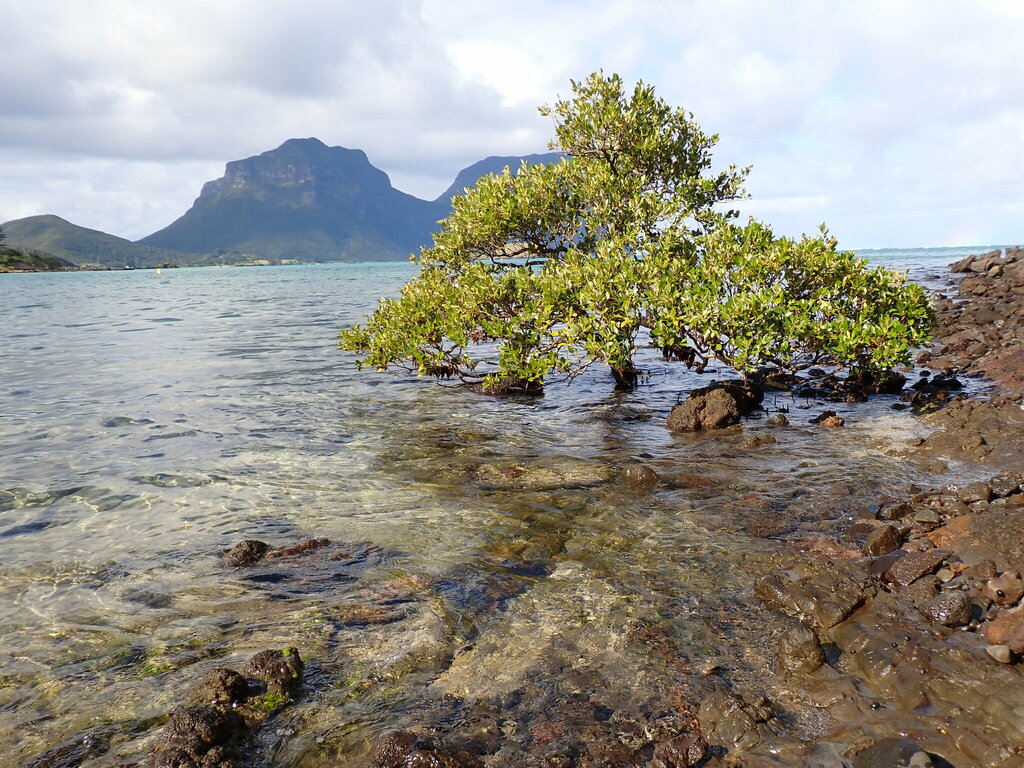
The grey mangrove (Avicennia marina, 海茄苳) is an evergreen tree of the genus Avicennia with numerous upright breathing roots (pneumatophores), the dominant mangrove species on Taiwan's west coast; TaiCOL also lists the names 海茄冬 and 海茄藤, and the Red List rates it Least Concern (NLC) [R002][R010][R011]. In Taijiang it grows on the intertidal flats of estuaries, along tidal creeks and on fish-pond embankments at Qigu (七股), the Zengwen River (曾文溪) estuary, Chengxi (城西) and Sicao (四草) [R001][R003]. In recent years the grey mangrove stand inside the Zengwen River Estuary Black-faced Spoonbill Reserve has spread rapidly, growing about 35-fold in area from 2009 to 2020, and the Taijiang National Park Headquarters has begun trials of thinning and other vegetation management [R006][R012].
Taxonomy and naming
- Scientific name Avicennia marina (Forssk.) Vierh.; the 2019 report places it in the family Acanthaceae, native R002SourceHsieh Tsung-hsin (謝宗欣), principal investigator, 《台江國家公園植物資源調查》[Taijiang National Park Plant Resources Survey] (commissioned from 國立臺南大學 [National University of Tainan] by 台江國家公園管理處 [Taijiang National Park Headquarters], December 2019 (ROC year 108))Original URL—Retrieved2026-11-01Snapshot timestamp—SourceFrom 《Taijiang National Park Plant Resources Survey (台江國家公園植物資源調查)》p. 頁 18、24–32(表 3–6)R003SourceHsieh Tsung-hsin (謝宗欣) 主持 [principal investigator]《台江國家公園植物資源調查》[Taijiang National Park Plant Resources Survey] 附錄 1 [Appendix 1]「台江國家公園及周緣地區植物名錄」[Plant Checklist of Taijiang National Park and Its Surrounding Areas]Original URL—Retrieved2026-11-01Snapshot timestamp—SourceFrom 《Taijiang National Park Plant Resources Survey (台江國家公園植物資源調查)》p. 附錄 1,頁 97Zone codes: T1 around the Qigu Lagoon, T2 around the Zengwen River estuary, T3 around the mouth of the Luermen River (Chengxi Village, the Chengxi Protection Forest, the Chengxi fish ponds, the south bank of the Luermen River), T4 around Sicao (report p. 6). This site extracted the table using PDF coordinates, so the zone column may contain one or two errors; the original document prevails..Official record
- TaiCOL uses 「海茄苳」 as its Chinese name, with the aliases 海茄藤 and 海茄冬; its category in the Red List of Taiwan's vascular plants is NLC (Not Currently Threatened) R010SourceTaiCOL 臺灣物種名錄(中央研究院)[TaiCOL Catalogue of Life in Taiwan (Academia Sinica)]:海茄苳 Avicennia marina,別名海茄藤、海茄冬,紅皮書等級 NLC,原生 [grey mangrove; aliases 海茄藤, 海茄冬; Red List category NLC; native](t0052682)Original URLhttps://api.taicol.tw/v2/taxon?scientific_name=Avicennia%20marinaRetrieved2026-11-01Snapshot timestamp—.Official record
Characteristics
- An evergreen tree with numerous erect pneumatophores (breathing roots); peak flowering from early June to mid-July, fruit ripening from early August to early September; the fruit stays on the parent tree and first grows a small seedling before falling (cryptovivipary), remaining on the parent tree for 2–6 weeks R011SourceHsieh Tsung-hsin (謝宗欣), principal investigator, 《台江國家公園植物資源調查》[Taijiang National Park Plant Resources Survey] (commissioned from 國立臺南大學 [National University of Tainan] by 台江國家公園管理處 [Taijiang National Park Headquarters], December 2019 (ROC year 108))Original URL—Retrieved2026-11-01Snapshot timestamp—SourceFrom 《Taijiang National Park Plant Resources Survey (台江國家公園植物資源調查)》p. 附錄 2,頁 126The species descriptions in Appendix 2 are quoted from Lu Fu-yuan (呂福原), Ou Chen-hsiung (歐辰雄), Teng Shu-lin (鄧書林) and Lin Te-hsun (林德勳) (2007), 《臺灣濱海鹽濕地造林與綠美化植物圖說》 (*Illustrated Guide to Plants for Afforestation and Greening of Taiwan's Coastal Salt Wetlands*)..Official record
Behavior and ecology
- Taijiang's casuarina windbreak stands in the intertidal zone on low, waterlogged ground and belongs to the "intertidal forest swamp" ecosystem (潮間帶森林沼澤); this brackish setting lets mangroves such as gray mangrove and white-flowered black mangrove grow among the casuarinas (p.69) R025SourceChang Yuan-mou (張原謀), Chung Chao-chin (鍾兆晉) and Lin Shu-feng (林淑鳳), 《聽見台江天籟:臺灣暗蟬》 [Hearing the Natural Music of Taijiang: Taiwan Twilight Cicada], 台江國家公園管理處 [Taijiang National Park Headquarters], December 2020 (official publication)Original URL—Retrieved2026-11-12Snapshot timestamp—SourceFrom 《Hearing the Natural Music of Taijiang: Taiwan Twilight Cicada (聽見台江天籟:臺灣暗蟬)》p. 69Photographed from the National Central Library copy and transcribed page by page by Claude; an official Taijiang headquarters publication used as the naming standard.. Official record
Distribution
First items: The Hailiao mangrove in QiguKey eventsMoreLess
- The 2019 survey is divided into four zones: around the Qigu Lagoon (T1), around the Zengwen River estuary (T2), around the mouth of the Luermen River (T3, including Chengxi Village) and around Sicao (T4); the checklist marks 海茄冬 in all four zones and in all three habitat types, 「紅樹林、鹽地沼澤、荒廢地」 ("mangrove, salt marsh, abandoned land") R003SourceHsieh Tsung-hsin (謝宗欣) 主持 [principal investigator]《台江國家公園植物資源調查》[Taijiang National Park Plant Resources Survey] 附錄 1 [Appendix 1]「台江國家公園及周緣地區植物名錄」[Plant Checklist of Taijiang National Park and Its Surrounding Areas]Original URL—Retrieved2026-11-01Snapshot timestamp—SourceFrom 《Taijiang National Park Plant Resources Survey (台江國家公園植物資源調查)》p. 附錄 1,頁 97Zone codes: T1 around the Qigu Lagoon, T2 around the Zengwen River estuary, T3 around the mouth of the Luermen River (Chengxi Village, the Chengxi Protection Forest, the Chengxi fish ponds, the south bank of the Luermen River), T4 around Sicao (report p. 6). This site extracted the table using PDF coordinates, so the zone column may contain one or two errors; the original document prevails..Official record
- Qigu: in the Hailiao Mangrove Reserve (海寮紅樹林保護區), 「紅樹林植物以海茄冬為主,混生欖李、土沉香」 ("the mangrove plants are mainly grey mangrove, mixed with white-flowered black mangrove and blind-your-eye mangrove"); T1-11, the Hailiao mangrove, is the largest mangrove stand in zone T1 R001SourceHsieh Tsung-hsin (謝宗欣), principal investigator, 《台江國家公園植物資源調查》[Taijiang National Park Plant Resources Survey] (commissioned from 國立臺南大學 [National University of Tainan] by 台江國家公園管理處 [Taijiang National Park Headquarters], December 2019 (ROC year 108))Original URL—Retrieved2026-11-01Snapshot timestamp—SourceFrom 《Taijiang National Park Plant Resources Survey (台江國家公園植物資源調查)》p. 頁 14–17R002SourceHsieh Tsung-hsin (謝宗欣), principal investigator, 《台江國家公園植物資源調查》[Taijiang National Park Plant Resources Survey] (commissioned from 國立臺南大學 [National University of Tainan] by 台江國家公園管理處 [Taijiang National Park Headquarters], December 2019 (ROC year 108))Original URL—Retrieved2026-11-01Snapshot timestamp—SourceFrom 《Taijiang National Park Plant Resources Survey (台江國家公園植物資源調查)》p. 頁 18、24–32(表 3–6).Official record
- Zengwen River estuary: in the Black-faced Spoonbill Reserve, 「東側有少數新生長的海茄冬,潮溝兩側有以海茄冬為主的紅樹林」 ("there are a few newly grown grey mangroves on the east side, and mangroves dominated by grey mangrove on both sides of the tidal creeks"); in the abandoned fish ponds of the Qigu Important Bird Area 「亦散生海茄冬及欖李」 ("grey mangrove and white-flowered black mangrove also grow scattered") R001SourceHsieh Tsung-hsin (謝宗欣), principal investigator, 《台江國家公園植物資源調查》[Taijiang National Park Plant Resources Survey] (commissioned from 國立臺南大學 [National University of Tainan] by 台江國家公園管理處 [Taijiang National Park Headquarters], December 2019 (ROC year 108))Original URL—Retrieved2026-11-01Snapshot timestamp—SourceFrom 《Taijiang National Park Plant Resources Survey (台江國家公園植物資源調查)》p. 頁 14–17.Official record
- Chengxi: T3-1 to T3-3 are in the tidal creeks of the Chengxi Protection Forest area, mainly grey mangrove and white-flowered black mangrove (T3-3 has only white-flowered black mangrove); T3-4 is distributed continuously along the tidal creek around the Lady Cai Temple (蔡姑娘廟); T3-5 is on the embankment along the Luermen River; T3-6 is in the Shorebird Reserve (鷸鴴科保護區), where mangroves also grow in the flooded salt flats R002SourceHsieh Tsung-hsin (謝宗欣), principal investigator, 《台江國家公園植物資源調查》[Taijiang National Park Plant Resources Survey] (commissioned from 國立臺南大學 [National University of Tainan] by 台江國家公園管理處 [Taijiang National Park Headquarters], December 2019 (ROC year 108))Original URL—Retrieved2026-11-01Snapshot timestamp—SourceFrom 《Taijiang National Park Plant Resources Survey (台江國家公園植物資源調查)》p. 頁 18、24–32(表 3–6).Official record
- Sicao: 「四草紅樹林以海茄冬為主,混生欖李、紅海欖、土沉香,另栽種有水筆仔和紅茄冬」 ("the Sicao mangroves are mainly grey mangrove, mixed with white-flowered black mangrove, spotted mangrove and blind-your-eye mangrove, and Kandelia and large-leafed orange mangrove have also been planted") R001SourceHsieh Tsung-hsin (謝宗欣), principal investigator, 《台江國家公園植物資源調查》[Taijiang National Park Plant Resources Survey] (commissioned from 國立臺南大學 [National University of Tainan] by 台江國家公園管理處 [Taijiang National Park Headquarters], December 2019 (ROC year 108))Original URL—Retrieved2026-11-01Snapshot timestamp—SourceFrom 《Taijiang National Park Plant Resources Survey (台江國家公園植物資源調查)》p. 頁 14–17. The 2011 recreation resources report records that 「鹽水溪河口到觀海橋則有大範圍的海茄苳紅樹林」 ("from the mouth of the Yanshui River to the Guanhai Bridge there is a large expanse of grey mangrove forest"), and that along the salt-transport canal of the Anshun Salt Field, the Chianan Canal drainage channel and the sandbars of the Yanshui River 「均可看到大範圍的海茄苳分布」 ("large expanses of grey mangrove can be seen") R008SourceLin Pao-hsiu (林寶秀), principal investigator, 《台江國家公園整體遊憩資源調查及規劃案》[Overall Survey and Planning of Recreational Resources in Taijiang National Park] (commissioned from 中華民國國家公園學會 [National Park Society of the Republic of China] by 台江國家公園管理處 [Taijiang National Park Headquarters], December 2011 (ROC year 100))Original URL—Retrieved2026-11-01Snapshot timestamp—SourceFrom 《Overall Survey and Planning of Recreational Resources in Taijiang National Park (台江國家公園整體遊憩資源調查及規劃案)》p. 頁 3-58、3-59(表 3-1-25).Official record
- TBN has 146 records of 海茄冬 within the queried area; the earliest is a specimen collected in Annan District on 1992-02-08 by Mou Shan-chieh (牟善傑); by administrative district, Annan District has the most with 113 records, and Anping District 25 R009Source台灣生物多樣性網絡 [Taiwan Biodiversity Network] (TBN) occurrence record query: 海茄冬 [grey mangrove], query box 23.00–23.08°N, 120.08–120.18°E (covering Tucheng, Chengxi, Sicao and the north side of Anping; excluding Qigu), 146 records in totalOriginal URLhttps://www.tbn.org.tw/api/v26/occurrence?taxonUUID=07e4c6ef-f041-4c04-a5ed-f4a1ed48b8ac&boundedBy=120.18%2023.08%2C120.08%2023.00&limit=1000Retrieved2026-11-01Snapshot timestamp—.Official record
- The park website's "Plant Resources" page: the true mangrove species now present in Taijiang are three, grey mangrove, white-flowered black mangrove and spotted mangrove, plus planted Kandelia and large-leafed orange mangrove, so that it 「已成為臺灣真紅樹林植物最多之地區」 ("has become the area with the most true mangrove species in Taiwan") R014Source台江國家公園管理處全球資訊網 [Taijiang National Park Headquarters website]「植物資源」[Plant Resources](自然保育/自然資源/陸域生物資源)[(Nature Conservation / Natural Resources / Terrestrial Biological Resources)]Original URLhttps://www.tjnp.gov.tw/ch/sglarticle/plant-resourcesRetrieved2026-11-06Snapshot timestamp—.Official record
- The park website's feature story "On the Sea-drifted Plants of Taijiang" (「談台江海漂植物」) lists the grey mangrove among the sea-drifted plants that reached Taijiang by floating on the sea and are classed as native (also listed: sea hibiscus, grey mangrove, white-flowered black mangrove, 老虎心 (Caesalpinia bonduc), 搭肉刺 (Caesalpinia crista), three-leaf derris, beach naupaka, Asian beach jujube, beach morning glory, bay bean, beach cowpea, 厚葉牽牛 (Ipomoea imperati), 臺灣蒺藜 (Tribulus taiwanense) and 圓萼天茄兒 (Ipomoea violacea)) R015Source台江國家公園管理處全球資訊網 [Taijiang National Park Headquarters website]專題報導 [feature story]「談台江海漂植物」[On the Sea-drifted Plants of Taijiang](2020-03-10)Original URLhttps://www.tjnp.gov.tw/ch/titlelist/feature-stories/2340Retrieved2026-11-06Snapshot timestamp—.Official record
The Hailiao mangrove in Qigu
- Lin Hsing-juh's team estimated the area of the Hailiao mangrove from the 1989 photo base map and images from 2005 and 2010 (unit: hectares) R005SourceLin Hsing-juh (林幸助), principal investigator, 《台江國家公園及周緣地區重要生物類群分佈及海岸濕地河口生態系變遷》[Distribution of Important Biotic Groups and Changes in Coastal Wetland and Estuarine Ecosystems in Taijiang National Park and Its Surrounding Areas] (commissioned from 國立中興大學 [National Chung Hsing University] by 台江國家公園管理處 [Taijiang National Park Headquarters], December 2011 (ROC year 100))Original URL—Retrieved2026-11-01Snapshot timestamp—SourceFrom 《Distribution of Important Biotic Groups and Changes in Coastal Wetland and Estuarine Ecosystems in Taijiang National Park and Its Surrounding Areas (台江國家公園及周緣地區重要生物類群分佈及海岸濕地河口生態系變遷)》p. 摘要;頁 2-28;表 2-15(頁 2-61):Official record
- 1989 zone 1, 4.76; zone 2, 0.23; zone 3, 0.20; total 5.19
- 2005 zone 1, 5.13; zone 2, 0.41; zone 3, 0.18; total 5.72
- 2010 zone 1, 5.10; zones 2 and 3, 0; total 5.10
- The report explains that the 2008 dredging works on the Qigu River (七股溪) cleared away the mangroves of zones 2 and 3 R005SourceLin Hsing-juh (林幸助), principal investigator, 《台江國家公園及周緣地區重要生物類群分佈及海岸濕地河口生態系變遷》[Distribution of Important Biotic Groups and Changes in Coastal Wetland and Estuarine Ecosystems in Taijiang National Park and Its Surrounding Areas] (commissioned from 國立中興大學 [National Chung Hsing University] by 台江國家公園管理處 [Taijiang National Park Headquarters], December 2011 (ROC year 100))Original URL—Retrieved2026-11-01Snapshot timestamp—SourceFrom 《Distribution of Important Biotic Groups and Changes in Coastal Wetland and Estuarine Ecosystems in Taijiang National Park and Its Surrounding Areas (台江國家公園及周緣地區重要生物類群分佈及海岸濕地河口生態系變遷)》p. 摘要;頁 2-28;表 2-15(頁 2-61).Official record
- The Hailiao mangrove is a pure stand of grey mangrove, with Clerodendrum inerme (苦林盤), Indian camphorweed (鯽魚膽), sea purslane (海馬齒), seablite (裸花鹼蓬) and others growing in the gaps R005SourceLin Hsing-juh (林幸助), principal investigator, 《台江國家公園及周緣地區重要生物類群分佈及海岸濕地河口生態系變遷》[Distribution of Important Biotic Groups and Changes in Coastal Wetland and Estuarine Ecosystems in Taijiang National Park and Its Surrounding Areas] (commissioned from 國立中興大學 [National Chung Hsing University] by 台江國家公園管理處 [Taijiang National Park Headquarters], December 2011 (ROC year 100))Original URL—Retrieved2026-11-01Snapshot timestamp—SourceFrom 《Distribution of Important Biotic Groups and Changes in Coastal Wetland and Estuarine Ecosystems in Taijiang National Park and Its Surrounding Areas (台江國家公園及周緣地區重要生物類群分佈及海岸濕地河口生態系變遷)》p. 摘要;頁 2-28;表 2-15(頁 2-61).Official record
Key events
- 1992-02-08 The earliest grey mangrove specimen within the TBN query box (Annan District, Mou Shan-chieh) R009Source台灣生物多樣性網絡 [Taiwan Biodiversity Network] (TBN) occurrence record query: 海茄冬 [grey mangrove], query box 23.00–23.08°N, 120.08–120.18°E (covering Tucheng, Chengxi, Sicao and the north side of Anping; excluding Qigu), 146 records in totalOriginal URLhttps://www.tbn.org.tw/api/v26/occurrence?taxonUUID=07e4c6ef-f041-4c04-a5ed-f4a1ed48b8ac&boundedBy=120.18%2023.08%2C120.08%2023.00&limit=1000Retrieved2026-11-01Snapshot timestamp—.
- 1989 The three zones of the Hailiao mangrove totaled 5.19 hectares R005SourceLin Hsing-juh (林幸助), principal investigator, 《台江國家公園及周緣地區重要生物類群分佈及海岸濕地河口生態系變遷》[Distribution of Important Biotic Groups and Changes in Coastal Wetland and Estuarine Ecosystems in Taijiang National Park and Its Surrounding Areas] (commissioned from 國立中興大學 [National Chung Hsing University] by 台江國家公園管理處 [Taijiang National Park Headquarters], December 2011 (ROC year 100))Original URL—Retrieved2026-11-01Snapshot timestamp—SourceFrom 《Distribution of Important Biotic Groups and Changes in Coastal Wetland and Estuarine Ecosystems in Taijiang National Park and Its Surrounding Areas (台江國家公園及周緣地區重要生物類群分佈及海岸濕地河口生態系變遷)》p. 摘要;頁 2-28;表 2-15(頁 2-61).
- 2008 The Qigu River dredging works cleared away zones 2 and 3 of the Hailiao mangrove R005SourceLin Hsing-juh (林幸助), principal investigator, 《台江國家公園及周緣地區重要生物類群分佈及海岸濕地河口生態系變遷》[Distribution of Important Biotic Groups and Changes in Coastal Wetland and Estuarine Ecosystems in Taijiang National Park and Its Surrounding Areas] (commissioned from 國立中興大學 [National Chung Hsing University] by 台江國家公園管理處 [Taijiang National Park Headquarters], December 2011 (ROC year 100))Original URL—Retrieved2026-11-01Snapshot timestamp—SourceFrom 《Distribution of Important Biotic Groups and Changes in Coastal Wetland and Estuarine Ecosystems in Taijiang National Park and Its Surrounding Areas (台江國家公園及周緣地區重要生物類群分佈及海岸濕地河口生態系變遷)》p. 摘要;頁 2-28;表 2-15(頁 2-61).
- 2009-04-14 Mangroves in the Black-faced Spoonbill Reserve about 0.12 hectares R006SourceChiu Yu-wen (邱郁文), principal investigator, 《台江國家公園曾文溪口濕地核心區棲地評估與保育研究計畫》[Habitat Assessment and Conservation Research for the Core Area of the Zengwen River Estuary Wetland in Taijiang National Park] (commissioned from 國立嘉義大學 [National Chiayi University] by 台江國家公園管理處 [Taijiang National Park Headquarters], December 2020 (ROC year 109))Original URL—Retrieved2026-11-01Snapshot timestamp—SourceFrom 《Habitat Assessment and Conservation Research for the Core Area of the Zengwen River Estuary Wetland in Taijiang National Park (台江國家公園曾文溪口濕地核心區棲地評估與保育研究計畫)》p. 摘要頁 XIV;頁 115;表 5.1.7-2(頁 120);頁 180.
- 2011-12 The report records 「少數新生長的海茄苳」 ("a few newly grown grey mangroves") on the east side of the reserve R005SourceLin Hsing-juh (林幸助), principal investigator, 《台江國家公園及周緣地區重要生物類群分佈及海岸濕地河口生態系變遷》[Distribution of Important Biotic Groups and Changes in Coastal Wetland and Estuarine Ecosystems in Taijiang National Park and Its Surrounding Areas] (commissioned from 國立中興大學 [National Chung Hsing University] by 台江國家公園管理處 [Taijiang National Park Headquarters], December 2011 (ROC year 100))Original URL—Retrieved2026-11-01Snapshot timestamp—SourceFrom 《Distribution of Important Biotic Groups and Changes in Coastal Wetland and Estuarine Ecosystems in Taijiang National Park and Its Surrounding Areas (台江國家公園及周緣地區重要生物類群分佈及海岸濕地河口生態系變遷)》p. 摘要;頁 2-28;表 2-15(頁 2-61).
- 2019-12 The plant resources survey recommends preventing or removing grey mangrove in the reserve R004SourceHsieh Tsung-hsin (謝宗欣), principal investigator, 《台江國家公園植物資源調查》[Taijiang National Park Plant Resources Survey] (commissioned from 國立臺南大學 [National University of Tainan] by 台江國家公園管理處 [Taijiang National Park Headquarters], December 2019 (ROC year 108))Original URL—Retrieved2026-11-01Snapshot timestamp—SourceFrom 《Taijiang National Park Plant Resources Survey (台江國家公園植物資源調查)》p. 頁 27.
- 2020-07-14 Mangroves in the reserve about 4.30 hectares R006SourceChiu Yu-wen (邱郁文), principal investigator, 《台江國家公園曾文溪口濕地核心區棲地評估與保育研究計畫》[Habitat Assessment and Conservation Research for the Core Area of the Zengwen River Estuary Wetland in Taijiang National Park] (commissioned from 國立嘉義大學 [National Chiayi University] by 台江國家公園管理處 [Taijiang National Park Headquarters], December 2020 (ROC year 109))Original URL—Retrieved2026-11-01Snapshot timestamp—SourceFrom 《Habitat Assessment and Conservation Research for the Core Area of the Zengwen River Estuary Wetland in Taijiang National Park (台江國家公園曾文溪口濕地核心區棲地評估與保育研究計畫)》p. 摘要頁 XIV;頁 115;表 5.1.7-2(頁 120);頁 180.
- 2022-05 The Taijiang National Park Headquarters continued trial work on grey mangrove stand management R012Source台灣英文新聞 [Taiwan News]〈維護棲地品質!台江國家公園黑琵保護區 首次發現三棘鱟個體〉[Maintaining habitat quality! Tri-spine horseshoe crab found for the first time in Taijiang National Park's spoonbill reserve], 2022-05-16 (citing the Taijiang National Park Headquarters)Original URLhttps://www.taiwannews.com.tw/zh/news/4539791Retrieved2026-11-01Snapshot timestamp—. On May 12, Director Chang Teng-wen (張登文) led staff in hands-on suppression of grey mangrove seedlings in the Shifen Black-faced Spoonbill Ecological Reserve; while wading they found a tri-spine horseshoe crab (三棘鱟), which the Headquarters said was the first horseshoe crab encountered in the reserve since its establishment R016Source台江國家公園管理處 [Taijiang National Park Headquarters], latest news 〈積極守護台江生態,我們鱟會有期〉[Actively Protecting Taijiang's Ecology: We Shall Meet Again (a pun on 鱟, horseshoe crab)] (2022-05-13)Original URLhttps://www.tjnp.gov.tw/ch/titlelist/latest-news/2053Retrieved2026-11-07Snapshot timestamp—Official press release (the account of the Taijiang National Park Headquarters alone)..
Biochemistry and physiology
First items: 1. Classification2. Photosynthesis and salinity3. Salt-tolerance mechanisms: the leaves "sweat out" saltMoreLess
1. Classification
- Scientific name Avicennia marina (Forssk.) Vierh., genus Avicennia R003SourceHsieh Tsung-hsin (謝宗欣) 主持 [principal investigator]《台江國家公園植物資源調查》[Taijiang National Park Plant Resources Survey] 附錄 1 [Appendix 1]「台江國家公園及周緣地區植物名錄」[Plant Checklist of Taijiang National Park and Its Surrounding Areas]Original URL—Retrieved2026-11-01Snapshot timestamp—SourceFrom 《Taijiang National Park Plant Resources Survey (台江國家公園植物資源調查)》p. 附錄 1,頁 97Zone codes: T1 around the Qigu Lagoon, T2 around the Zengwen River estuary, T3 around the mouth of the Luermen River (Chengxi Village, the Chengxi Protection Forest, the Chengxi fish ponds, the south bank of the Luermen River), T4 around Sicao (report p. 6). This site extracted the table using PDF coordinates, so the zone column may contain one or two errors; the original document prevails.R019SourceHibino T, Meng YL, Kawamitsu Y, et al. (2001). Molecular cloning and functional characterization of two kinds of betaine-aldehyde dehydrogenase in betaine-accumulating mangrove Avicennia marina (Forsk.) Vierh. Plant Molecular Biology 45(3): 353–363Original URLhttps://doi.org/10.1023/a:1006497113323Retrieved2026-11-09Snapshot timestamp—Journal article abstract..
- The family to which this genus is assigned differs in literature of different periods:
- The 2019 Taijiang National Park Plant Resources Survey places it in Acanthaceae (爵床科) R003SourceHsieh Tsung-hsin (謝宗欣) 主持 [principal investigator]《台江國家公園植物資源調查》[Taijiang National Park Plant Resources Survey] 附錄 1 [Appendix 1]「台江國家公園及周緣地區植物名錄」[Plant Checklist of Taijiang National Park and Its Surrounding Areas]Original URL—Retrieved2026-11-01Snapshot timestamp—SourceFrom 《Taijiang National Park Plant Resources Survey (台江國家公園植物資源調查)》p. 附錄 1,頁 97Zone codes: T1 around the Qigu Lagoon, T2 around the Zengwen River estuary, T3 around the mouth of the Luermen River (Chengxi Village, the Chengxi Protection Forest, the Chengxi fish ponds, the south bank of the Luermen River), T4 around Sicao (report p. 6). This site extracted the table using PDF coordinates, so the zone column may contain one or two errors; the original document prevails..
- The 2011 estuarine ecology report of the Taijiang National Park Headquarters writes Avicenniaceae (海欖科) R005SourceLin Hsing-juh (林幸助), principal investigator, 《台江國家公園及周緣地區重要生物類群分佈及海岸濕地河口生態系變遷》[Distribution of Important Biotic Groups and Changes in Coastal Wetland and Estuarine Ecosystems in Taijiang National Park and Its Surrounding Areas] (commissioned from 國立中興大學 [National Chung Hsing University] by 台江國家公園管理處 [Taijiang National Park Headquarters], December 2011 (ROC year 100))Original URL—Retrieved2026-11-01Snapshot timestamp—SourceFrom 《Distribution of Important Biotic Groups and Changes in Coastal Wetland and Estuarine Ecosystems in Taijiang National Park and Its Surrounding Areas (台江國家公園及周緣地區重要生物類群分佈及海岸濕地河口生態系變遷)》p. 摘要;頁 2-28;表 2-15(頁 2-61).
- A 2005 study of root anatomy writes Verbenaceae (馬鞭草科) R020SourcePurnobasuki H, Suzuki M (2005). Aerenchyma tissue development and gas-pathway structure in root of Avicennia marina (Forsk.) Vierh. Journal of Plant Research 118(4): 285–294Original URLhttps://doi.org/10.1007/s10265-005-0221-7Retrieved2026-11-09Snapshot timestamp—Journal article abstract..
- The difference results from updates to the classification system; all refer to the same plant.
- The 2011 report of the Taijiang National Park Headquarters says grey mangrove 「具有泌鹽腺及可行光合作用的綠色指狀呼吸根」 ("has salt-secreting glands and green, finger-like pneumatophores capable of photosynthesis") and is 「耐寒及耐鹽能力極強,為世界分布最廣泛的紅樹林植物」 ("extremely tolerant of cold and salt, and the most widely distributed mangrove plant in the world") R005SourceLin Hsing-juh (林幸助), principal investigator, 《台江國家公園及周緣地區重要生物類群分佈及海岸濕地河口生態系變遷》[Distribution of Important Biotic Groups and Changes in Coastal Wetland and Estuarine Ecosystems in Taijiang National Park and Its Surrounding Areas] (commissioned from 國立中興大學 [National Chung Hsing University] by 台江國家公園管理處 [Taijiang National Park Headquarters], December 2011 (ROC year 100))Original URL—Retrieved2026-11-01Snapshot timestamp—SourceFrom 《Distribution of Important Biotic Groups and Changes in Coastal Wetland and Estuarine Ecosystems in Taijiang National Park and Its Surrounding Areas (台江國家公園及周緣地區重要生物類群分佈及海岸濕地河口生態系變遷)》p. 摘要;頁 2-28;表 2-15(頁 2-61). Official record
2. Photosynthesis and salinity
- An experiment in which seedlings were irrigated with 0, 200, 400 and 600 mM sodium chloride (seawater is about 500 mM) R017SourceGuo Z, Wei MY, Zhong YH, et al. (2023). Leaf sodium homeostasis controlled by salt gland is associated with salt tolerance in mangrove plant Avicennia marina. Tree Physiology 43(5): 817–831Original URLhttps://doi.org/10.1093/treephys/tpad002Retrieved2026-11-09Snapshot timestamp—Journal article abstract.:
- At 200 mM, whole-plant dry weight and photosynthetic parameters actually rose; that is, moderate salt benefits grey mangrove.
- Above 400 mM, growth and photosynthesis declined.
- At 600 mM, the maximum photochemical efficiency of photosystem II (Fv/Fm) dropped markedly; under the electron microscope the thylakoids of the chloroplasts were swollen, the grana separated and the starch grains smaller, and in severe cases even the outer chloroplast membrane was destroyed.
3. Salt-tolerance mechanisms: the leaves "sweat out" salt
- Salt glands:
- Grey mangrove has salt glands in the epidermis of the upper leaf surface. The secretory and stalk cells of the glands have dense protoplasm and many mitochondria, and the cells are connected by numerous plasmodesmata; it is a structure that actively excretes salt at an energy cost R017SourceGuo Z, Wei MY, Zhong YH, et al. (2023). Leaf sodium homeostasis controlled by salt gland is associated with salt tolerance in mangrove plant Avicennia marina. Tree Physiology 43(5): 817–831Original URLhttps://doi.org/10.1093/treephys/tpad002Retrieved2026-11-09Snapshot timestamp—Journal article abstract..
- At all salinities, the sodium content of the leaves is higher than that of the stems and roots; but above 400 mM the sodium content of the roots keeps rising while that of the leaves stays unchanged, because the excess salt is excreted by the salt glands. Salt crystals on the leaf surface increase with salinity R017SourceGuo Z, Wei MY, Zhong YH, et al. (2023). Leaf sodium homeostasis controlled by salt gland is associated with salt tolerance in mangrove plant Avicennia marina. Tree Physiology 43(5): 817–831Original URLhttps://doi.org/10.1093/treephys/tpad002Retrieved2026-11-09Snapshot timestamp—Journal article abstract..
- In the leaf epidermis where salt glands are concentrated, salt treatment raises gene expression of the Na⁺/H⁺ antiporters (SOS1, NHX1), the proton pumps (AHA1, VHA-c1) and the potassium channels (AKT1, HAK5, GORK), while the only sodium influx protein, HKT1, is suppressed R017SourceGuo Z, Wei MY, Zhong YH, et al. (2023). Leaf sodium homeostasis controlled by salt gland is associated with salt tolerance in mangrove plant Avicennia marina. Tree Physiology 43(5): 817–831Original URLhttps://doi.org/10.1093/treephys/tpad002Retrieved2026-11-09Snapshot timestamp—Journal article abstract..
- Sodium efflux from the salt glands peaks at 400 mM; the researchers conclude that salinities below 200 mM favor growth, and that below 400 mM the salt glands can excrete sodium effectively R017SourceGuo Z, Wei MY, Zhong YH, et al. (2023). Leaf sodium homeostasis controlled by salt gland is associated with salt tolerance in mangrove plant Avicennia marina. Tree Physiology 43(5): 817–831Original URLhttps://doi.org/10.1093/treephys/tpad002Retrieved2026-11-09Snapshot timestamp—Journal article abstract..
- Salt exclusion at the roots (congener):
- A study of the congener Avicennia officinalis shows that after salt treatment the root exodermis becomes two-layered and large amounts of hydrophobic suberin are deposited in the endodermis, blocking 90–95% of the salt from entering the xylem R018SourceKrishnamurthy P, Jyothi-Prakash PA, Qin L, et al. (2014). Role of root hydrophobic barriers in salt exclusion of a mangrove plant Avicennia officinalis. Plant, Cell & Environment 37(7): 1656–1671Original URLhttps://doi.org/10.1111/pce.12272Retrieved2026-11-09Snapshot timestamp—Journal article abstract; a congener..
- Suberin is also deposited around the salt glands of the leaves, preventing the excreted salt from flowing back R018SourceKrishnamurthy P, Jyothi-Prakash PA, Qin L, et al. (2014). Role of root hydrophobic barriers in salt exclusion of a mangrove plant Avicennia officinalis. Plant, Cell & Environment 37(7): 1656–1671Original URLhttps://doi.org/10.1111/pce.12272Retrieved2026-11-09Snapshot timestamp—Journal article abstract; a congener..
- The sources consulted give no measurements of the proportion of salt excluded by grey mangrove itself. Unverified
- Osmoprotectant: glycine betaine
- In a study comparing four mangrove species, glycine betaine was detected only in grey mangrove, and its content increased with salinity; the other three use pinitol as their main osmoprotectant R019SourceHibino T, Meng YL, Kawamitsu Y, et al. (2001). Molecular cloning and functional characterization of two kinds of betaine-aldehyde dehydrogenase in betaine-accumulating mangrove Avicennia marina (Forsk.) Vierh. Plant Molecular Biology 45(3): 353–363Original URLhttps://doi.org/10.1023/a:1006497113323Retrieved2026-11-09Snapshot timestamp—Journal article abstract..
- Grey mangrove has two forms of betaine-aldehyde dehydrogenase (BADH), the enzyme of the last step of betaine synthesis: one resembles the spinach chloroplast type and is expressed more at high salinity; the other carries an SKL sequence at its C-terminus and its expression is unaffected by salinity. Both enzymes are more heat-tolerant than the spinach enzyme R019SourceHibino T, Meng YL, Kawamitsu Y, et al. (2001). Molecular cloning and functional characterization of two kinds of betaine-aldehyde dehydrogenase in betaine-accumulating mangrove Avicennia marina (Forsk.) Vierh. Plant Molecular Biology 45(3): 353–363Original URLhttps://doi.org/10.1023/a:1006497113323Retrieved2026-11-09Snapshot timestamp—Journal article abstract..
4. Root aeration: how the pneumatophores deliver oxygen
- The roots of grey mangrove are divided into cable roots, pneumatophores, anchor roots and feeding (absorbing) roots, and all four kinds have aerenchyma R020SourcePurnobasuki H, Suzuki M (2005). Aerenchyma tissue development and gas-pathway structure in root of Avicennia marina (Forsk.) Vierh. Journal of Plant Research 118(4): 285–294Original URLhttps://doi.org/10.1007/s10265-005-0221-7Retrieved2026-11-09Snapshot timestamp—Journal article abstract.:
- There are no intercellular spaces in the 0–150 micrometers of the root tip; aerenchyma begins to form about 200 micrometers from the tip.
- The aerenchyma forms by the "separation" of cortical cells (schizogeny), not by cell death and dissolution.
- During its formation the cortical cells elongate 1.8–3.9 times lengthwise and widen 2.2–2.9 times crosswise, forming channels parallel to the root axis and tapering at both ends; neighboring channels are connected by many small pores, so that the air passages of the whole root form a single system.
- Oxygen leakage from the roots and heavy metals:
- The roots leak oxygen into the surrounding mud (radial oxygen loss, ROL). In a comparison of seedlings of three mangrove species, large-leafed orange mangrove (紅茄冬) leaked the most oxygen and was also the most tolerant of heavy metals; mixed lead, zinc and copper treatment inhibited growth and reduced oxygen loss R021SourceLiu Y, Tam NF, Yang JX, Pi N, Wong MH, Ye ZH (2009). Mixed heavy metals tolerance and radial oxygen loss in mangrove seedlings. Marine Pollution Bulletin 58(12): 1843–1849Original URLhttps://doi.org/10.1016/j.marpolbul.2009.07.023Retrieved2026-11-09Snapshot timestamp—Journal article abstract; potted seedling experiment..
- In a comparison of seedlings of six mangrove species, pioneer species such as grey mangrove had less lignification and suberization of the root exodermis, and lower tolerance of lead, zinc and copper than the Rhizophoraceae species large-leafed orange mangrove, Kandelia (秋茄, i.e. 水筆仔) and spotted mangrove (紅海欖) R022SourceCheng H, Jiang ZY, Liu Y, et al. (2014). Metal (Pb, Zn and Cu) uptake and tolerance by mangroves in relation to root anatomy and lignification/suberization. Tree Physiology 34(6): 646–656Original URLhttps://doi.org/10.1093/treephys/tpu042Retrieved2026-11-09Snapshot timestamp—Journal article abstract; seedling experiment..
5. Cold tolerance
- The report of the Taijiang National Park Headquarters says grey mangrove is extremely cold-tolerant R005SourceLin Hsing-juh (林幸助), principal investigator, 《台江國家公園及周緣地區重要生物類群分佈及海岸濕地河口生態系變遷》[Distribution of Important Biotic Groups and Changes in Coastal Wetland and Estuarine Ecosystems in Taijiang National Park and Its Surrounding Areas] (commissioned from 國立中興大學 [National Chung Hsing University] by 台江國家公園管理處 [Taijiang National Park Headquarters], December 2011 (ROC year 100))Original URL—Retrieved2026-11-01Snapshot timestamp—SourceFrom 《Distribution of Important Biotic Groups and Changes in Coastal Wetland and Estuarine Ecosystems in Taijiang National Park and Its Surrounding Areas (台江國家公園及周緣地區重要生物類群分佈及海岸濕地河口生態系變遷)》p. 摘要;頁 2-28;表 2-15(頁 2-61). Official record
- A low-temperature experiment on seedlings in China gave a different result: compared with Kandelia (Kandelia obovata) and river mangrove (桐花樹, Aegiceras corniculatum), grey mangrove seedlings suffered more chilling injury and the largest drop in chlorophyll, with marked rises in hydrogen peroxide, hydroxyl radicals and malondialdehyde R023SourcePeng YL, Wang YS, Fei J, Sun CC, Cheng H (2015). Ecophysiological differences between three mangrove seedlings (Kandelia obovata, Aegiceras corniculatum, and Avicennia marina) exposed to chilling stress. Ecotoxicology 24(7–8): 1722–1732Original URLhttps://doi.org/10.1007/s10646-015-1488-7Retrieved2026-11-09Snapshot timestamp—Journal article abstract; seedling experiment..
- The difference is that the former concerns the global distribution range, the latter is an experimental result for seedlings from a particular provenance. The sources consulted give no measurements of the cold tolerance of the Taijiang population. Unverified
6. Secondary metabolites
- Seven new naphthoquinone derivatives, avicennones A–G, were isolated from the twigs of grey mangrove, along with the known compounds avicequinones A and C, stenocarpoquinone B, and avicenols A and C R024SourceHan L, Huang X, Dahse HM, et al. (2007). Unusual naphthoquinone derivatives from the twigs of Avicennia marina. Journal of Natural Products 70(6): 923–927Original URLhttps://doi.org/10.1021/np060587gRetrieved2026-11-09Snapshot timestamp—Journal article abstract..
- Compounds with a 4,9-dione structure among them showed strong antiproliferative activity, moderate cytotoxicity and antibacterial activity in cell experiments R024SourceHan L, Huang X, Dahse HM, et al. (2007). Unusual naphthoquinone derivatives from the twigs of Avicennia marina. Journal of Natural Products 70(6): 923–927Original URLhttps://doi.org/10.1021/np060587gRetrieved2026-11-09Snapshot timestamp—Journal article abstract.. These are laboratory results, not therapeutic effects in humans.
- The sources consulted include no citable research on whether the leaves and fruit of grey mangrove are edible or toxic. Unverified
Conservation
First items: Mangrove expansion in the Black-faced Spoonbill ReserveMoreLess
Mangrove expansion in the Black-faced Spoonbill Reserve
- In 2011 (ROC year 100), Lin Hsing-juh's (林幸助) team: 「黑面琵鷺保護區內東側有少數新生長的海茄苳,但分布範圍分散」 ("in the eastern part of the Black-faced Spoonbill Reserve there are a few newly grown grey mangroves, but their distribution is scattered") R005SourceLin Hsing-juh (林幸助), principal investigator, 《台江國家公園及周緣地區重要生物類群分佈及海岸濕地河口生態系變遷》[Distribution of Important Biotic Groups and Changes in Coastal Wetland and Estuarine Ecosystems in Taijiang National Park and Its Surrounding Areas] (commissioned from 國立中興大學 [National Chung Hsing University] by 台江國家公園管理處 [Taijiang National Park Headquarters], December 2011 (ROC year 100))Original URL—Retrieved2026-11-01Snapshot timestamp—SourceFrom 《Distribution of Important Biotic Groups and Changes in Coastal Wetland and Estuarine Ecosystems in Taijiang National Park and Its Surrounding Areas (台江國家公園及周緣地區重要生物類群分佈及海岸濕地河口生態系變遷)》p. 摘要;頁 2-28;表 2-15(頁 2-61).Official record
- In 2019, Hsieh Tsung-hsin's (謝宗欣) team: in the shallow waters on the east side of the reserve and at the north embankment (T2-2), 「近年來因水域陸化使水深變淺,隨著海茄冬的生長亦會加速底泥的淤積」 ("in recent years the water has become shallower as the waters turn to land, and the growth of grey mangrove will also accelerate the deposition of sediment"); once it forms forest its expansion 「可能會造成黑面琵鷺的覓食區域變小,宜加強防範海茄冬生長或考慮移除」 ("may shrink the foraging area of the black-faced spoonbill; measures against the growth of grey mangrove should be strengthened, or its removal considered") R004SourceHsieh Tsung-hsin (謝宗欣), principal investigator, 《台江國家公園植物資源調查》[Taijiang National Park Plant Resources Survey] (commissioned from 國立臺南大學 [National University of Tainan] by 台江國家公園管理處 [Taijiang National Park Headquarters], December 2019 (ROC year 108))Original URL—Retrieved2026-11-01Snapshot timestamp—SourceFrom 《Taijiang National Park Plant Resources Survey (台江國家公園植物資源調查)》p. 頁 27.Official record
- In 2020, Chiu Yu-wen's (邱郁文) team compared orthophotos from the Aerial Survey Office (農林航空測量所) with aerial photographs (all taken at or near low tide) R006SourceChiu Yu-wen (邱郁文), principal investigator, 《台江國家公園曾文溪口濕地核心區棲地評估與保育研究計畫》[Habitat Assessment and Conservation Research for the Core Area of the Zengwen River Estuary Wetland in Taijiang National Park] (commissioned from 國立嘉義大學 [National Chiayi University] by 台江國家公園管理處 [Taijiang National Park Headquarters], December 2020 (ROC year 109))Original URL—Retrieved2026-11-01Snapshot timestamp—SourceFrom 《Habitat Assessment and Conservation Research for the Core Area of the Zengwen River Estuary Wetland in Taijiang National Park (台江國家公園曾文溪口濕地核心區棲地評估與保育研究計畫)》p. 摘要頁 XIV;頁 115;表 5.1.7-2(頁 120);頁 180:Official record
- 2009-04-14 about 0.12 hectares
- 2016-05-18 about 2.00 hectares
- 2018-10-06 about 2.28 hectares
- 2020-07-14 about 4.30 hectares
- The report's conclusion: an increase of 3483.33% in 11 years (about 34.8-fold); 「紅樹林雖提供隱密環境其棲息空間,但持續的擴展則可能造成棲地陸化,最後可能導致不適合水鳥棲息」 ("although mangroves provide a secluded environment as habitat, their continued expansion may turn the habitat into land, which may eventually make it unsuitable for waterbirds").
- The same report's management recommendations are of two kinds: 「定點疏伐」 ("site-specific thinning"), giving priority to the grey mangrove stands on the inner mudflats; and, through working holidays or environmental education activities, 「邀請當地民眾參與紅樹林(海茄苳)幼苗拔除」 ("inviting local people to take part in pulling up mangrove (grey mangrove) seedlings") R006SourceChiu Yu-wen (邱郁文), principal investigator, 《台江國家公園曾文溪口濕地核心區棲地評估與保育研究計畫》[Habitat Assessment and Conservation Research for the Core Area of the Zengwen River Estuary Wetland in Taijiang National Park] (commissioned from 國立嘉義大學 [National Chiayi University] by 台江國家公園管理處 [Taijiang National Park Headquarters], December 2020 (ROC year 109))Original URL—Retrieved2026-11-01Snapshot timestamp—SourceFrom 《Habitat Assessment and Conservation Research for the Core Area of the Zengwen River Estuary Wetland in Taijiang National Park (台江國家公園曾文溪口濕地核心區棲地評估與保育研究計畫)》p. 摘要頁 XIV;頁 115;表 5.1.7-2(頁 120);頁 180.Official record
- In 2022 the Taijiang National Park Headquarters stated publicly that the reserve 「面臨海茄冬植物快速擴張生長、濕地水體交換及土壤底質劣化等狀況」 ("faces conditions such as the rapid expanding growth of grey mangrove, [problems of] water exchange in the wetland, and degradation of the soil substrate"), and that year it 「持續辦理海茄冬植群管理及微棲地調整等試驗工作」 ("continued trial work such as grey mangrove stand management and microhabitat adjustment") R012Source台灣英文新聞 [Taiwan News]〈維護棲地品質!台江國家公園黑琵保護區 首次發現三棘鱟個體〉[Maintaining habitat quality! Tri-spine horseshoe crab found for the first time in Taijiang National Park's spoonbill reserve], 2022-05-16 (citing the Taijiang National Park Headquarters)Original URLhttps://www.taiwannews.com.tw/zh/news/4539791Retrieved2026-11-01Snapshot timestamp—.Secondhand account
- The 2020–2021 (ROC years 109–110) survey of the Zengwen River Estuary Wetland of Importance also lists 「紅樹林過度的成長」 ("excessive growth of mangroves") as a threat to the Formosan fiddler crab (臺灣旱招潮蟹): mangroves slow the flow of seawater and speed the settling of fine particles, changing the sand-to-mud ratio of the flats; the same page of the report notes that the Qingcaolun mudflat is the southernmost point of the Formosan fiddler crab's distribution in Taiwan R007SourcePeng Shao-hung (彭紹宏), principal investigator, 《109-110 年度曾文溪口重要濕地(國際級)生態及水質基礎調查計畫》[2020–2021 Baseline Survey of Ecology and Water Quality of the Zengwen River Estuary Wetland of Importance (International Level)] (commissioned from 財團法人成大研究發展基金會 [NCKU Research and Development Foundation] by 台江國家公園管理處 [Taijiang National Park Headquarters], July 2021 (ROC year 110))Original URL—Retrieved2026-11-01Snapshot timestamp—SourceFrom 《2020–2021 Baseline Ecological and Water Quality Survey of the Zengwen River Estuary Wetland of Importance (International Level) (109-110年度曾文溪口重要濕地(國際級)生態及水質基礎調查計畫)》p. 頁 78.Official record
Differing accounts
- In 2025 scholars at National Chung Hsing University analyzed 130 documents dating from 1864 onward; a news report quotes their conclusion: 「現存台灣西部紅樹林均非自然原生分布,僅剩屏東東港大鵬灣仍有百年海茄苳族群」 ("none of the existing mangroves of western Taiwan are naturally native in distribution; only Dapeng Bay in Donggang, Pingtung, still has a century-old grey mangrove population") R013Source公視新聞網 [PTS News Network]〈研究指台灣紅樹林多由人為引入 僅剩大鵬灣為原生植物〉[Study finds most of Taiwan's mangroves were introduced by people; only Dapeng Bay remains native], 2025-04-12, reporters Yang Min-feng (楊旻峰) and Peng Huan-chun (彭煥羣)Original URLhttps://news.pts.org.tw/article/746674Retrieved2026-11-01Snapshot timestamp—.Secondhand account
- The 2019 report of the Taijiang National Park Headquarters, on the other hand, lists 海茄冬 as a "native" (「原生」) true mangrove plant of Taijiang R002SourceHsieh Tsung-hsin (謝宗欣), principal investigator, 《台江國家公園植物資源調查》[Taijiang National Park Plant Resources Survey] (commissioned from 國立臺南大學 [National University of Tainan] by 台江國家公園管理處 [Taijiang National Park Headquarters], December 2019 (ROC year 108))Original URL—Retrieved2026-11-01Snapshot timestamp—SourceFrom 《Taijiang National Park Plant Resources Survey (台江國家公園植物資源調查)》p. 頁 18、24–32(表 3–6)R003SourceHsieh Tsung-hsin (謝宗欣) 主持 [principal investigator]《台江國家公園植物資源調查》[Taijiang National Park Plant Resources Survey] 附錄 1 [Appendix 1]「台江國家公園及周緣地區植物名錄」[Plant Checklist of Taijiang National Park and Its Surrounding Areas]Original URL—Retrieved2026-11-01Snapshot timestamp—SourceFrom 《Taijiang National Park Plant Resources Survey (台江國家公園植物資源調查)》p. 附錄 1,頁 97Zone codes: T1 around the Qigu Lagoon, T2 around the Zengwen River estuary, T3 around the mouth of the Luermen River (Chengxi Village, the Chengxi Protection Forest, the Chengxi fish ponds, the south bank of the Luermen River), T4 around Sicao (report p. 6). This site extracted the table using PDF coordinates, so the zone column may contain one or two errors; the original document prevails.. Official record
See also
- TreesMangroves⚖︎Intertidal plant community, most diverse in Taiwan at Taijiang
- CombretaceaeWhite-flowered black mangrove (Lumnitzera racemosa)True mangrove of the family Combretaceae
- RhizophoraceaeSpotted mangrove (Rhizophora stylosa)⚖︎True mangrove of the family Rhizophoraceae
- EuphorbiaceaeBlind-your-eye mangroveA vulnerable mangrove tree of the family Euphorbiaceae
- Sicao⚖︎Area at the southern end of Annan District, by the Yanshui River mouthContains 2 items
- Chengxi Windbreak Forest⚖︎Coastal windbreak forest in Chengxi Village, AnnanContains 2 items
- ThreskiornithidaeBlack-faced spoonbill (Platalea minor)⚖︎Endangered spoonbill of the ibis family
- Zengwen River⚖︎River of southern Taiwan, formerly the Wanli RiverContains 3 items
- LimulidaeTri-spine horseshoe crab (三棘鱟)An endangered horseshoe crab
- CicadidaeTaiwan twilight cicada (Taiwanosemia hoppoensis)⚖︎Taiwan-endemic dawn-and-dusk cicada, sole species of its genus
- Beishanwei Waterbird Reserve (Zone A2)⚖︎Zone A2 of the Sicao Wildlife Reserve
- TreesKandeliaViviparous mangrove of the family Rhizophoraceae
- ScrophulariaceaeMyoporum bontioides (kulanpan)Endangered shrub of the mangrove fringe
- Qigu Salt Pan Wetland of Importance (National Level)National-level wetland on the Qigu and Jiangjun coast
- AizoaceaeSea purslane (Sesuvium portulacastrum)Salt-tolerant creeping succulent herb
- Sicao Wetland of Importance (International Grade)⚖︎International-grade wetland in Annan District
- AmaranthaceaeSeablite (Suaeda maritima)⚖︎Succulent salt-tolerant herb of the amaranth family
- HongqiedingA jiaotou settlement of Daofengliao Village, Xuejia
- Yanshui River Estuary Wetland of Importance (National Level)⚖︎National wetland at the Yanshui River mouth, Tainan
- Zengwen River Estuary Wetland of Importance (International Level)⚖︎International wetland at the Zengwen River mouth


Reports that mention it
Hall of Faith3.4Faith / Temple histories
Sicao Dazhong Temple
Two sets of founding dates are given, 1700 and 1801/1817, and there are three accounts of who the principal deity, the Zhenhai Da Yuanshuai, really was; the ossuary mound behind the temple keeps the Sino-Dutch war of 1661 present on this sandbar.
Hall of Ecology5.2Ecology / Protected areas and disputes
Qigu
The Zengwen River Estuary Wetland is of international importance, yet to this day it has no statutory conservation and wise use plan; and the figures for black-faced spoonbills come from two statistical systems that do not connect with each other.
Hall of Ecology5.3Ecology / Habitats
Chengxi Windbreak Forest (Tucheng's Home Ground)
A beach she-oak protection forest first planted in 1910, sheltering the largest known population of large land crabs in Taiwan, the main habitat of the Hoppo cicada, and a woodland wetland where salt and fresh water intermingle.
Hall of Ecology5.4Ecology / Protected areas and disputes
Sicao and the Mouth of the Yanshui River
Four sets of official notices give the area of the Sicao Wildlife Reserve; the current figure is 543.186 hectares. The water system inside its Zone A3 lies within Chengxi Village.
