What it is
Beimen (北門) is the northernmost end of this ecological belt: a two-hundred-year-old tile-paved salt field, a ring of lagoon and sandbars, and a coastline that begins here and retreats all the way south.
The Jingzijiao tile-paved salt fields
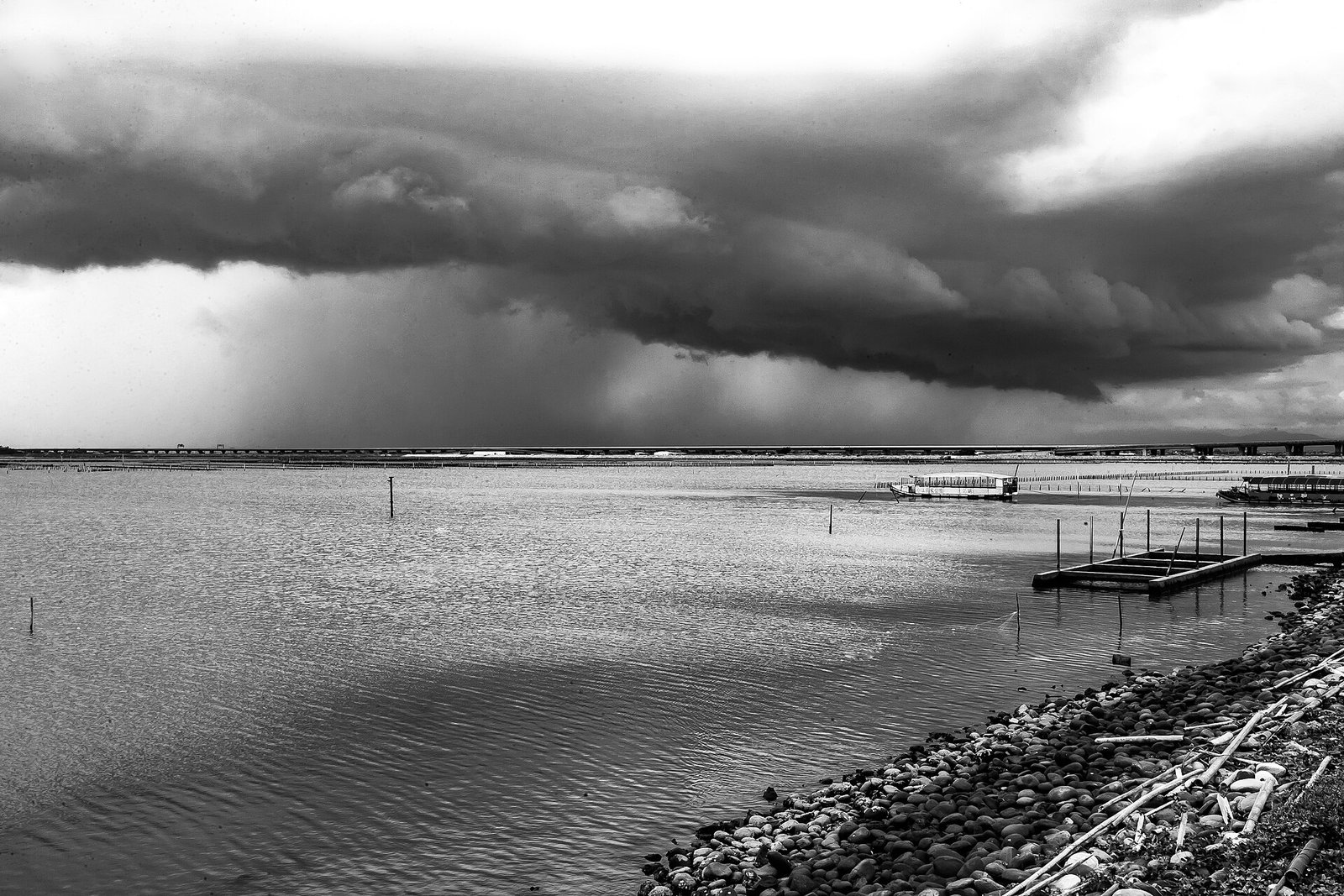
Official recordThe Jingzijiao Tile-Paved Salt Fields (井仔腳瓦盤鹽田) were originally part of the Qing-period Laidong Salt Works (瀨東鹽場) and moved to their present site in 1818 (Jiaqing 23); they are the salt fields with the longest history at their present site in Taiwan, about two hundred years R001SourceInventory of the ecological belt: Beimen section (the Jingzijiao tile-paved salt fields moved here in 1818; the Beimen Lagoon about 230 meters from Jingzijiao; the Beimen Wetland; the Blackfoot Disease Memorial Hall about 2.04 kilometers from Jingzijiao; the Wangyegang and Qingshangang Sandbars; Qingshan Fishing Port, a second-class fishing harbor with a total area of about 48 hectares, which is also the northern land boundary of Taijiang National Park)Original URLhttps://www.tjnp.gov.tw/Retrieved2026-10-18Snapshot timestamp—Mostly a secondhand compilation; areas and distances have not been checked item by item against the official originals.. In a straight line they are only about 230 meters from the Beimen Lagoon (北門潟湖); oyster racks and fish farm ponds are still in use within the lagoon today, alongside the surrounding mangroves R001SourceInventory of the ecological belt: Beimen section (the Jingzijiao tile-paved salt fields moved here in 1818; the Beimen Lagoon about 230 meters from Jingzijiao; the Beimen Wetland; the Blackfoot Disease Memorial Hall about 2.04 kilometers from Jingzijiao; the Wangyegang and Qingshangang Sandbars; Qingshan Fishing Port, a second-class fishing harbor with a total area of about 48 hectares, which is also the northern land boundary of Taijiang National Park)Original URLhttps://www.tjnp.gov.tw/Retrieved2026-10-18Snapshot timestamp—Mostly a secondhand compilation; areas and distances have not been checked item by item against the official originals..
Official recordThe Beimen Wetland lies between the Jishui River (急水溪) and the Jiangjun River (將軍溪) and has a variety of landforms, including intertidal flats, lagoons, and offshore barrier sandbars, which support shellfish and oyster farming R001SourceInventory of the ecological belt: Beimen section (the Jingzijiao tile-paved salt fields moved here in 1818; the Beimen Lagoon about 230 meters from Jingzijiao; the Beimen Wetland; the Blackfoot Disease Memorial Hall about 2.04 kilometers from Jingzijiao; the Wangyegang and Qingshangang Sandbars; Qingshan Fishing Port, a second-class fishing harbor with a total area of about 48 hectares, which is also the northern land boundary of Taijiang National Park)Original URLhttps://www.tjnp.gov.tw/Retrieved2026-10-18Snapshot timestamp—Mostly a secondhand compilation; areas and distances have not been checked item by item against the official originals.. Another site often mentioned along with it is the Taiwan Blackfoot Disease Memorial Hall, about 2.04 kilometers from Jingzijiao — blackfoot disease is an endemic peripheral vascular disease of Taiwan's southwestern coast, presumed to have been caused by long-term drinking of deep-well water with excessive arsenic content R001SourceInventory of the ecological belt: Beimen section (the Jingzijiao tile-paved salt fields moved here in 1818; the Beimen Lagoon about 230 meters from Jingzijiao; the Beimen Wetland; the Blackfoot Disease Memorial Hall about 2.04 kilometers from Jingzijiao; the Wangyegang and Qingshangang Sandbars; Qingshan Fishing Port, a second-class fishing harbor with a total area of about 48 hectares, which is also the northern land boundary of Taijiang National Park)Original URLhttps://www.tjnp.gov.tw/Retrieved2026-10-18Snapshot timestamp—Mostly a secondhand compilation; areas and distances have not been checked item by item against the official originals..
The sandbars and the northern boundary of the national park
Official recordThe Wangyegang Sandbar (王爺港汕) and the Qingshangang Sandbar (青山港汕) are the first line of defense for the Beimen and Qigu lagoons; they also serve as nursery grounds for marine resources and protect the aquaculture in the lagoons R001SourceInventory of the ecological belt: Beimen section (the Jingzijiao tile-paved salt fields moved here in 1818; the Beimen Lagoon about 230 meters from Jingzijiao; the Beimen Wetland; the Blackfoot Disease Memorial Hall about 2.04 kilometers from Jingzijiao; the Wangyegang and Qingshangang Sandbars; Qingshan Fishing Port, a second-class fishing harbor with a total area of about 48 hectares, which is also the northern land boundary of Taijiang National Park)Original URLhttps://www.tjnp.gov.tw/Retrieved2026-10-18Snapshot timestamp—Mostly a secondhand compilation; areas and distances have not been checked item by item against the official originals.. Further south, Qingshan Fishing Port (青山漁港), on the boundary between Qigu (七股) and Jiangjun, is a second-class fishing harbor with a total area of about 48 hectares including its outer and inner harbors; it is also the northern boundary of the land area of Taijiang National Park (臺江國家公園) R001SourceInventory of the ecological belt: Beimen section (the Jingzijiao tile-paved salt fields moved here in 1818; the Beimen Lagoon about 230 meters from Jingzijiao; the Beimen Wetland; the Blackfoot Disease Memorial Hall about 2.04 kilometers from Jingzijiao; the Wangyegang and Qingshangang Sandbars; Qingshan Fishing Port, a second-class fishing harbor with a total area of about 48 hectares, which is also the northern land boundary of Taijiang National Park)Original URLhttps://www.tjnp.gov.tw/Retrieved2026-10-18Snapshot timestamp—Mostly a secondhand compilation; areas and distances have not been checked item by item against the official originals..
Coastal erosion rates in the Beimen section
Official recordIn the official cross-section monitoring, the Beimen reclaimed tidal land (S19–S31) has an annual erosion rate of 3.25 to 13.57 meters, one of the largest values measured anywhere in Tainan, and it is listed as a 「高潛勢」 ("high-potential") erosion section R004Source《臺南市一級海岸防護計畫(核定本)》 [Tainan City Class-1 Coastal Protection Plan (Approved)], Table 2-9 and erosion-potential grading (Beimen reclaimed tidal land, S19–S31, eroding 3.25–13.57 meters a year, listed as high potential; no beach left in front of the seawall on the inner side of the Beimen Lagoon)Original URLhttps://www.wra06.gov.tw/Retrieved2026-10-19Snapshot timestamp—. The inner sides of the Beimen Lagoon and the Qigu Lagoon (七股潟湖) (the areas sheltered by the Wangyegang, Qingshangang, and Wangzailiao (網仔寮汕) Sandbars) are in a different state: there is no longer any beach in front of the seawalls, but there has been no marked change in recent years R004Source《臺南市一級海岸防護計畫(核定本)》 [Tainan City Class-1 Coastal Protection Plan (Approved)], Table 2-9 and erosion-potential grading (Beimen reclaimed tidal land, S19–S31, eroding 3.25–13.57 meters a year, listed as high potential; no beach left in front of the seawall on the inner side of the Beimen Lagoon)Original URLhttps://www.wra06.gov.tw/Retrieved2026-10-19Snapshot timestamp—.
Two management logics for shellfish
Official recordWhen discussing the economic shellfish of the lagoons and tidal flats, the locations must not be confused. In the Shifen Black-faced Spoonbill Ecological Reserve, the three horn-snail species (shuan horn snail (栓海蜷) 135.10, shaojiu horn snail (燒酒海蜷) 95.92, and tiejian horn snail (鐵尖海蜷) 30.96 ind./m²) and the huanwen clam (環文蛤) are officially judged to be 「數量均屬豐富」 ("all abundant in number"), and the recommendation is that 「可以再於有規劃下開放漁民進行採捕」 ("harvesting by fishers may again be permitted under a plan") R003SourceSurvey of economic shellfish and harvesting recommendations for the Shifen Black-faced Spoonbill Ecological Reserve (shuan horn snail (栓海蜷) 135.10 / shaojiu horn snail (燒酒海蜷) 95.92 / tiejian horn snail (鐵尖海蜷) 30.96 ind./m², 2017 (ROC year 106); huanwen clam (環文蛤) 5.82 / 6.19 / 2.16 ind./m² in 2015 / 2016 / 2017 (ROC years 104 / 105 / 106))Original URLhttps://www.tjnp.gov.tw/Retrieved2026-10-19Snapshot timestamp台江處舊站委託報告清單(網站時光機回溯,The original recommends that 「可以再於有規劃下開放漁民進行採捕」 ("harvesting by fishers may again be permitted under a plan")..
Official recordBut on the tidal flats outside the Qingcaolun (青草崙) seawall, the same group of species is twice called 「罕見的物種」 ("rare species"); the huanwen clam averages only 0.06 ind./m² across the four seasons, and the only official recommendation is to 「長期觀察招潮蟹與海蜷類的族群變化」 ("observe population changes of fiddler crabs and horn snails over the long term"), with no mention of harvesting at all R002Source《109-110 年度曾文溪口重要濕地(國際級)生態及水質基礎調查計畫》 [2020–2021 Baseline Survey of Ecology and Water Quality of the Zengwen River Estuary Wetland of Importance (International Level)] (abundance of three horn-snail species and the huanwen clam (環文蛤) on the Qingcaolun tidal flats, with management recommendations), 成大研究發展基金會 [NCKU Research and Development Foundation], co-principal investigator Liu Ching-yu (劉靜榆), July 2021 (ROC year 110)Original URLhttps://www.tjnp.gov.tw/Retrieved2026-10-19Snapshot timestamp—. The two sites differ in year, method, and location; the comparison of these two management logics is set out in 5.2 Qigu.
Chronology: records from the Beimen area
First items: The Laidong Salt Works moved to its pres…International Black-faced Spoonbill Cens…Census: 57 birds at the mouth of the Baz…MoreLess
- 1818
The Laidong Salt Works moved to its pres…MoreLess
The Laidong Salt Works moved to its present site at Jingzijiao, becoming the tile-paved salt field with the longest history at its present site in Taiwan R001SourceInventory of the ecological belt: Beimen section (the Jingzijiao tile-paved salt fields moved here in 1818; the Beimen Lagoon about 230 meters from Jingzijiao; the Beimen Wetland; the Blackfoot Disease Memorial Hall about 2.04 kilometers from Jingzijiao; the Wangyegang and Qingshangang Sandbars; Qingshan Fishing Port, a second-class fishing harbor with a total area of about 48 hectares, which is also the northern land boundary of Taijiang National Park)Original URLhttps://www.tjnp.gov.tw/Retrieved2026-10-18Snapshot timestamp—Mostly a secondhand compilation; areas and distances have not been checked item by item against the official originals..
- 2003
01-26International Black-faced Spoonbill Cens…MoreLess
International Black-faced Spoonbill Census: 7 birds at the mouth of the Bazhang River (八掌溪口) R008SourceYu Y.T.《The International Black-faced Spoonbill Census: 24-26 January 2003》,香港觀鳥會 [Hong Kong Bird Watching Society]Original URLhttps://hkbws.org.hk/BBS/attachment.php?aid=2489Retrieved2026-11-01Snapshot timestamp—Page: PDF p. 20..
- 2005
01-23Census: 57 birds at the mouth of the Baz…MoreLess
Census: 57 birds at the mouth of the Bazhang River R009SourceYu Y.T.《The International Black-faced Spoonbill Census: 21-23 January 2005》,香港觀鳥會 [Hong Kong Bird Watching Society]Original URLhttps://hkbws.org.hk/BBS/attachment.php?aid=2491Retrieved2026-11-01Snapshot timestamp—Pages: PDF pp. 11, 27..
- 2006
01-08Census: 4 birds at the mouth of the Bazh…MoreLess
Census: 4 birds at the mouth of the Bazhang River R010SourceYu Y.T. & Wong C.C.《The International Black-faced Spoonbill Census: 6-8 January 2006》,香港觀鳥會 [Hong Kong Bird Watching Society]Original URLhttps://hkbws.org.hk/BBS/attachment.php?aid=2492Retrieved2026-11-01Snapshot timestamp—Page: PDF p. 29..
- 2013
2013–2016Japanese eel (glass eels) in the stow-ne…MoreLess
Japanese eel (glass eels) in the stow-net fishery at Qingshan Fishing Port increased from an average of 9.5 to 71.5 fish per trip R005SourceChen Meng-hsien (陳孟仙) 主持 [principal investigator],《台江國家公園海域生態系生物資源調查與多樣性保育研究(2/4)》[Survey of Biological Resources and Biodiversity Conservation Research in the Marine Ecosystem of Taijiang National Park (2/4)],國立中山大學受託 [contractor: National Sun Yat-sen University],台江國家公園管理處委託 [commissioned by the Taijiang National Park Headquarters],民國 106 年 [2017 (ROC year 106)]Original URLhttps://ws.moi.gov.tw/001/Upload/OldFile_TJNP/Result/20180109162652929405.pdfRetrieved2026-11-01Snapshot timestamp—SourceFrom 《Survey of Biological Resources and Biodiversity Conservation Research on the Marine Ecosystem of Taijiang National Park (2/4) (台江國家公園海域生態系生物資源調查與多樣性保育研究(2/4))》p. 476–477Table 9-6: stow-net fishery catch reports at Qingshan Fishing Port, 2013–2016; Japanese eel (glass eels) given as the average number of fish per trip..
- 2016
01-16Census: 782 birds in the 「嘉義縣與台南市八掌溪口」 (…MoreLess
Census: 782 birds in the 「嘉義縣與台南市八掌溪口」 ("Bazhang River mouth, Chiayi County and Tainan City") survey area R011Source香港觀鳥會 [Hong Kong Bird Watching Society]《The International Black-faced Spoonbill Census 2016》(EAAFP 網站轉載 [reposted on the EAAFP website])Original URLhttps://eaaflyway.org/wp-content/uploads/2018/01/bfs_census_2016.pdfRetrieved2026-11-01Snapshot timestamp—Page: PDF p. 26 (printed p. 25), Table 1..
- 2020
05-25The Executive Yuan approved the 《臺南市一級海岸…MoreLess
The Executive Yuan approved the 《臺南市一級海岸防護計畫》 [Tainan City Class-1 Coastal Protection Plan], listing the Beimen reclaimed tidal land as a high-potential erosion section R004Source《臺南市一級海岸防護計畫(核定本)》 [Tainan City Class-1 Coastal Protection Plan (Approved)], Table 2-9 and erosion-potential grading (Beimen reclaimed tidal land, S19–S31, eroding 3.25–13.57 meters a year, listed as high potential; no beach left in front of the seawall on the inner side of the Beimen Lagoon)Original URLhttps://www.wra06.gov.tw/Retrieved2026-10-19Snapshot timestamp—.
- 2025
01-18International Black-faced Spoonbill Cens…MoreLess
International Black-faced Spoonbill Census: 668 birds in the Beimen survey area, the most of any Tainan survey area that day R007Source農業部林業及自然保育署 [Forestry and Nature Conservation Agency, Ministry of Agriculture] 補助計畫 [subsidized project] 114 林發-09.3-保-21《綠網關注鳥類族群調查暨保育教育計畫(四)》[Green Network Population Survey and Conservation Education Project for Birds of Concern (IV)],中華民國野鳥學會執行 [carried out by the Chinese Wild Bird Federation],計畫主持人張瑞麟 [principal investigator Chang Jui-lin],2026-01-30Original URLhttps://www.forest.gov.tw/file/203414Retrieved2026-11-01Snapshot timestamp—Counts for each Tainan survey area on January 18, 2025..
Species recorded in this area
- Birds: black-faced spoonbill (Beimen survey area, Bazhang River mouth)R007Source農業部林業及自然保育署 [Forestry and Nature Conservation Agency, Ministry of Agriculture] 補助計畫 [subsidized project] 114 林發-09.3-保-21《綠網關注鳥類族群調查暨保育教育計畫(四)》[Green Network Population Survey and Conservation Education Project for Birds of Concern (IV)],中華民國野鳥學會執行 [carried out by the Chinese Wild Bird Federation],計畫主持人張瑞麟 [principal investigator Chang Jui-lin],2026-01-30Original URLhttps://www.forest.gov.tw/file/203414Retrieved2026-11-01Snapshot timestamp—Counts for each Tainan survey area on January 18, 2025.R008SourceYu Y.T.《The International Black-faced Spoonbill Census: 24-26 January 2003》,香港觀鳥會 [Hong Kong Bird Watching Society]Original URLhttps://hkbws.org.hk/BBS/attachment.php?aid=2489Retrieved2026-11-01Snapshot timestamp—Page: PDF p. 20.; records of other bird species in the Beimen survey area are to be added.
- Crabs and shellfish: oyster-rack farming in the Beimen Lagoon R001SourceInventory of the ecological belt: Beimen section (the Jingzijiao tile-paved salt fields moved here in 1818; the Beimen Lagoon about 230 meters from Jingzijiao; the Beimen Wetland; the Blackfoot Disease Memorial Hall about 2.04 kilometers from Jingzijiao; the Wangyegang and Qingshangang Sandbars; Qingshan Fishing Port, a second-class fishing harbor with a total area of about 48 hectares, which is also the northern land boundary of Taijiang National Park)Original URLhttps://www.tjnp.gov.tw/Retrieved2026-10-18Snapshot timestamp—Mostly a secondhand compilation; areas and distances have not been checked item by item against the official originals.; other records are to be added.
- Fish (Qingshan Fishing Port):
- Stow-net fishery: 8 species in 8 families, including Japanese eel (glass eels) (日本鰻鱺), milkfish (虱目魚), flathead grey mullet (鯔), bartail flathead (印度牛尾魚), mangrove red snapper (銀紋笛鯛), blackhead seabream (黑棘鯛) and southern rudderfish (南方舵魚) R005SourceChen Meng-hsien (陳孟仙) 主持 [principal investigator],《台江國家公園海域生態系生物資源調查與多樣性保育研究(2/4)》[Survey of Biological Resources and Biodiversity Conservation Research in the Marine Ecosystem of Taijiang National Park (2/4)],國立中山大學受託 [contractor: National Sun Yat-sen University],台江國家公園管理處委託 [commissioned by the Taijiang National Park Headquarters],民國 106 年 [2017 (ROC year 106)]Original URLhttps://ws.moi.gov.tw/001/Upload/OldFile_TJNP/Result/20180109162652929405.pdfRetrieved2026-11-01Snapshot timestamp—SourceFrom 《Survey of Biological Resources and Biodiversity Conservation Research on the Marine Ecosystem of Taijiang National Park (2/4) (台江國家公園海域生態系生物資源調查與多樣性保育研究(2/4))》p. 476–477Table 9-6: stow-net fishery catch reports at Qingshan Fishing Port, 2013–2016; Japanese eel (glass eels) given as the average number of fish per trip..
- In 2013–2018 the croaker family (Sciaenidae) had the largest catch weight (19.5%), followed by the mackerel family (Scombridae), the cutlassfish family (Trichiuridae), the jack family (Carangidae) and the grunt family (Haemulidae); in the mullet family (Mugilidae), the flathead grey mullet (wuyu, 烏魚) and doua (豆仔) are common R006SourceChen Meng-hsien (陳孟仙) 主持 [principal investigator],《台江國家公園海域生態系生物資源調查與多樣性保育研究(4/4)》[Survey of Biological Resources and Biodiversity Conservation Research in the Marine Ecosystem of Taijiang National Park (4/4)],國立中山大學受託 [contractor: National Sun Yat-sen University],台江國家公園管理處委託 [commissioned by the Taijiang National Park Headquarters],民國 108 年 [2019 (ROC year 108)]Original URLhttps://ws.moi.gov.tw/001/Upload/OldFile_TJNP/Result/20200116114816137508.pdfRetrieved2026-11-01Snapshot timestamp—SourceFrom 《Survey of Biological Resources and Biodiversity Conservation Research on the Marine Ecosystem of Taijiang National Park (4/4) (台江國家公園海域生態系生物資源調查與多樣性保育研究(4/4))》p. 168–169Catch weight by family from the catch reports of Qingshan Fishing Port, 2013–2018..
- Plants: to be added.
- Terrestrial animals: to be added.
Long-term changes in numbers
Catches at Qingshan Fishing Port
| Item | Value | Source |
|---|---|---|
| Japanese eel (glass eels), average fish per trip | 9.5 in 2013 (ROC year 102), 23.8 in 2014 (ROC year 103), 68.8 in 2015 (ROC year 104), 71.5 in 2016 (ROC year 105) | R005SourceChen Meng-hsien (陳孟仙) 主持 [principal investigator],《台江國家公園海域生態系生物資源調查與多樣性保育研究(2/4)》[Survey of Biological Resources and Biodiversity Conservation Research in the Marine Ecosystem of Taijiang National Park (2/4)],國立中山大學受託 [contractor: National Sun Yat-sen University],台江國家公園管理處委託 [commissioned by the Taijiang National Park Headquarters],民國 106 年 [2017 (ROC year 106)]Original URLhttps://ws.moi.gov.tw/001/Upload/OldFile_TJNP/Result/20180109162652929405.pdfRetrieved2026-11-01Snapshot timestamp—SourceFrom 《Survey of Biological Resources and Biodiversity Conservation Research on the Marine Ecosystem of Taijiang National Park (2/4) (台江國家公園海域生態系生物資源調查與多樣性保育研究(2/4))》p. 476–477Table 9-6: stow-net fishery catch reports at Qingshan Fishing Port, 2013–2016; Japanese eel (glass eels) given as the average number of fish per trip. |
| Reported weight, mullet family | 147 kg in 2013, 1,148 kg in 2016 | R006SourceChen Meng-hsien (陳孟仙) 主持 [principal investigator],《台江國家公園海域生態系生物資源調查與多樣性保育研究(4/4)》[Survey of Biological Resources and Biodiversity Conservation Research in the Marine Ecosystem of Taijiang National Park (4/4)],國立中山大學受託 [contractor: National Sun Yat-sen University],台江國家公園管理處委託 [commissioned by the Taijiang National Park Headquarters],民國 108 年 [2019 (ROC year 108)]Original URLhttps://ws.moi.gov.tw/001/Upload/OldFile_TJNP/Result/20200116114816137508.pdfRetrieved2026-11-01Snapshot timestamp—SourceFrom 《Survey of Biological Resources and Biodiversity Conservation Research on the Marine Ecosystem of Taijiang National Park (4/4) (台江國家公園海域生態系生物資源調查與多樣性保育研究(4/4))》p. 168–169Catch weight by family from the catch reports of Qingshan Fishing Port, 2013–2018. |
| Reported weight, grunt family | 1,446 kg in 2013, 3,771 kg in 2016, 5,087 kg in 2018 | R006SourceChen Meng-hsien (陳孟仙) 主持 [principal investigator],《台江國家公園海域生態系生物資源調查與多樣性保育研究(4/4)》[Survey of Biological Resources and Biodiversity Conservation Research in the Marine Ecosystem of Taijiang National Park (4/4)],國立中山大學受託 [contractor: National Sun Yat-sen University],台江國家公園管理處委託 [commissioned by the Taijiang National Park Headquarters],民國 108 年 [2019 (ROC year 108)]Original URLhttps://ws.moi.gov.tw/001/Upload/OldFile_TJNP/Result/20200116114816137508.pdfRetrieved2026-11-01Snapshot timestamp—SourceFrom 《Survey of Biological Resources and Biodiversity Conservation Research on the Marine Ecosystem of Taijiang National Park (4/4) (台江國家公園海域生態系生物資源調查與多樣性保育研究(4/4))》p. 168–169Catch weight by family from the catch reports of Qingshan Fishing Port, 2013–2018. |
Beimen and the Bazhang River mouth in the black-faced spoonbill census
The survey areas were divided differently in different years, so the figures cannot be compared directly.
| Year | Survey area | Birds | Source |
|---|---|---|---|
| 2003 | Bazhang River mouth | 7 | R008SourceYu Y.T.《The International Black-faced Spoonbill Census: 24-26 January 2003》,香港觀鳥會 [Hong Kong Bird Watching Society]Original URLhttps://hkbws.org.hk/BBS/attachment.php?aid=2489Retrieved2026-11-01Snapshot timestamp—Page: PDF p. 20. |
| 2005 | Bazhang River mouth | 57 | R009SourceYu Y.T.《The International Black-faced Spoonbill Census: 21-23 January 2005》,香港觀鳥會 [Hong Kong Bird Watching Society]Original URLhttps://hkbws.org.hk/BBS/attachment.php?aid=2491Retrieved2026-11-01Snapshot timestamp—Pages: PDF pp. 11, 27. |
| 2006 | Bazhang River mouth | 4 | R010SourceYu Y.T. & Wong C.C.《The International Black-faced Spoonbill Census: 6-8 January 2006》,香港觀鳥會 [Hong Kong Bird Watching Society]Original URLhttps://hkbws.org.hk/BBS/attachment.php?aid=2492Retrieved2026-11-01Snapshot timestamp—Page: PDF p. 29. |
| 2016 | Bazhang River mouth, Chiayi County and Tainan City | 782 | R011Source香港觀鳥會 [Hong Kong Bird Watching Society]《The International Black-faced Spoonbill Census 2016》(EAAFP 網站轉載 [reposted on the EAAFP website])Original URLhttps://eaaflyway.org/wp-content/uploads/2018/01/bfs_census_2016.pdfRetrieved2026-11-01Snapshot timestamp—Page: PDF p. 26 (printed p. 25), Table 1. |
| 2025 | Beimen | 668 | R007Source農業部林業及自然保育署 [Forestry and Nature Conservation Agency, Ministry of Agriculture] 補助計畫 [subsidized project] 114 林發-09.3-保-21《綠網關注鳥類族群調查暨保育教育計畫(四)》[Green Network Population Survey and Conservation Education Project for Birds of Concern (IV)],中華民國野鳥學會執行 [carried out by the Chinese Wild Bird Federation],計畫主持人張瑞麟 [principal investigator Chang Jui-lin],2026-01-30Original URLhttps://www.forest.gov.tw/file/203414Retrieved2026-11-01Snapshot timestamp—Counts for each Tainan survey area on January 18, 2025. |
Behind this door is the internal site, with profiles of people and local comments. The internal site is deployed separately.